‘Movies’ of interaction between light and matter help advance quantum tech
Femtosecond microscopy technique captures up to 1 quadrillion images per second
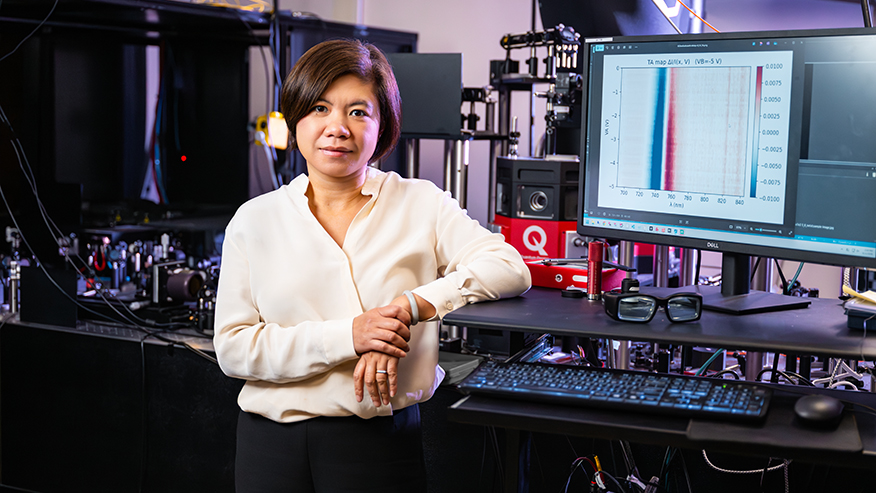
Libai Huang uses an ultrafast microscopy method to observe and record the interaction between light and matter, work that is helping to advance quantum technologies. (Purdue University photo/Kelsey Lefever)
WEST LAFAYETTE, Ind. — The quantum world holds a cast of characters with exotic names and superhero powers: Witness the exciton, a traveling electron that carries with it the space it left behind, or the polariton, which transitions indistinguishably between light and matter. But to use them in quantum devices, scientists must unravel the rules that govern their surprising behavior.
With a microscopy technique she developed, Purdue University’s Libai Huang is able to see quantum particles moving through materials at a rate of up to 1 quadrillion (that’s 1,000,000,000,000,000) images per second, helping to establish the rules that advance computer chips, solar cells and LEDs, and quantum computing. In many ways, Huang’s work is about making the invisible visible, creating a foundation for a new generation of quantum materials with properties that can be engineered rather than discovered by chance.
“We’re answering a fundamental question: How do these particles move through materials?” said Huang, the Tarpo Professor of Chemistry in Purdue’s College of Science and director of the Quantum Photonic Integrated Design Center (QuPIDC), an Energy Frontier Research Center sponsored by the U.S. Department of Energy. QuPIDC brings together experimentalists, theorists and engineers to co-design quantum materials and nanophotonic structures for future quantum technologies. “I create movies that look at the motion of these particles, or lack of motion, and these tell us a lot about how they move and couple with light. Before we developed this technique, there was no tool to really understand how these particles move in materials; it was always just inferred from indirect measurements.”
Excitons and polaritons are two quasiparticles — particles that arise from the collective interaction of simpler particles — valued for their ability to absorb and emit light and move electrical charge. As these particles move and carry energy through their material, factors in the environment, like interaction with other particles and light, vibration, material defects, and changes in temperature and pressure, affect their behavior.
Whether for more efficient solar cells or future quantum technologies, scientists want to control energy-carrying particles in these complex situations. And while there are many ways to measure their movement, Huang’s system allows her to directly see and record the behavior of excitons and polaritons with temporal and spatial resolution. Her work is funded by the U.S. Department of Defense, the U.S. Department of Energy and the National Science Foundation.
By visualizing quantum dynamics directly, Huang not only observes quantum phenomena, but also seeks to establish the design principles for controlling collective quantum states in future materials and devices. A central focus of her research is understanding and engineering quantum coherence, the ability of quantum particles to move and interact collectively while preserving their quantum nature.
Her most recent work explores situations in which many excitons interact with one another as well as interactions between light and matter, which she sees as critical to future applications. Matter is easy to manipulate because it interacts with the light and matter around it, but it is therefore also easily disrupted; whereas light can be difficult to alter but therefore remains stable over the long term.
“This is important for things like quantum computing, where you need both coherence and the ability to manipulate the state. You want something that, when you don’t want to change it, it stays the same forever, but when you want to change it, you can do so easily,” said Huang, a member of the Purdue Quantum Science and Engineering Institute. “So, you need both light and matter to maintain coherence but still have strong interactions. And these are the ingredients that we are working on in my group.”
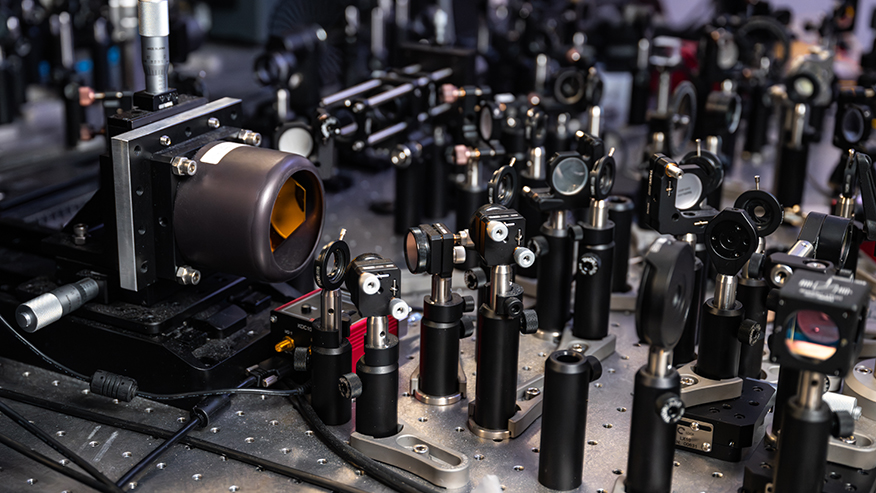
Huang describes her microscopy technique as similar in many ways to a digital camera, in that it has lenses and light detectors. But in place of a shutter, she uses a pulsed laser that can fire as fast as once per femtosecond. Just as a sports photographer would use a fast shutter speed to capture a clear image of an athlete in motion, the pulsed laser is an ultrafast shutter that provides just enough light to capture clear images of energy-carrying particles moving through materials.
Seeing particles move can help boost solar cell efficiency
In her early research, Huang used the microscopy technique to track excitons, which arise from the interaction between a moving electron and, oddly enough, the space where an electron used to be, which is called a hole. As a semiconducting material absorbs energy, electrons may escape from their orbit around individual atoms and travel through the material. When they do so, they leave behind a spot that can be thought of as missing negative charge. That’s often the end of the story, but under certain conditions, the electron and the hole are so strongly attracted to one another that they are bound and move together, forming the neutrally charged exciton.
Huang’s technique is ideal for investigating excitons because the quasiparticle is created when an electron absorbs light, so she is able to create the exciton with one pulse and then use additional pulses to track its movement, conditions that give her control over both spatial and temporal resolution. Her work on how excitons move through materials has shown that superstimulated electrons in thin-film methylammonium lead iodide might improve solar cell efficiency beyond the conventionally accepted Shockley-Queisser limit. She has tested a technique for surpassing that same limit that uses excitons with a mix of energy levels. And she has shown that the loss of excitons through exciton-exciton annihilation can be controlled using quantum phase relationships.
Light, matter, action: Capturing energy in real time
She further developed the technique by using the pulsed laser to create and track polaritons, a quasiparticle that is a hybrid between excitons and photons, the smallest unit of light. With the light of the pulsed laser, Huang can create this hybrid state in which the exciton absorbs and emits light so fast that it’s impossible to distinguish whether the energy exists as light or matter.
Using these and other enhanced microscopy techniques, her current research focuses on many-body exciton interactions and light-matter interactions. She has demonstrated that the relationship between excitons and polaritons can be used to move energy quickly across previously unrealized distances using a plasmonic nanoparticle array integrated with two-dimensional halide perovskite. In a layered two-dimensional material called a moiré superlattice, she has observed a quantum phenomenon in which particles repel one another so strongly that they freeze in place, a feature previously only seen in the ultracold gases typically used for quantum simulations. And she found a sweet spot for moving energy that uses a mix of coherent and incoherent energy transport in perovskite nanocrystal superlattice. This vision extends beyond a single laboratory. As director of a multi-institutional QuPIDC center, Huang works on many-body interactions with researchers across physics, chemistry, materials science and engineering.
Huang describes the resulting “movies” she creates with a nonchalance that makes it easy to follow the quantum phenomena they describe.
“So some of the images that we show are initially just a circle, like a pancake, and this pancake just gets bigger and bigger because of the function of time, because the exciton moves around,” Huang said. “And there are more extreme versions. Maybe this exciton moves very fast because it’s a polariton. And sometimes they have different ways of moving. If it’s a many-body interaction, and I’m adding more, we can show that I can stop them from moving. It’s as if you’re boarding a bus, and if everyone has a seat, then you will no longer be able to move because you don’t want to sit on top of the other person.”
Huang’s work exemplifies Purdue’s growing leadership in quantum science and engineering and is a part of Purdue Computes, a comprehensive initiative that spans computing departments, physical artificial intelligence, quantum science and semiconductor innovation. Through a partnership between the colleges of Science and Engineering, Purdue has launched an expanded portfolio of quantum degree programs spanning certificates, minors, master’s degrees and doctoral concentrations. Students have opportunities to learn alongside faculty pushing the frontiers of quantum science, engineering and technology, creating a direct connection between groundbreaking research and the workforce needed to advance the emerging quantum economy.
About Purdue University
Purdue University is a research institution ranked among the top 10 public universities in the United States. More than 111,000 students study at Purdue across multiple campuses, including more than 57,000 at our main campus locations in West Lafayette and Indianapolis. As a land-grant university committed to affordability and accessibility, Purdue’s main campus has frozen tuition 14 years in a row, enabling more students than ever to graduate debt-free.
Papers
Ultrafast dynamic microscopy of carrier and exciton transport
Annual Review of Physical Chemistry
DOI: 10.1146/annurev-physchem-042018-052605
Long-range hot-carrier transport in hybrid perovskites visualized by ultrafast microscopy
Science
DOI: 10.1126/science.aam7744
Cooperative singlet and triplet exciton transport in tetracene crystals visualized by ultrafast microscopy
Nature Chemistry
DOI: 10.1038/nchem.2348
Exciton annihilation in molecular aggregates suppressed through quantum interference
Nature Chemistry
DOI: 10.1038/s41557-023-01233-x
Enhanced two-dimensional exciton propagation via strong light-matter coupling with surface lattice plasmons
ACS Photonics
DOI: 10.1021/acsphotonics.3c00466
Frozen non-equilibrium dynamics of exciton Mott insulators in moiré superlattices
Nature Materials
DOI: 10.1038/s41563-025-02135-8
Environment-assisted quantum transport of excitons in perovskite nanocrystal superlattices
Nature Communications
DOI: 10.1038/s41467-024-55812-8
Media contact: Mary Martialay, mmartial@purdue.edu
Purdue Computes News

Purdue-Google summit advances physical AI, manufacturing and workforce readiness
October 16, 2026

Purdue and University of Illinois, 2 engineering powerhouses, team up to strengthen semiconductor workforce in U.S.
September 22, 2026
Purdue secures $19M from NSF to develop AI-driven programmable labs for semiconductors, advanced materials
August 5, 2026
Purdue expands semiconductor professional education portfolio to advance global workforce development
July 8, 2026