Purdue is first U.S. university to deploy Google TPU AI infrastructure
New computing resources will help Purdue researchers and students tackle complex AI projects and accelerate discovery
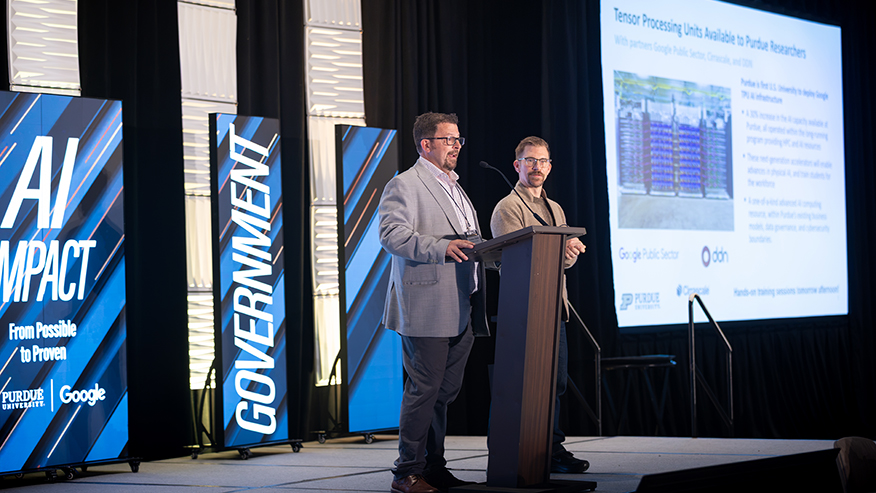
From left: Preston Smith, executive director of Purdue University’s Rosen Center for Advanced Computing, and Adam Deer, research and education executive lead of Google Public Sector, announce a new collaboration that will leverage Google Tensor Processing Units at Purdue, increasing the university’s AI computing capacity by 30% and expanding resources available for faculty and student research. (Purdue University photo/Jonathan Poole)
WEST LAFAYETTE, Ind. — Purdue University is expanding its artificial intelligence research capabilities through a collaboration with Google Public Sector, Cirrascale and DDN that provides Google Tensor Processing Units (TPUs) for faculty and student research. The university will be the first U.S. academic institution to provide this custom AI hardware to researchers as part of its campus computing program.
The addition of Google’s AI accelerators represents a 30% increase in the AI capacity at Purdue. Following integration in the newly renovated and expanded Mathematical Sciences Building Data Center, initial Purdue researchers are expected to begin using the system in January 2027.
Purdue announced the collaboration Thursday (Oct. 29) at AI Impact: From Possible to Proven, the third annual AI summit co-sponsored by Purdue and Google. The event brought together academic, industry and government leaders to explore the transition of physical AI from experimentation to real-world implementation. Physical AI uses artificial intelligence to help machines and systems interact with and respond to the physical world. Applications include autonomous vehicles, robotics, computer vision and advanced manufacturing.
“Purdue is at the forefront of physical AI, and having leading accelerators on our own infrastructure is a real advantage for our students and faculty. For students, access to these cutting-edge computing resources prepares them to graduate with the AI skills to stand out in the workforce,” said Preston Smith, executive director of Purdue’s Rosen Center for Advanced Computing. “Working with Google Public Sector, Cirrascale and DDN to integrate TPUs within the framework of our long-running community cluster high-performance computing program gives us the performance we need for ambitious training and inference work, while operating it within our existing business. We’re looking forward to bringing this system to bear to solve our researchers’ problems.”
Purdue’s integration of Google’s AI accelerators will give researchers access to one-of-a-kind advanced AI computing resources while Purdue maintains institutional control over data, security and governance.
“Research has shown that investment in high-end computing resources like Purdue’s community cluster supercomputers is strongly predictive of future research outcomes, and this significant investment will keep Purdue at the forefront of enabling AI-accelerated science,” Smith said.
About Purdue University
Purdue University is a research institution ranked among the top 10 public universities in the United States. More than 111,000 students study at Purdue across multiple campuses, including more than 57,000 at our main campus locations in West Lafayette and Indianapolis. As a land-grant university committed to affordability and accessibility, Purdue’s main campus has frozen tuition 14 years in a row, enabling more students than ever to graduate debt-free.
Media contact: Trevor Peters, peter237@purdue.edu
Purdue Computes News

Purdue-Google summit advances physical AI, manufacturing and workforce readiness
October 16, 2026
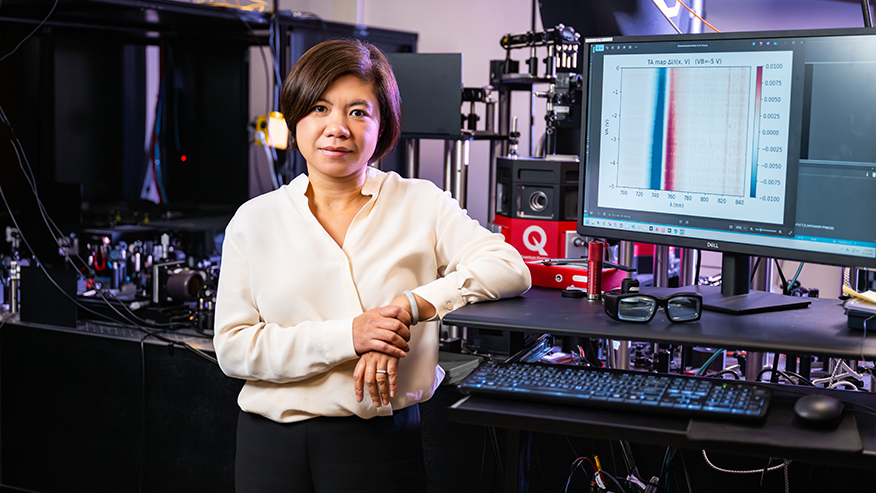
‘Movies’ of interaction between light and matter help advance quantum tech
October 6, 2026

Purdue and University of Illinois, 2 engineering powerhouses, team up to strengthen semiconductor workforce in U.S.
September 22, 2026
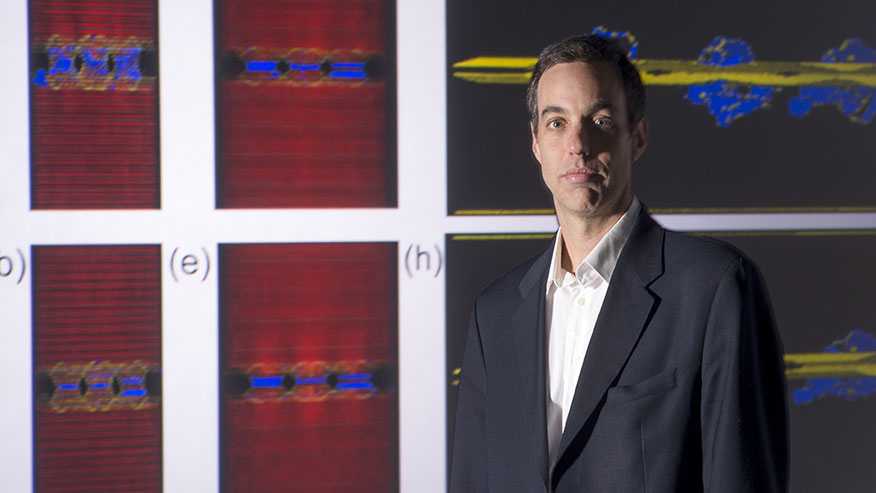
Purdue secures $19M from NSF to develop AI-driven programmable labs for semiconductors, advanced materials
August 5, 2026