Purdue researchers study cancer in canines to help advance treatments for humans
Dogs across Midwest find customized care at the Evan and Sue Ann Werling Comparative Oncology Research Center
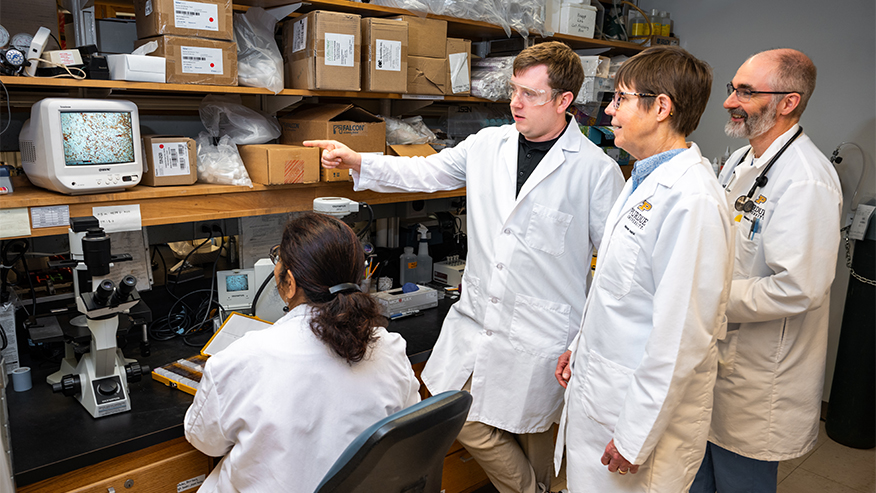
A team of veterinary experts at Purdue University study canine cancer to better treat and understand cancer in both animals and humans. (Purdue University photo/Kelsey Lefever)
WEST LAFAYETTE, Ind. — Studying canine cancer — including personalizing treatments, honing protocols and exploring new drugs, all of which will shed light on human cancer care — is the focus of veterinary researchers at a specialized center at Purdue’s College of Veterinary Medicine.
The researchers, including Deborah Knapp, distinguished professor of comparative oncology and the Dolores L. McCall Professor of Veterinary Medicine, have been doing this kind of research for decades. Knapp is an expert in the field of comparative oncology, studying cancer in one species to better understand it in another.
“Comparative oncology allows us to study cancer in pet animals that help the pets and help us to learn things that impact human cancer research,” Knapp said. “It’s a rare case of win-win-win. The pet benefits, the next 100 animals benefit and that knowledge also helps humans with cancer.”
Knapp is one of a team of comparative oncologists at the Evan and Sue Ann Werling Comparative Oncology Research Center, which opened a year ago at Purdue’s College of Veterinary Medicine and builds on a comparative oncology program established in 1979. She is also the associate director of clinical comparative oncology at the Purdue Institute for Cancer Research, where many of the other researchers also work.
Maximizing health benefits: One size doesn’t fit all
The team chooses their research topics strategically for the maximum suspected benefit to individual pets as well as for overall cancer knowledge. Areas of research include work on bladder cancer; lymphoma; and osteosarcoma, a bone cancer, all of which have similar progressions in dogs and humans. Other researchers are working on high-energy treatments called tumor ablations that allow them to safely and effectively shrink tumors without surgery, chemotherapy or radiation.
They also partner with other experts outside the center, working closely with other researchers at Purdue including engineers, computer scientists and physicists.
“We are moving toward a more personalized, proactive approach to addressing cancer,” Knapp said. “And one of the best ways to do that is to study dog breeds who are prone to certain kinds of cancer. We can improve treatments and protocols much more efficiently when we’re working with a breed we already know tends to be prone to certain kinds of cancer.”
Knapp used this method to study early detection methods for bladder cancer in Scottish terriers, who get bladder cancer as much as 20 times more frequently than other dog breeds. Using that knowledge, her team was able to study early detection and prevention methods — methods that could translate to human patients as that form of bladder cancer is similar to a form found in humans.
“The progression of cancer in dogs is much more similar to humans than it would be in rodents,” Knapp said. “So we are able to treat pet dogs who are sick while at the same time learning to help both dogs and people.
A new center, a new hope
The team also tackles osteosarcoma, a rare bone cancer that is often devastating in humans but common in large-breed dogs. Michael Childress, professor of comparative oncology and a researcher in the Tyler Trent Pediatric Cancer Research Center within the Purdue Institute for Cancer Research, studies how to strategically match medicines to an individual patient’s cancer.
“For cancers like osteosarcoma, it’s very rare in humans, so it can be difficult to study,” Childress said. “But unfortunately, it’s very common in large-breed dogs like Great Danes and Rottweilers. What I am most focused on is trying to find ways to — very, very quickly — identify which drug is going to work best for which patient and which patient is going to respond best to which drug.”
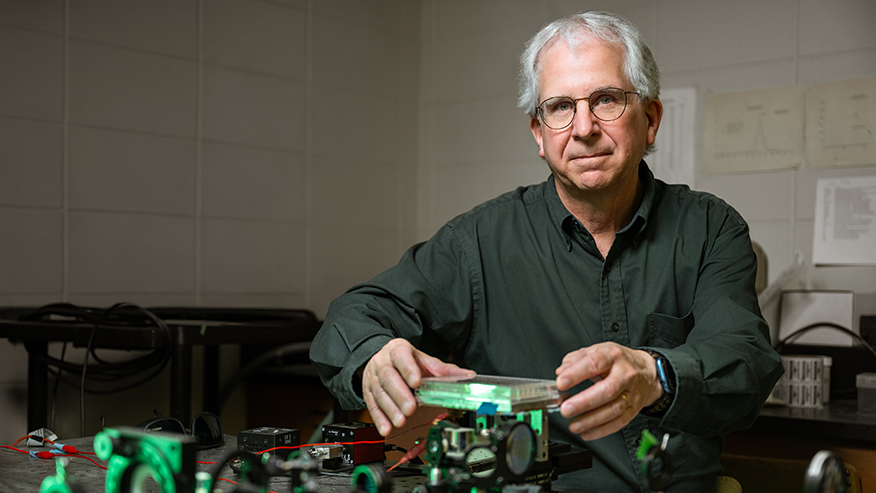
Childress and his team use tools like Doppler radar — more famous for predicting summer storms — and AI to gain insight into why some patients respond to drugs while others don’t. Solving that mystery could help treat patients, both canine and human, faster while prolonging their quality of life.
Around Indiana and the entire Midwest — and sometimes from across the United States — veterinarians refer dogs suspected of having cancer to the veterinarians at the Werling Center. They receive the best treatment through the newest ideas and technologies.
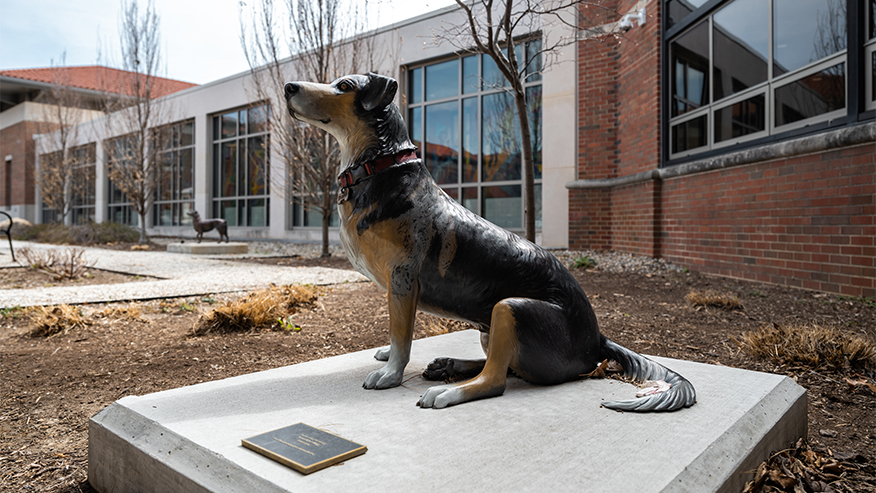
“The Werling Center is special because it came out of the community, and it’s made from the community,” Knapp said. “It grew out of a very special relationship with the Werlings, Sue Ann and Evan. They had a dog named Brandi who had bladder cancer. She participated in two of our clinical trials and out of that grew a friendship and this partnership with the Werlings. They were fascinated by what we do and wanted to help.”
The dogs’ families often build relationships with the veterinarians and the staff. A statue of Brandi greets everyone as they walk through the doors of the Werling Center. And once they’re inside, there are more kindred spirits. Marejka Shaevitz, a clinical assistant professor of oncology at the Werling Center who helps coordinate research projects and track patients, did her residency training at Purdue and is a cancer survivor herself.
“It is a special privilege to care for animals with cancer because you form a bond not only with the animals but with their family,” Knapp said. “It’s such a scary, vulnerable time. And while you’re trying to help them, you’re also helping others. It makes the scary time feel maybe not so dark. It means so much to be able to make a difference to these pets and pet owners.”
This research is part of Purdue’s One Health initiative, which focuses on solving complex challenges at the intersection of human, animal and plant health and delivering real-world impact. Purdue is working to improve health outcomes and foster economic growth through four key pillars: academic programs, research, facility infrastructure and industry partnership.
About Purdue University
Purdue University is a research institution ranked among the top 10 public universities in the United States. More than 106,000 students study at Purdue across multiple campuses, including more than 57,000 at our main campus locations in West Lafayette and Indianapolis. As a land-grant university committed to affordability and accessibility, Purdue’s main campus has frozen tuition 14 years in a row, enabling more students than ever to graduate debt-free.
Media contact: Brittany Steff, bsteff@purdue.edu
One Health News

Purdue, Elanco, partners celebrate One Health Research Institute groundbreaking
October 7, 2026
Lasers, Doppler effect personalize chemotherapy drug selection for cancer tumors
September 29, 2026

Provost announces leadership appointments, promotions
September 14, 2026

Purdue to expand research footprint in Indianapolis with new facility
July 20, 2026