Lasers, Doppler effect personalize chemotherapy drug selection for cancer tumors
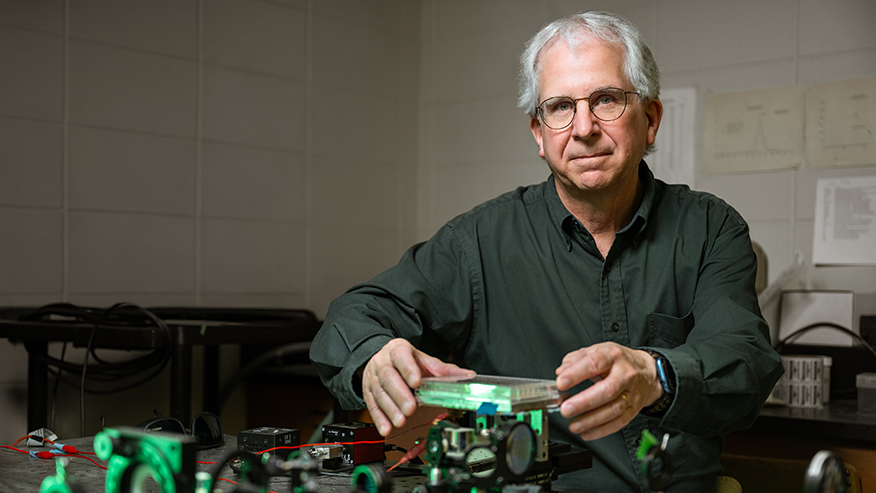
Purdue University researcher David Nolte uses laser light, the Doppler effect and AI in an imaging system that may be able to pinpoint the best chemotherapy drugs to treat an individual patient’s tumor. (Purdue University photo/Kelsey Lefever)
WEST LAFAYETTE, Ind. — Like each person, each cancer is unique. And with the growing array of chemotherapy drugs available, gaining early insight into how individual tumors respond to specific drugs would help improve treatment. Harnessing the tools of laser light, the Doppler effect and AI, Purdue University scientist David Nolte is building an imaging system to do just that.
Nolte’s goal is to personalize and improve chemotherapy treatment. In a project launched this spring that will test its capabilities, the system is being used to assess experimental chemotherapy drugs for osteosarcoma, a common and often serious bone cancer. The unique data the system gathers will one day pinpoint the best drugs for the individual tumor, shortening the costly, time-consuming pipeline that stands between a lab bench and a patient in need.
Nolte, the Edward M. Purcell Distinguished Professor of Physics and Astronomy and a member of the Purdue Institute for Cancer Research, hopes the system will be used for a rapid evaluation of patient biopsies obtained during diagnosis, which will help doctors choose the most effective chemotherapy for each patient. He envisions a wide variety of uses for his “biodynamic imaging” system in healthcare and life sciences.
“All living systems are basically little machines, and cancer drugs affect how those machines run. This means that some things move faster in some parts and slow down in others, and we can see those changes,” Nolte said. “We can use motion as a form of image contrast in light imaging. My optical technique is general and has opened all kinds of applications.”
Nolte recently installed a prototype in the lab of Karen Pollok, professor of pediatrics at Indiana University School of Medicine. There, Pollok will use Nolte’s equipment to evaluate the impact of experimental chemotherapy drugs on tumor cells derived from more than 30 osteosarcoma patients, including a cell line donated by Tyler Trent, a beloved Purdue student who succumbed to osteosarcoma in 2019. In studying multiple cell lines simultaneously, the team can conduct broad testing, running every drug and drug combination with the potential to benefit patients. Pollok’s patient-derived models are a carefully characterized resource that captures the key genetic drivers of each patient’s cancer, and they can serve as a reference atlas to inform work with new patients.
To understand the meaning of changes the imaging system captures, Nolte trains AI algorithms on images with known outcomes, the same way now-ubiquitous image recognition programs are trained. Once calibrated, the system will be able to predict outcomes from new images.
“One of the challenges in developing new cancer therapies is understanding, as early as possible, how a tumor is responding to a potential treatment,” Pollok said. “It’s especially meaningful to apply this technology to living 3D tissue derived from Tyler Trent’s tumor, along with models from many other osteosarcoma patients who are part of this effort. We hope it will give us new insight into how these tumors respond to experimental drugs and, over time, help us more quickly identify the treatments that warrant further study.”
In earlier work with a team of researchers, Nolte tested this approach against drug and tumor reactions researchers already understood from more traditional research — in what is known as a retrospective clinical trial — for muscle-invasive bladder cancer patients undergoing neoadjuvant chemotherapy, a common but not universal treatment for the disease. Their study, published in 2023, accurately predicted whether patients at four bladder cancer centers would benefit from the therapy, a promising indication that biodynamic imaging can provide a fast and simple quantitative analysis that can help doctors choose the most effective course of treatment.
The system was successfully used at IU School of Medicine in a Phase II clinical trial to predict chemoresistance in human esophageal carcinoma, and it was also used in a preclinical trial of canine B-cell lymphoma at Purdue. In other current projects, biodynamic imaging is being used to predict the viability of in vitro fertilized livestock embryos and to spot bacterial and viral infections.
Work on the imaging system is supported by the National Science Foundation’s Chemical, Bioengineering, Energy and Transport Systems division, and by a pilot award from the National Center for Advancing Translational Sciences’ Clinical and Translational Science Awards, which is supported by the National Institutes of Health.
Nolte, a 2025 National Academy of Inventors fellow, disclosed his innovation to the Purdue Office of Technology Commercialization and was recently awarded a patent on an improved version of his system that renders the system far more user-friendly. His hope is that his system will someday be tested in a prospective clinical trial to determine which of two common courses of breast cancer therapy — Adriamycin/Cytoxan (AC) and Taxotere/Cytoxan (TC) — would be most effective for a patient, a decision that is now largely dependent on where patients are treated.
“Within 48 hours of a patient having a biopsy removed, we could tell the doctor, ‘This patient will respond better to AC than to TC,’ or vice versa,” Nolte said. “If we were successful with a prospective trial, we could change the standards of care in the United States.”
Exponentially greater sensitivity to the movement of living tissue
The novelty of the system is the combination of laser light with the Doppler effect — the stretching and pulling of electromagnetic waves familiar to anyone who has heard the change in pitch of a speeding motorcycle as it passes by. When bounced off a moving target, any wavelength of light will exhibit the Doppler effect, stretching or compressing depending on whether the target is moving toward or away from the source of light. But laser light offers unparalleled sensitivity to movement.
To understand why, Nolte says it’s helpful to think of laser light — which exhibits properties of both a particle and a wave — as a pulse of a wavelength, a little snippet of a wave with a set beginning and end. Ordinary white light is a hodgepodge, with pulses of different-sized waves emanating from the source in staggered series. But the pulses in laser light are organized, moving forward like a marching band, aligned in a fixed, predictable order that physicists call coherence. Because many pulses reach the object and report back — either compressed or stretched — simultaneously, Nolte estimates laser light offers roughly 1 million times greater sensitivity to movement than the best light microscope.
Nolte’s system detects infinitesimal motion of cellular machinery within living tissue that is imperceptible to conventional medical imaging like microscopy, X-ray or MRI. By observing living movement at the nanometer scale, he gains a front-row seat to cellular mechanisms as they unfold. When the biodynamic images are analyzed with AI, those nascent events are translated into predicted outcomes.
“In my lab we track how everything inside of living cells is moving,” Nolte said. “Let’s say something inside of a living cell is moving at a speed of about the diameter of one hydrogen atom per second. You could not measure that movement with any kind of ordinary light. But we can. We are picking up average motions down to about 30 picometers per second.”
About Purdue University
Purdue University is a research institution ranked among the top 10 public universities in the United States. More than 111,000 students study at Purdue across multiple campuses, including more than 57,000 at our main campus locations in West Lafayette and Indianapolis. As a land-grant university committed to affordability and accessibility, Purdue’s main campus has frozen tuition 14 years in a row, enabling more students than ever to graduate debt-free.
Papers
Biodynamic prediction of neoadjuvant chemotherapy response: Results from a prospective multicenter study of predictive accuracy among muscle-invasive bladder cancer patients
Urologic Oncology: Seminars and Original Investigations
DOI: 10.1016/j.urolonc.2022.11.017
Comparative oncology chemosensitivity assay for personalized medicine using low-coherence digital holography of dynamic light scattering from cancer biopsies
Scientific Reports
DOI: 10.1038/s41598-024-52404-w
Biodynamic digital holography of chemoresistance in a pre-clinical trial of canine B-cell lymphoma
Biomedical Optics Express
DOI: 10.1364/BOE.9.002214
Biodynamic digital holographic speckle microscopy for oocyte and embryo metabolic evaluation
Applied Optics
DOI: 10.1364/AO.404298
Intracellular doppler spectroscopy of live tissue sentinels for a fast in-vitro bacterial infection assay
Scientific Reports
DOI: 10.1038/s41598-025-08523-z
One Health News

Provost announces leadership appointments, promotions
September 14, 2026
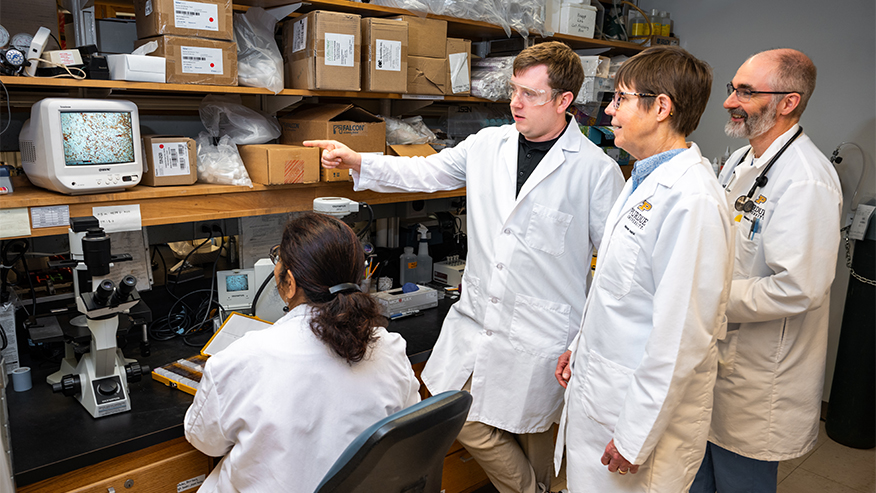
Purdue researchers study cancer in canines to help advance treatments for humans
August 27, 2026
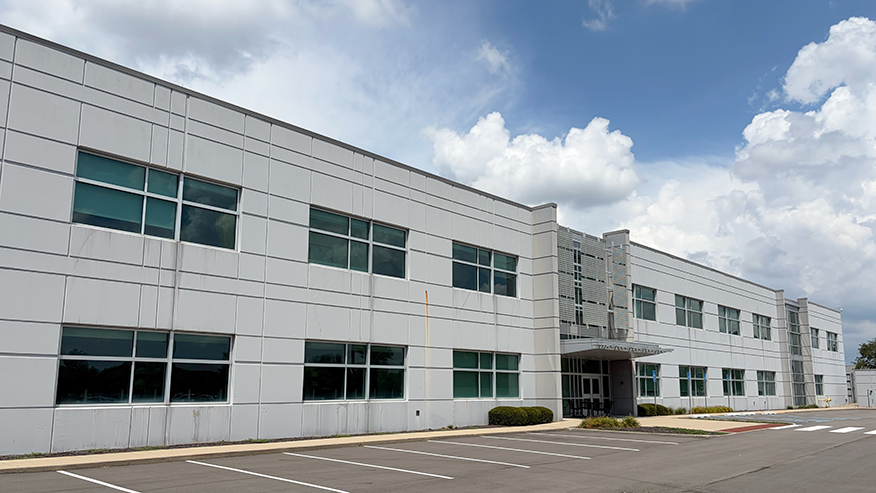
Purdue to expand research footprint in Indianapolis with new facility
July 20, 2026
Purdue-backed consortium wins National Science Foundation’s Regional Innovation Engines competition
July 15, 2026