Purdue Innovates awards funds to develop concrete, imaging and semiconductor innovations
3 Purdue researcher-led projects received $129,000 from Trask Innovation Fund
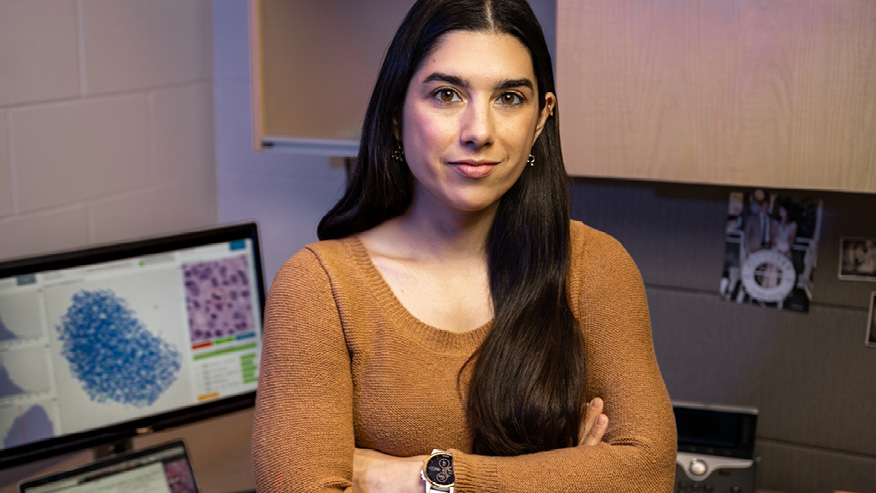
Nadia Lanman, a researcher in the Purdue Institute for Cancer Research, leads a team that has developed a patent-pending, AI-based pathology annotation system called AnnotateAnyCell. She leads one of three projects that have received more than $129,000 from Purdue Innovates’ Trask Innovation Fund to develop the intellectual property. (Purdue University photo/Kelsey Lefever)
WEST LAFAYETTE, Ind. — Purdue University researchers in the College of Engineering and the Purdue Institute for Cancer Research have received $129,072 from the Trask Innovation Fund to lead projects that will enhance Purdue-owned intellectual property for commercial use.
The innovations are in the areas of cell annotation, concrete and semiconductors.
The fund is managed by the Purdue Innovates Office of Technology Commercialization (OTC). Funding recipients can receive up to $50,000 for their initial project; they may reapply a maximum of three times to receive up to an aggregate cap of $100,000 to support the same technology.
The application deadline for the next round of Trask funding is Feb. 20. Applicants are encouraged to speak with their OTC business development manager to learn if they will benefit from applying.
The fall 2025 Trask Innovation Fund recipients, their Purdue affiliations, projects and award amounts are:

Kendra Erk; College of Engineering; “Upcycled Absorbent Materials From the Manufacture of Disposable Diapers for Use as Internal Curing Agents in Concrete”; $50,000
Erk is a professor in the School of Materials Engineering. She has developed a patent-pending, novel concrete admixture upcycled from absorbent waste materials from the manufacture of disposable diapers into internal curing agents for concrete.
“Concrete is the most widely used material in the world, but it is prone to early-age shrinkage and cracking as it cures,” she said. “When concrete cracks, water and corrosive chemicals can penetrate the structure, accelerating damage and increasing the risk of serious failure over time. This leads to higher maintenance costs, disruptions to transportation and utilities, and in extreme cases, safety hazards.”
Erk’s admixture uses a water-absorbing, hydrogel-based material as an internal curing agent. It releases moisture from inside the concrete as it hardens, which significantly reduces cracking at its source.
“Instead of ending up in landfills, the absorbent waste materials are supplied by industrial partners and processed by our research team into a form that can be easily added to concrete,” she said. “This approach combines performance benefits with sustainability, turning an existing waste stream into a valuable construction material.”
Erk said the Trask-funded project will develop and validate the new curing agent made from upcycled absorbed waste materials that vary in chemistry, size and shape.
“The project will identify and optimize formulations that most effectively reduce shrinkage and cracking in concrete,” she said. “The funding supports the experimental work needed to refine this technology; benchmark its performance; and move it closer to real-world use in durable, sustainable infrastructure.”
Erk has a courtesy appointment in the School of Sustainability Engineering and Environmental Engineering. She also serves as assistant dean for the First-Year Engineering Program.
Nadia Lanman; Purdue Institute for Cancer Research; “Showcasing Generalizability of the AnnotateAnyCell Framework for the Annotation of Whole Slide Images”; $29,072
Lanman is a research associate professor in the Purdue Institute for Cancer Research, with a courtesy appointment in the College of Veterinary Medicine’s Department of Comparative Pathobiology. She leads a team that has designed AnnotateAnyCell, a patent-pending, AI-based pathology annotation system and method that helps users dissect a sample more quickly and accurately than by manual annotation.
“Current methods are too slow for clinical use, requiring pixel-level labeling that is time intensive and is prone to varied results,” she said. “Existing digital pathology tools either use oversimplified approaches that miss diagnostics complexity or are semisupervised methods that require substantial labeled data.”
Lanman said this bottleneck in digital pathology limits the development of robust AI for precision medicine.
“If this challenge is not addressed, vast amounts of histopathology data will remain underutilized, representing a significant missed opportunity that slows progress and innovation in precision medicine,” she said.
Lanman said AnnotateAnyCell is an open-source, web-based platform that produces fully labeled whole-slide images enriched with quantitative measurements of cells and nuclei.
“The Trask funding will allow us to show that the model generalizes well across images,” she said. “The funding will also allow us to develop a strong use case to show the method enables users to answer a biologically relevant problem that no other method can currently solve.”
Lanman also is a member of the Institute for Physical Artificial Intelligence.
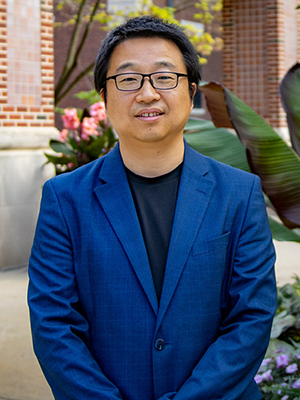
Wenzhuo Wu; College of Engineering; “From Lab to Fab: Scalable Production of 2D Tellurene for Next-Generation Semiconductor Devices”; $50,000
Wu is a professor in the Edwardson School of Industrial Engineering. He leads a team that has developed a solution-based method to produce 2D tellurene, an ultrathin semiconductor material with superior electronic performance. The patented method can be scaled up beyond small laboratory batches.
“There is strong interest in 2D semiconductors because they could enable new device architectures and unprecedented computing capabilities,” he said. “The lack of scalable, consistent production limits their application.”
Wu said if this manufacturing bottleneck isn’t solved, promising 2D semiconductor breakthroughs may take much longer to reach real products, which slows progress toward faster, more energy-efficient electronics that people depend on every day, including smartphones, wearables, medical devices and the computing infrastructure behind modern AI tools.
“Ultimately, delayed materials innovation results in higher energy costs, greater heat management challenges and slower performance improvements that affect both consumers and industry,” he said.
Wu’s Trask project aims to scale up 2D tellurene manufacturing so industry and R&D partners can access device-grade material for prototyping and evaluation.
“The Trask funding supports the equipment, materials and on-campus testing needed to demonstrate a repeatable, consistent process and generate a strong data package that industry partners can use to make go-no-go decisions,” he said.
Wu also is a member of the Institute for Physical Artificial Intelligence, Purdue Center on Aging and the Life Course, Purdue Institute for Drug Discovery, Purdue Institute for Integrative Neuroscience, Purdue Institute of Inflammation, Immunology and Infectious Disease, Purdue Quantum Science and Engineering Institute and Women’s Global Health Institute.
About Purdue Innovates Office of Technology Commercialization
The Purdue Innovates Office of Technology Commercialization operates one of the most comprehensive technology transfer programs among leading research universities in the U.S. Services provided by this office support the economic development initiatives of Purdue University and benefit the university’s academic activities through commercializing, licensing and protecting Purdue intellectual property. In fiscal year 2024, the office reported 145 deals finalized with 224 technologies signed, 466 invention disclosures received, and 290 U.S. and international patents received. The office is managed by the Purdue Research Foundation, a private, nonprofit foundation created to advance the mission of Purdue University. Contact otcip@prf.org for more information.
About Purdue University
Purdue University is a public research university leading with excellence at scale. Ranked among top 10 public universities in the United States, Purdue discovers, disseminates and deploys knowledge with a quality and at a scale second to none. More than 106,000 students study at Purdue across multiple campuses, locations and modalities, including more than 57,000 at our main campus in West Lafayette and Indianapolis. Committed to affordability and accessibility, Purdue’s main campus has frozen tuition 14 years in a row. See how Purdue never stops in the persistent pursuit of the next giant leap — including its integrated, comprehensive Indianapolis urban expansion; the Mitch Daniels School of Business; Purdue Computes; and the One Health initiative — at https://www.purdue.edu/president/strategic-initiatives.
Media contact: Steve Martin, sgmartin@prf.org
Purdue Research Foundation News

PaveX receives NSF funding to help agencies plan road repairs sooner, more efficiently
August 4, 2026

Amplified Sciences enrolls patients in PanAMP real-world, multicenter clinical utility study
May 8, 2026
Novin AgriTech receives USDA grant to develop novel traits for wheat, accelerate trait integration
May 6, 2026

Purdue student entrepreneurs receive $50,000 from Purdue Innovates Incubator
April 29, 2026