Purdue nuclear engineer creates, validates inexpensive gamma radiation monitoring tech
Technology costs less than traditional methods, distinguishes gamma from neutron radiation
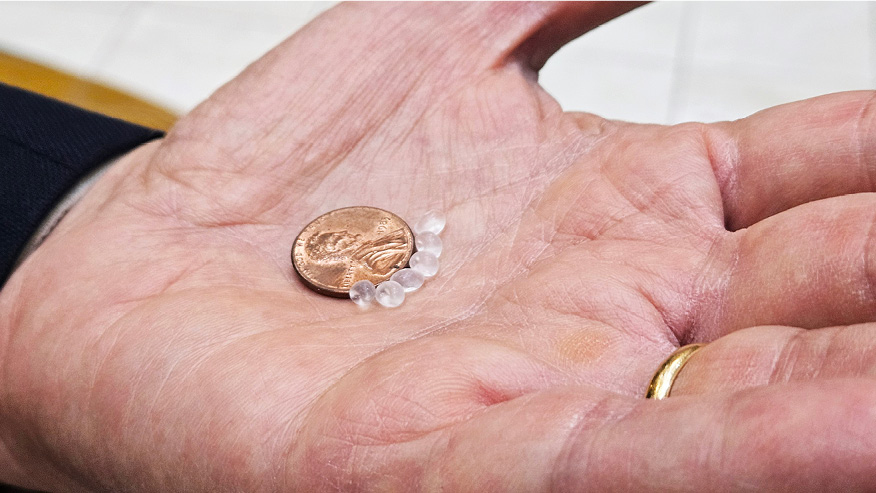
Gamma radiation dosimeters smaller than a penny developed at Purdue University are lightweight and nonpowered, distinguish gamma rays from neutron rays, and accurately record irradiation levels at a fraction of the cost of traditional dosimeters. Nuclear engineer Rusi Taleyarkhan leads a team that created the dosimeters from polylactic acid, a renewable, bio-based polymer. (Purdue Research Foundation photo/Liz Mogan)
WEST LAFAYETTE, Ind. — Inexpensive, highly accurate gamma radiation dosimeter technologies developed at Purdue University’s College of Engineering could lower the costs of medical device sterilization, radiation cancer therapy, food irradiation, packaging sterilization and enhance nuclear power reactor safety.
Rusi Taleyarkhan, a Purdue nuclear engineer, leads a team that has created and validated two patent-pending innovations composed of beads made from polylactic acid (PLA). PLA is a renewable, bio-based polymer widely used in medical applications, in the food packaging industry and as an adhesive.
The Purdue technologies are lightweight and nonpowered, distinguish gamma rays from neutron rays, and accurately record irradiation levels at a fraction of the cost of traditional dosimeters.
- One requires the user to weigh the sample, irradiate it, compress it with a hot press, and measure mass loss with a scale or balance and porosity with a microscope.
- The other requires the user to weigh the sample, irradiate it, subject it to a solvent and measure mass loss.
Taleyarkhan is a professor in the School of Nuclear Engineering and has a courtesy appointment in the College of Health and Human Sciences. Two papers about his research were published in the peer-reviewed journals Sensors and Instruments.
Taleyarkhan disclosed the innovations to the Purdue Innovates Office of Technology Commercialization, which has applied for patents to protect the intellectual property. Industry partners interested in developing or commercializing them should contact Aaron Taggart, business development and licensing manager — physical sciences, at adtaggart@prf.org about track codes 70076 and 70419.

The Purdue PLA methods
Taleyarkhan said the Purdue innovations determine gamma and neutron irradiation doses through a correlation of simple physical changes in PLA’s properties.
“In one method, irradiated PLA is examined for changes in rheological properties like deformation and pore volume,” he said. “Experiments were developed to correlate and determine irradiation levels in low (0-11 kilograys) and high (11-120 kilograys) gamma-dose ranges.
“In the other, even simpler method, the PLA biopolymer beads are subjected to gamma-neutron radiation. We then used techniques like placing the beads in acetone or another liquid and measured how much is dissolved at two temperatures,” he said. “The higher the mass dissolved, the higher the radiation dose.”
The beads determine within a few seconds how much of a dose was from gamma versus neutron radiation. They also can be used to detect radiation not only at room temperature but in extreme heat and radiation conditions within a commercial nuclear reactor.
“We dissolve the beads in a vial at different temperatures in an ordinary water bath,” he said. “Then we use common weight scales not only to find the total radiation dose but also tell gamma radiation from neutron radiation.”
Comparing complexity and expense
Taleyarkhan said gamma radiation is omnipresent in daily life, coming from cosmic or universal sources, terrestrial sources, and man-made sources.
“Man-made sources include nuclear reactors, accelerators and isotopes that produce radiation to diagnose or treat disease, X-rays to diagnose disease and sterilize equipment in hospitals, and more,” he said.
Taleyarkhan said traditional technology to monitor gamma radiation has remained largely the same for more than 80 years.
“Those sensor technologies monitor for the telltale charge buildup in ionized gases or solids or monitoring of light flashes,” he said. “They can rapidly become saturated, especially in high gamma fields, and lose their ability to perform. To monitor for high levels of gamma radiation without saturation requires even more exotic techniques but at the cost of efficiency and accuracy in postprocessing.”
Traditional detectors also are expensive. Taleyarkhan said individual dosimeters, called thermoluminescent dosimeters, cost up to $35 apiece. They are sent to outside labs that use million-dollar equipment to process them.
“For industrial-scale purposes such as the $2 billion sterilization market, gamma dosimeters are estimated to cost more than $1,000 each, not including postprocessing specialized expensive spectrometers,” he said. “For in-reactor gamma-neutron monitoring purposes, fission-chamber detectors cost up to $1 million each.”
The PLA beads cost about $5 to $10 per kilogram on the retail market, with Taleyarkhan’s system using only up to two grams at a time.
“Even at $10 per kilogram, or 1 cent per gram, the base cost for PLA dosimeter stock taken directly off the shelf would be 2 cents,” he said.
Next development steps
Taleyarkhan said there are several steps to develop the PLA bead innovations for the sterilization market. The first step is reliably meeting the industry’s accuracy metric, which he said the team already is close to approaching.
“Second, we need to package the system for ease of handling so users can follow a few simple instructions to place it in locations for monitoring and a protocol to read the dose,” he said. “Finally, we need to partner with an established industry player to achieve synergy with their existing customer base and products.”
The Department of Energy’s National Nuclear Security Administration, in collaboration with their Savannah River National Laboratory, has awarded grants to Taleyarkhan to support his research.
About Purdue Innovates Office of Technology Commercialization
The Purdue Innovates Office of Technology Commercialization operates one of the most comprehensive technology transfer programs among leading research universities in the U.S. Services provided by this office support the economic development initiatives of Purdue University and benefit the university’s academic activities through commercializing, licensing and protecting Purdue intellectual property. In fiscal year 2024, the office reported 145 deals finalized with 224 technologies signed, 466 invention disclosures received, and 290 U.S. and international patents received. The office is managed by the Purdue Research Foundation, a private, nonprofit foundation created to advance the mission of Purdue University. Contact otcip@prf.org for more information.
About Purdue University
Purdue University is a public research university leading with excellence at scale. Ranked among top 10 public universities in the United States, Purdue discovers, disseminates and deploys knowledge with a quality and at a scale second to none. More than 106,000 students study at Purdue across multiple campuses, locations and modalities, including more than 57,000 at our main campus in West Lafayette and Indianapolis. Committed to affordability and accessibility, Purdue’s main campus has frozen tuition 14 years in a row. See how Purdue never stops in the persistent pursuit of the next giant leap — including its integrated, comprehensive Indianapolis urban expansion; the Mitch Daniels School of Business; Purdue Computes; and the One Health initiative — at https://www.purdue.edu/president/strategic-initiatives.
Media contact: Steve Martin, sgmartin@prf.org
Purdue Research Foundation News

Purdue wearable AI device aims to improve epinephrine injections to treat anaphylaxis
October 14, 2026

Innovative solutions abound at Moonshot Pitch Challenge
September 17, 2026

SK hynix breaks ground on $4 billion advanced packaging production facility in Purdue Research Park
August 27, 2026

Purdue’s new underwater robot could make ocean missions more reliable
August 26, 2026