Purdue turbine designs show promise for next-gen propulsion
Researchers validate patent-pending designs for transonic inlet turbines and diodic turbines
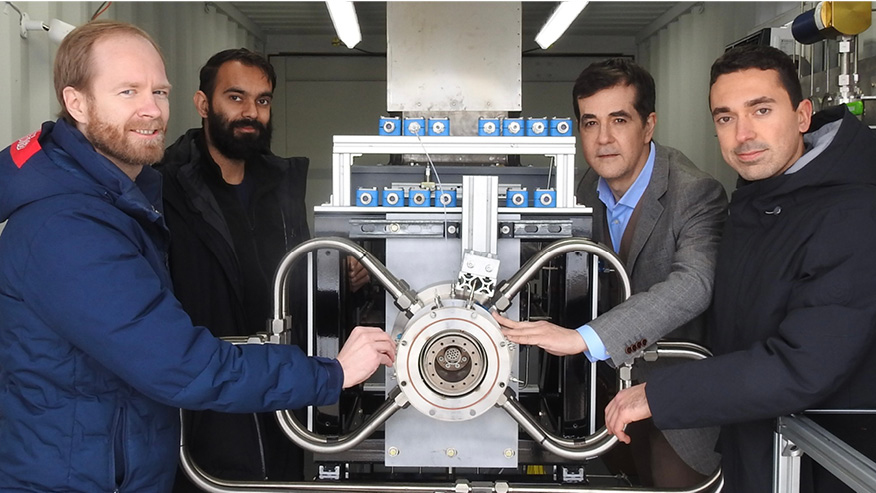
Lukas Inhestern, Lakshya Bhatnagar, Guillermo Paniagua and Sergio Grasa prepare to test their rotating detonation combustor to be integrated into an M250 engine test rig. Paniagua has designed turbines with applications that include power generation and aerospace and marine propulsion. (Purdue University photo/Eric Bach)
WEST LAFAYETTE, Ind. — Purdue University turbine designs have been proven to accommodate transonic inlet speeds, first through detailed computational analyses and more recently in experimental demonstrations.
Industrial applications for the designs include rotating detonation engines for power generation and aerospace and marine propulsion.
Guillermo Paniagua is a Reilly Professor of Mechanical Engineering in Purdue’s College of Engineering. He disclosed the transonic inlet turbine design and the diodic turbine design to the Purdue Innovates Office of Technology Commercialization, which has applied for patents to protect the intellectual property.
Industry partners interested in developing or commercializing the designs should contact Aaron Taggart, business development and licensing manager — physical sciences, at adtaggart@prf.org about track codes 69809 and 70451.
Paniagua conducts his research at Maurice J. Zucrow Laboratories, the largest academic propulsion lab in the world.
Transonic inlet turbine design

Paniagua said traditional turbines operate with a very narrow range of inlet Mach numbers.
“They are constrained to values below 0.3 in typical power plants and 0.6 in rocket liquid motors,” he said.
Paniagua’s transonic inlet turbine design functions for any inlet Mach number, which provides an increase in operability and flexibility compared to current designs. It can be integrated into existing engines.
“The unit’s endwalls have a smooth, contoured geometry that provides a steady increase in the channel height in the intended flow direction,” he said. “The flow passage geometry from inlet to outlet is such that the throat area is larger than the inlet area.”
Paniagua said the design outperforms traditional turbines.
“In previous patent disclosures, our team presented turbines that are suitable for Mach numbers in the supersonic range, above Mach 2.5,” he said. “No traditional turbines offer continuous operation from low subsonic to high supersonic ranges.
“With our new technology we will enable compact engines with rotating detonation combustors,” he said.
The U.S. Department of Energy provided funding to support Paniagua’s research.
Design for diodic turbines
Paniagua said rotating detonation combustors are key enablers for more compact gas turbines. They may increase fuel efficiency, provided full engine integration challenges are resolved.
“A fundamental issue in integrating this combustor into an engine is that pressure fluctuations from the combustor may travel upstream into the compressor, causing stall or even surge,” he said.
Paniagua said a possible solution is diodic valves, which function as a two-way diode in the system, allowing fuel to move freely in one direction while limiting flow in the other.
“Unfortunately, these solutions also introduce pressure losses,” he said.
One of Paniagua’s diodic turbine designs increases diodicity levels by an order of magnitude while also producing lower levels of losses. This concept was demonstrated using computational fluid dynamics, and an experimental demonstration is planned.
“By including this new type of diodic turbine in emerging rotation detonation engines, numerous industries could introduce new combustion engines to their existing technologies, making them more efficient,” Paniagua said.
Further design development
Paniagua and his team will refine the turbine designs and conduct experimental campaigns to validate performance across a range of operating conditions. Upcoming research will focus on:
- Scaling the technology for integration into full gas turbine test rigs
- Reducing overall pressure losses to maximize efficiency gains
- Collaborating with industry partners to adapt the designs for aerospace propulsion, power generation and marine applications
“Ultimately, our goal is to bridge the gap between laboratory demonstrations and industrial deployment,” Paniagua said. “We are looking forward to working with partners to accelerate the path from proof of concept to real-world engines.”
This article was prepared as an account of work sponsored by an agency of the U.S. government. Neither the U.S. government nor any agency thereof, nor any of their employees, makes any warranty, express or implied, or assumes any legal liability of responsibility for the accuracy, completeness or usefulness of any information, apparatus, product or process disclosed, or represents that its use would not infringe privately owned rights. Reference herein to any specific commercial product, process or service by trade name, trademark, manufacturer or otherwise does not necessarily constitute or imply its endorsement, recommendation or favoring by the U.S. government or any agency thereof. The views and opinions of authors expressed herein do not necessarily state or reflect those of the U.S. government or any agency thereof.
About Purdue Innovates Office of Technology Commercialization
The Purdue Innovates Office of Technology Commercialization operates one of the most comprehensive technology transfer programs among leading research universities in the U.S. Services provided by this office support the economic development initiatives of Purdue University and benefit the university’s academic activities through commercializing, licensing and protecting Purdue intellectual property. In fiscal year 2025, the office reported 161 deals executed with 269 technologies licensed, 479 invention disclosures received, and 267 U.S. and international patents received. The office is managed by the Purdue Research Foundation, a private, nonprofit foundation created to advance the mission of Purdue University. Contact otcip@prf.org for more information.
About Purdue University
Purdue University is a public research university leading with excellence at scale. Ranked among top 10 public universities in the United States, Purdue discovers, disseminates and deploys knowledge with a quality and at a scale second to none. More than 106,000 students study at Purdue across multiple campuses, locations and modalities, including more than 57,000 at our main campus in West Lafayette and Indianapolis. Committed to affordability and accessibility, Purdue’s main campus has frozen tuition 14 years in a row. See how Purdue never stops in the persistent pursuit of the next giant leap — including its integrated, comprehensive Indianapolis urban expansion; the Mitch Daniels School of Business; Purdue Computes; and the One Health initiative — at https://www.purdue.edu/president/strategic-initiatives.
Media contact: Steve Martin, sgmartin@prf.org
Purdue Research Foundation News

Purdue wearable AI device aims to improve epinephrine injections to treat anaphylaxis
October 14, 2026

Innovative solutions abound at Moonshot Pitch Challenge
September 17, 2026
SK hynix breaks ground on $4 billion advanced packaging production facility in Purdue Research Park
August 27, 2026

Purdue’s new underwater robot could make ocean missions more reliable
August 26, 2026