
Data scientist discovers the magic of Purdue’s online Master of Science in Applied Statistics program
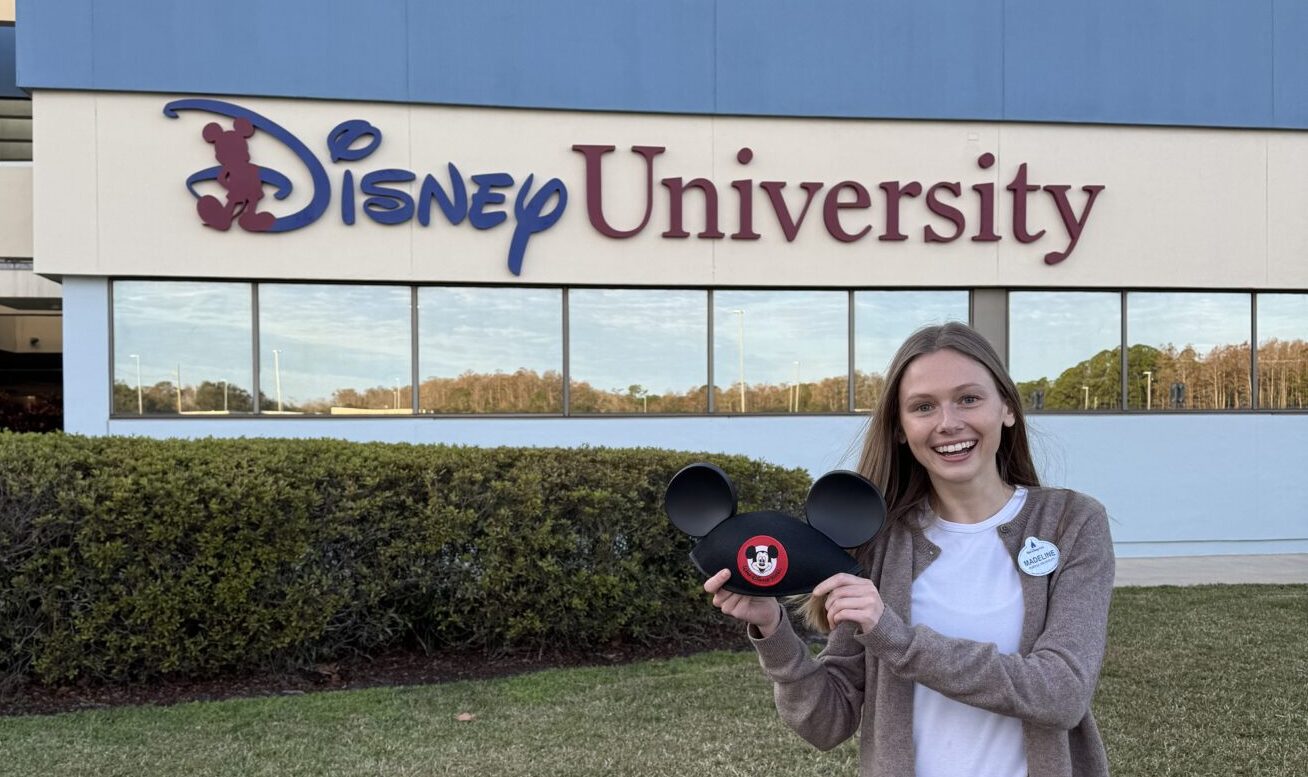
For Madeline Fuchs, opportunity didn’t knock. It popped up as a Walt Disney Co. LinkedIn advertisement looking for grad students to intern in Florida. In a fairy tale twist, now she is completing her Master of Science in Applied Statistics degree online while mastering a new full-time position.
Fuchs is part of the first cohort completing the Purdue University’s online Master of Science in Applied Statistics program. She will be graduating in December 2025, almost two years after starting the program. She credits her education with opening the door to Disney.
“I wouldn’t have had that opportunity if I wasn’t in this program,” Fuchs said. “Before that, I was working in Indianapolis at a small firm I was hired at after college. A pretty typical path. It’s so cool now to be at this really big company — and a company I grew up with.”
That was the start of Fuchs’ adventure.
She relocated to Florida to join the company’s Decision Science and Integration team. Six months later, she accepted a full-time offer as a data scientist with Disney Advertising’s Data and Measurement Science team. Now, she creates modeled audience segments — such as consumer behavior, household characteristics and psychographics — to meet advertisers’ needs.
“It’s really cool,” Fuchs said. “Disney is all over the place. It’s fun to hear about the parks and what’s going on and all that fun stuff. I love being a data scientist. I love the work I get to do, the modeling and all of that.”
Before coming to Purdue, Fuchs said she was searching for her next step.
Ready to take your next step in applied statistics?
After majoring in statistics and actuarial science, which uses statistics and analytics to measure risk, at Butler University, she was undecided about when to start her master’s, what to study and where to attend. As she researched her options, she discovered that Purdue was introducing the online Master of Applied Statistics program.
“I was between statistics, more computer science, machine learning or data science,” Fuchs said. “Purdue is pretty well known, especially in Indiana, for being one of the better schools. So, I saw they had applied statistics. I liked how that was applying statistics more into real world applications with coding and stuff. That drove me towards that avenue.”
She said she did not have any qualms about participating in such an innovative program because most of the programs she considered were newer as was the field she was exploring, data science.
“I was looking at new all around,” Fuchs said, laughing. “The name helped. You say, ‘Purdue’ and people are like, ‘Wow!’ and I’m like, ‘Yeah! Yeah!’”
What she found at Purdue were professors passionate about the program and opportunities to refresh her knowledge while developing new skills. While similar graduate programs at other universities offered introductory courses, she said Purdue offered a more rigorous approach.
“I liked how deep they went with different statistical methodologies and coding because there’s a lot of programs that were Intro to Python, intro to this, intro to that, whereas because I have worked previously, I’ve worked with that code, and I don’t really need that,” Fuchs said.
“It took what I learned in undergrad with statistics and what I knew from working as a data science consultant and grounded that into deeper statistical modeling knowledge. That’s been really cool to get to do throughout the program.”
Although the online format offered Fuchs the flexibility she needed, she was concerned about limited interaction. However, professors and students worked together to build a strong, supportive virtual community.
“The professors are always, I feel, really helpful,” she said. “They are willing to spend time with you and help you understand if you don’t get it in the lecture or the textbooks the first time through.”
Students met through Discord groups to talk about their classes and on camera to discuss group projects. The program’s online modality proved to be perfect for unexpected twists and turns her career path took, allowing her to continue classes as she moved across the country.
“I really liked it, especially while working full-time,” Fuchs said. “If I had a long day at work, I could do my lectures the next day. I didn’t have to go to a class that was at a specific time. It wasn’t like you had to be there; you had to be in person. I could make it work with my schedule, based on the type of workday I had, which I found really nice.”
The program came at the perfect time for her new career. During the almost three years between completing her undergraduate degree and starting her new roles, there were subjects that she did not use often. Working on her master’s not only helped her recapture forgotten concepts and offer addition context, it also provided the most recent developments.
“A lot of data science can change quickly with technology,” Fuchs said. “Working on my master’s program while working has been nice. It keeps me refreshed on statistical concepts so when people mention something in a meeting, I’m not like, ‘Oh gosh! What is this modeling?’ I have it right there.”
As she nears graduation, Fuchs said it has been a good experience.
“It’s helped me keep my mind thinking and not just running to the couch, doing nothing, after work,” Fuchs said. “It’s helped me to continue to grow and to push myself in a new direction — not just at work, but also educationally and as a person.”
Assistant Professor of Practice and Online Chair for the Department of Statistics Tim Keaton said, “I’m so glad we were able to expand our long-running residential version of this program into this new flexible form that allows excellent students like Madeline to participate from wherever they are. It has been great to work with these students and see them gain valuable skills they actively taking back to their diverse industries.”
Ready to challenge yourself while strengthening your skill set? The Master of Science in Applied Statistics program is offered online by one of the nation’s largest and most computationally modernized statistics programs. This degree elevates the working professional’s knowledge of the latest computational tools and methodologies, preparing them for a field with a predicted 35% job growth, according to the U.S. Bureau of Labor Statistics.
Learn more by visiting the program’s webpage.