Purdue picked as a host institution for prestigious 51 Pegasi b postdoctoral fellowship
3-year program focuses on advancing planetary science and astronomy studies
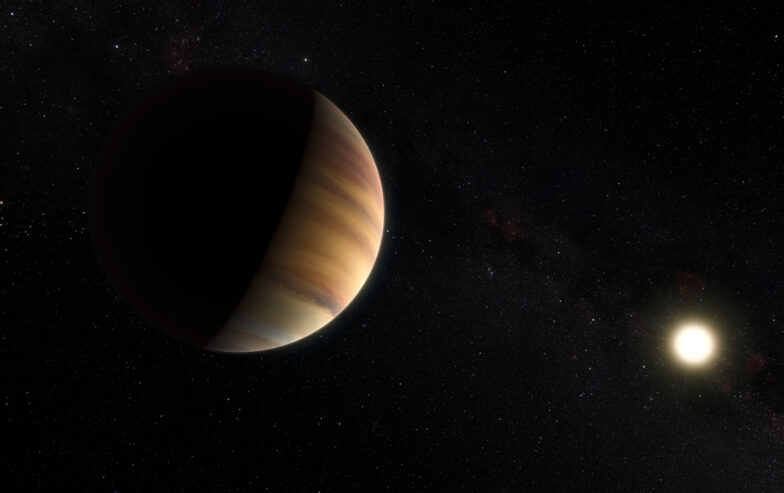
This artist’s view shows the hot Jupiter exoplanet 51 Pegasi b, sometimes referred to as Bellerophon, which orbits a star about 50 light-years from Earth in the northern constellation of Pegasus (The Winged Horse). This was the first exoplanet around a normal star to be found in 1995. Twenty years later this object was also the first exoplanet to be be directly detected spectroscopically in visible light.
WEST LAFAYETTE, Ind. — Purdue University has been selected to serve as a host institution for the prestigious 51 Pegasi b Postdoctoral Fellowship, awarded by the Heising-Simons Foundation to give scholars the opportunity to conduct cutting-edge theoretical, observational and experimental research in planetary astronomy.
The annual 51 Pegasi b Postdoctoral Fellowship, named after the first exoplanet discovered orbiting a sun-like star, recognizes promising early-career investigators in the field of planetary astronomy, which brings together research efforts to characterize planetary objects within the solar system and beyond to exoplanetary systems.
Alexandria V. Johnson, a Purdue assistant professor of earth, atmospheric and planetary sciences, said the university’s selection as a host institution for the fellowship is a testament to the pioneering research environments that Purdue has cultivated within the Department of Earth, Atmospheric, and Planetary Sciences (EAPS), the Department of Physics and Astronomy, and throughout the College of Science.
Another important factor in Purdue’s selection was the wide range of programs offered and support provided for scholars by the Office for Graduate Students and Postdoctoral Scholars, added Johnson, who will serve as Purdue’s faculty institutional contact for the fellowship.
“Heising-Simons Foundation representatives visited Purdue not only to learn about and assess our research endeavors but to ensure fellows would be placed in a supportive environment that is dedicated to their all-around success and development as scholars,” Johnson said. “We look forward to welcoming our inaugural 51 Pegasi b fellows in their pursuit of advancing our understanding of exoplanets, solar system science, planet formation and evolution, planetary atmospheres, protoplanetary disks and other related areas.”
The application period for the next class of 51 Pegasi b fellows runs through Oct. 3. An announcement of selected fellows and their host locations is expected next spring, ahead of the start of the fall 2026 semester. Incoming fellows and host faculty will work closely with Purdue’s Office for Graduate Students and Postdoctoral Scholars in their transition, Johnson said.
The 51 Pegasi b fellow receives a three-year grant of up to $450,000 to cover salary and benefits, indirect costs, as well as highly flexible research-related discretionary spending. Since its launch in 2017 by the Heising-Simons Foundation, the fellowship has supported 66 fellows with up to eight fellowships awarded each year, and expanded to 28 host institutions in the U.S.
“This is a very exciting moment for Purdue, once again putting us in elite company to serve as a host institution for one of the nation’s most prestigious postdoctoral fellowship programs focused on advancing the study of planetary astronomy,” said Lucy Flesch, the Frederick L. Hovde Dean of the College of Science and also a professor of earth, atmospheric and planetary sciences.
The Heising-Simons Foundation is a family foundation based in California that works with its many partners to advance sustainable solutions in climate and clean energy, enable groundbreaking research in science, enhance the education of the youngest learners, and support human rights.
The name Pegasus and its plural Pegasi comes from the Greek word for spring. The exoplanet 51 Pegasi b, also called “Dimidium,” was discovered 30 years ago this fall on Oct. 6, 1995. Its discoverers Michel Mayor and Didier Queloz shared the Nobel Prize in Physics in 2019.
EAPS at Purdue has a great diversity of programs and intersecting disciplines, focused on exploring the connections between the Earth’s interior and surface, climate and sustainability, planetary exploration and spacecraft missions and the development of emerging fields of study, Faculty and students study in fields such as tectonics, geophysics, atmospheric dynamics and chemistry, environmental sciences, biogeochemistry, climate change, severe weather, planetary sciences, astrobiology, data science, and other areas.
Space News

Purdue 1 essay competition invites Indiana fifth graders to imagine the future of space exploration
September 30, 2026
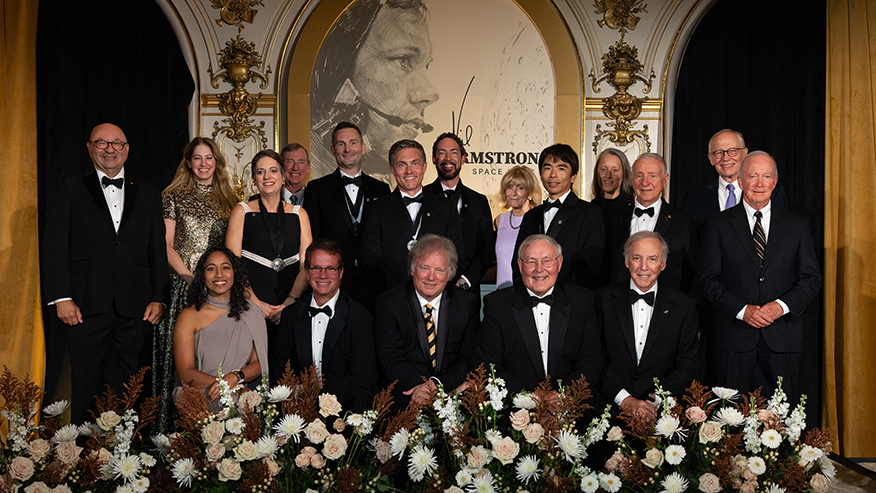
Falcon 9 Booster Landing Team receives first Neil Armstrong Space Prize for reusable rocket research
September 16, 2026
A smarter way to track satellites beyond Earth’s orbit
August 11, 2026
Keys to future human exploration, past planetary conditions hide under surface of moon, Mars
July 29, 2026