In-space manufacturing, quantum projects part of all-Boilermaker suborbital spaceflight
Purdue 1 mission will include 2 autonomous experiments alongside real-time research by crew
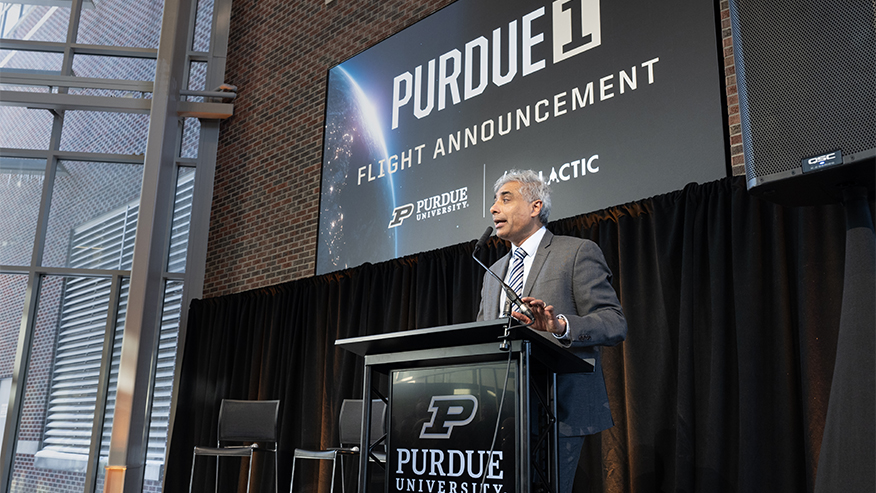
Arvind Raman, the John A. Edwardson Dean of Purdue’s College of Engineering, announces autonomous experiments in quantum technology and in-space manufacturing will be included in the all-Boilermaker Purdue 1 flight by Virgin Galactic scheduled for 2027. (Purdue University photo/John Underwood)
WEST LAFAYETTE, Ind. — Purdue University is expanding the scientific footprint of 2027’s all-Boilermaker suborbital flight mission with the addition of onboard autonomous experiments in quantum technology and in-space chip manufacturing.
The experiments, prepared by Purdue researchers, will be housed in research lockers for the flight aboard a Virgin Galactic suborbital spacecraft, dubbed Purdue 1. The lockers join two onboard experiments in microgravity that will be conducted and monitored in real time by a Purdue researcher and graduate student who are part of the spacecraft’s five-person crew.
The autonomous experiments advance Purdue’s goals of setting a precedent for academic access to space and providing an emphasis on teaching and research. The additional experiments were announced Wednesday (Jan. 28) in the Herman and Heddy Kurz Atrium in Purdue’s Neil Armstrong Hall of Engineering.
“These experiments contribute an additional important research facet to the Purdue 1 mission,” said Arvind Raman, the John A. Edwardson Dean of Purdue’s College of Engineering. “Space is the next endless frontier, and these research opportunities demonstrate Purdue’s focus on preparing and utilizing that frontier.”
Plans were announced in September for the all-Boilermaker flight, which is expected to lift off next year. Designed to seat up to six passengers, Virgin Galactic’s next-generation spaceship is customizable and will have one seat removed for this mission to fly the five crew members and create space for the research lockers on a payload rack.
Known as the Cradle of Astronauts, Purdue has 30 alumni — 29 from Purdue Engineering — who have already flown in space or been selected as NASA astronaut candidates. The five-person Purdue 1 crew will include Steven Collicott, a professor of aerospace engineering in the School of Aeronautics and Astronautics; current Purdue graduate student Abigail Mizzi; and alumnus Jason Williamson. Two other alumni joining the flight will be named later.
The autonomous research locker in-space manufacturing experiment is a continuation of the work of Ajay Malshe, director of Purdue’s Center for In-Space Manufacturing (CISM). The experiment will test the use of laser-assisted techniques to provide a compact, localized energy source for semiconductor and metal manufacturing.
“Purdue is poised to activate its world-class leadership in convergent manufacturing science and engineering to pioneer the next generation of materials, processes and applications for in-space manufacturing,” said Malshe, also director of Purdue’s Manufacturing and Materials Research Laboratories. “By converging deep technical expertise with cross-sector collaboration through CISM, we are laying the foundation to overcome today’s constraints and unlock transformative semiconductor and electronics manufacturing capabilities beyond Earth’s surface.”
“This autonomous experiment represents a paradigm shift in how we build beyond Earth,” Malshe said. “By moving away from the massive, energy-intensive and gravity-centric manufacturing processes of Earth-bound industry, which are fundamentally unsuited for the constraints of spacecraft or factory in space at orbital depots, we are pioneering a lean, scalable future for extraterrestrial commerce and dynamic in-space operation. In partnership with government and industrial partners, we are not just testing a process, we are architecting the foundation of the space economy.”
In-space manufacturing involves creating the necessary infrastructure to efficiently supply future missions off-planet. Research focuses on in-space operations and innovative technologies to eliminate the need for repeated maintenance and resupply missions. In addition, manufacturing electronic devices and quantum technologies is supported by extreme conditions such as temperatures, microgravity and more.
Laser cooling and trapping neutral rubidium atoms are the focus of the autonomous quantum experiment in the second research locker. Four faculty in Purdue’s Elmore Family School of Electrical and Computer Engineering are creating the experiment with industry partner Infleqtion, a world leader in deployed atom-based quantum technology and the only company in the world to have cold atom systems operating aboard the International Space Station since 2018. Infleqtion has been a partner of the Purdue Quantum Science and Engineering Institute for the past four years.
The experiment is designed to examine laser-cooled atoms at near-absolute zero temperatures to measure a variety of parameters that are key to atom-based quantum technology in a microgravity environment. This is the first step toward quantum positioning, navigation and timing (Q-PNT) for future space exploration.
“Sending quantum technology into space allows us to move from laboratory demonstrations to real-world engineering of next-generation navigation systems,” said Shengwang Du, a Purdue professor of electrical and computer engineering and lead on the experiment. “By evaluating quantum systems in the space environment, we can understand how atom-based quantum sensors behave in microgravity and identify the pathways to deploy them for future lunar and deep-space missions. This work positions Purdue at the forefront of translating quantum science into practical capabilities for space exploration.”
Du said laser-cooled atoms are the foundation for Q-PNT systems and related technology used for earth monitoring, space exploration and future deep-space missions. The quantum technology could reduce and ultimately eliminate today’s reliance on GPS systems.
Purdue faculty Alexandra Boltasseva, the Ron and Dotty Garvin Tonjes Distinguished Professor of Electrical and Computer Engineering; Vladimir Shalaev, the Bob and Anne Burnett Distinguished Professor of Electrical and Computer Engineering; and Joseph Lukens, an associate professor of engineering, also are involved in the quantum experiment.
Collicott and Mizzi will conduct real-time experiments on how fluids behave in zero gravity — a research area that is critical to advancing spaceflight design, fuel management and future long-duration space missions.
Mizzi’s experiment focuses on the zero-gravity oscillations of liquids set in motion by rotation, such as the motion of rocket propellants sloshing in their tanks after a spacecraft rotates to dock at a space station. Collicott, who has been an expert in fluid physics for almost 40 years, plans to use novel testing to gather data on the nonuniform effect of liquid spreading over a surface.
About Virgin Galactic
Virgin Galactic is an aerospace and space travel company, pioneering human-first spaceflight for private individuals, researchers, and governments with its advanced SpaceShips and launch vehicle. Scale and profitability are driven by next generation vehicles capable of taking humans to space at an unprecedented frequency with an industry-leading cost structure. You can find more information at https://www.virgingalactic.com.
About Purdue University
Purdue University is a public research university leading with excellence at scale. Ranked among top 10 public universities in the United States, Purdue discovers, disseminates and deploys knowledge with a quality and at a scale second to none. More than 106,000 students study at Purdue across multiple campuses, locations and modalities, including more than 57,000 at our main campus locations in West Lafayette and Indianapolis. Committed to affordability and accessibility, Purdue’s main campus has frozen tuition 14 years in a row. See how Purdue never stops in the persistent pursuit of the next giant leap — including its integrated, comprehensive Indianapolis urban expansion; the Mitch Daniels School of Business; Purdue Computes; and the One Health initiative — at https://www.purdue.edu/president/strategic-initiatives.
Media contact: Brian Huchel, bhuchel@purdue.edu
Note to journalists:
A video of Ajay Malshe discussing in-space manufacturing is available on YouTube.
Space News
Limiting space junk’s threat by predicting its mess in the Earth-moon neighborhood
March 26, 2026
Findings suggest red planet was warmer, wetter billions of years ago
December 1, 2025
Fire in the sky: Strong summer storms in the Midwest send wildfire smoke into the previously pristine stratosphere
October 20, 2025

All-Boilermaker team to crew Virgin Galactic suborbital mission Purdue 1
September 23, 2025