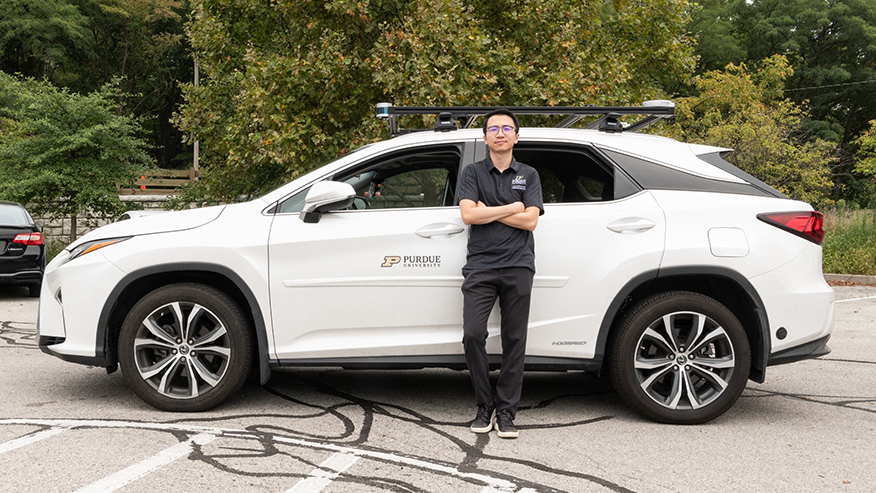
Purdue engineers have found that autonomous vehicles (AVs) could understand their passengers better with the help of ChatGPT or other chatbots made possible by artificial intelligence algorithms called large language models. The study, to be presented Sept. 25 at the 27th IEEE International Conference on Intelligent Transportation Systems, may be among the first experiments testing how well a real AV can use large language models to interpret commands from a passenger and drive accordingly.
Researchers in Purdue’s College of Engineering have developed a patent-pending optical counterfeit detection method for chips used in semiconductor devices. The Purdue method is called RAPTOR, or residual attention-based processing of tampered optical responses. It leverages deep learning to identify tampering. It improves upon traditional methods, which face challenges in scalability and discriminating between natural degradation and adversarial tampering.
Seasonal flu shots, which support the physical health pillar of the Healthy Boiler Program, are provided annually at no charge to all benefits-eligible Purdue faculty and staff, as well as spouses and dependents covered on a Purdue health plan, through a variety of means at all three Center for Healthy Living locations.