Purdue secures $19M from NSF to develop AI-driven programmable labs for semiconductors, advanced materials
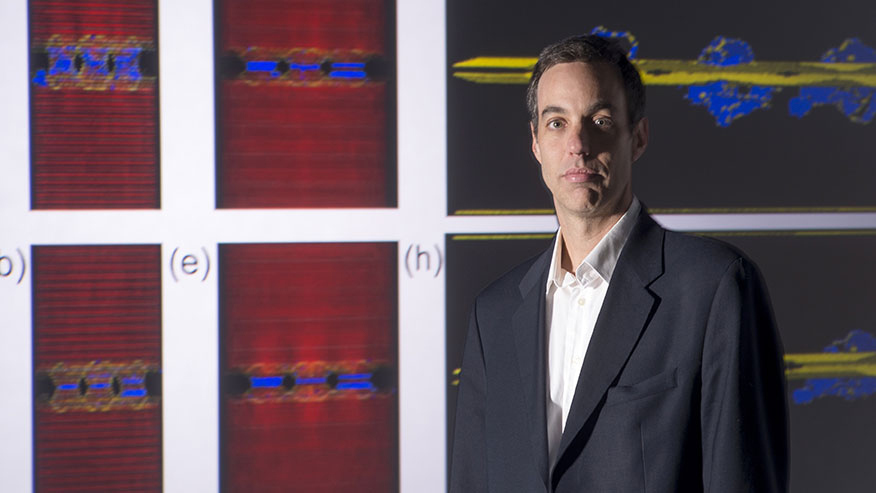
Alejandro Strachan, a Reilly Professor of Materials Engineering at Purdue University, is leading an initiative that will connect researchers across the country to advanced experimental facilities, simulations and AI-driven tools, accelerating the discovery and deployment of next-generation materials for electronics, energy, aerospace and defense applications. (Purdue University photo)
WEST LAFAYETTE, Ind. — Purdue University researchers will lead a $19 million effort to build an online, cloud-based lab that provides access to physical labs, simulations and AI tools to a national community of remote users for designing advanced materials and manufacturing processes for semiconductor, aerospace, defense and energy systems.
The Intelligent Codesign Cloud Lab for Non-Equilibrium and Low-Dimensional Materials (ICoN-PCL), funded by the U.S. National Science Foundation Directorate for Technology, Innovation and Partnerships (NSF TIP), aims to accelerate the discovery and integration of new, state-of-the-art materials into cutting-edge technologies, such next-generation electronics, nuclear reactors and space systems. ICoN-PCL will help transform isolated instruments into coordinated discovery engines that help redefine how research facilities operate and facilitate the exchange of knowledge and data. ICoN-PCL is funded as part of the NSF Test Bed: Toward a Network of Programmable Cloud Laboratories program.
Alejandro Strachan, a Reilly Professor of Materials Engineering at Purdue, will direct and spearhead the development of the test bed that will bring together experts in data and AI with the unique experimental facilities and expertise of Purdue’s Birck Nanotechnology Center and Manufacturing and Materials Research Laboratories (MMRL), as well as Drexel University’s Metadata Research Center.
Across critical technology sectors, the same core challenge exists: Due to the complexity of these engineering systems, new materials are often discovered decades before they can be implemented into manufacturing processes and technologies, thereby stifling innovation.
“For decades, materials discovery, manufacturing and device fabrication have operated in silos, slowing the path from breakthrough to real-world impact,” Strachan said. “ICoN-PCL is about bringing these pieces together by using AI and data to enable true codesign, where materials and processes are developed simultaneously to accelerate innovation in ways we simply couldn’t accomplish before.”
ICoN-PCL will connect the entire advanced materials and manufacturing pipeline, from materials discovery and synthesis to fabrication, device integration and testing. It will give remote users access to a variety of AI and automation tools, as well as physical facilities that may have been previously unavailable to many researchers:
- Access to advanced equipment at cutting-edge facilities such as Birck, home to Purdue’s advanced research and development of semiconductors and other advanced technology, and the MMRL, which offers equipment for materials handling, fabrication, postprocessing and characterization
- Existing datasets and simulations available through integrated platforms such as nanoHUB, a database for computational nanotechnology research that Strachan co-directs
- A multiagent AI assistant, ICoN Research Assistant, that can help design experiments and efficiently navigate millions of possible material and process combinations
- Digital twins — virtual replicas of physical systems that mirror their behavior in real time — that can run simulations of experiments and predict outcomes before they’re executed
- Automated “self-driving” workflows that can design, run and optimize fabrication processes
Together, these features help to advance the path from discovery to implementation by eliminating gaps between steps, automating experimentation, using AI to guide decision-making and reducing duplicate research. Rather than following a sequential design process, researchers can use ICoN-PCL to codesign materials and the manufacturing processes best suited for their properties.
The platform will focus on two applications: developing next-generation electronics using advanced 2D materials and creating materials capable of performing at the extreme conditions required for energy and aerospace systems.
While 2D materials — more than 10,000 thinner than a human hair — show great promise for future semiconductor technologies, manufacturers still face challenges in producing them reliably and understanding how small defects affect performance. By combining unique, large-scale experiments with digital twins, ICoN-PCL will help its users identify the best material combinations and manufacturing processes.
For materials used in extreme environments, the platform will provide tools to accelerate design, manufacturing, testing and characterization. These tools aim to help researchers create stronger, more durable materials and generate high-quality data for future innovations that more rapidly scale to improve U.S. competitiveness and benefit society.
ICoN-PCL will also be used for training in AI, materials science, manufacturing and autonomous experimentation, expanding educational access and helping to grow the national talent pool capable of discovering and generating trustworthy results in key technology areas. Users from academia, industry and government can collaborate and access the same data and equipment no matter their location.
ICoN-PCL will be part of Purdue Computes, a strategic initiative to advance Purdue’s research and educational excellence in computing, semiconductors, physical artificial intelligence through the Institute of Physical Artificial Intelligence and quantum science and engineering through the Purdue Quantum Science and Engineering Institute.
About Purdue University
Purdue University is a research institution ranked among the top 10 public universities in the United States. More than 106,000 students study at Purdue across multiple campuses, including more than 57,000 at our main campus locations in West Lafayette and Indianapolis. As a land-grant university committed to affordability and accessibility, Purdue’s main campus has frozen tuition 14 years in a row, enabling more students than ever to graduate debt-free.
Media contact: Lindsey Macdonald, macdonl@purdue.edu
Purdue Computes News
Purdue-Google summit advances physical AI, manufacturing and workforce readiness
October 16, 2026
‘Movies’ of interaction between light and matter help advance quantum tech
October 6, 2026

Purdue and University of Illinois, 2 engineering powerhouses, team up to strengthen semiconductor workforce in U.S.
September 22, 2026
Purdue expands semiconductor professional education portfolio to advance global workforce development
July 8, 2026