1 week out: Countdown to the search for Amelia Earhart’s plane begins
Archaeological Legacy Institute, Purdue ready to explore Pacific island’s lagoon for aviation pioneer’s missing plane wreckage
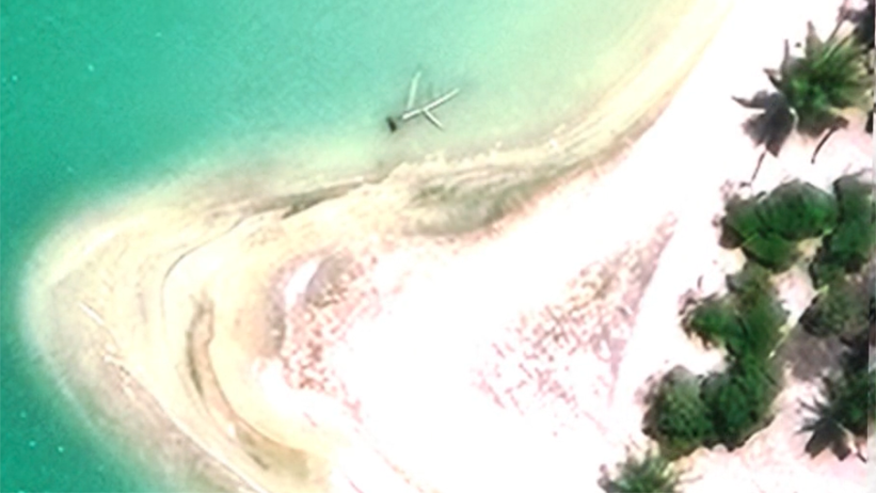
A satellite image shows the Taraia Object in a lagoon on Nikumaroro. (Photo provided by Rick Pettigrew, Archaeological Legacy Institute)
WEST LAFAYETTE, Ind. — In one week, the Archaeological Legacy Institute (ALI), Purdue Research Foundation (PRF) and Purdue University will embark on an expedition to the South Pacific in an attempt to solve the disappearance of Amelia Earhart during her mission to become the first person to fly around the world at the equator.
The expedition will include almost three weeks of travel and research to determine if a visual anomaly spotted in satellite images of Nikumaroro’s lagoon is Earhart’s missing Lockheed Electra 10-E. The search originally was announced in July 2025, 88 years to the day that Earhart and her navigator Fred Noonan mysteriously disappeared.
Richard Pettigrew, executive director of ALI, is leading the expedition team traveling to Nikumaroro. With the journey’s launch approaching quickly, he said the prospect of setting off on a discovery mission of this potential magnitude is exhilarating.
“With just a week to go before the launch of our expedition, my conscious focus is on the execution of our fieldwork plan,” he said. “Inevitably, though, this comes with an array of strong feelings. I’m intensely and eternally grateful to the many individuals and organizations who have helped to make our vision real. I feel truly lucky to be in a position to possibly solve one of the greatest mysteries of all time, whether or not that happens.”
The expedition was delayed in October 2025 as the team worked through additional stages of the permit approval process with the Republic of Kiribati, the island nation in which Nikumaroro is located. The onset of the South Pacific cyclone season during the winter months prevented a safe departure later in 2025.
Expedition members will rendezvous at Tarawa, Kiribati, on Oct. 6 and depart by sea the next day for Nikumaroro in the Phoenix Islands of Kiribati. The team will sail six days to arrive at Nikumaroro and then spend the following days on the small island in the search effort.
Three Purdue representatives will be part of the crew: Steve Schultz, senior vice president and general counsel, and Sirisha Bandla and Marc Hagle, both alumni and members of Purdue’s Cradle of Astronauts.
Work on Nikumaroro will focus on inspecting the Taraia Object, first noticed in satellite imagery in 2020 and later confirmed to be visible on aerial photos taken of the island’s lagoon as far back as 1938.
Initial work will include videos and still images of the site prior to any disturbance, followed by remote sensing with magnetometers and sonar. Then the team will employ underwater excavation using a hydraulic dredge to expose the object for identification. Fieldwork will include a walk-over survey of nearby land surfaces to search for debris washed up by waves.
The expedition is scheduled to arrive back in Tarawa around Oct. 22 and fly home the following day.
For Pettigrew, the mission offers the opportunity to solve one of the greatest mysteries of the 20th century.
“Finding Amelia Earhart’s Electra aircraft would be the discovery of a lifetime,” he said. “Other evidence already collected by The International Group for Historic Aircraft Recovery establishes an extremely persuasive, multifaceted case that the final destination for Earhart and her navigator Fred Noonan was on Nikumaroro. Confirming the plane wreckage there would be the smoking-gun proof.”
The Purdue Research Foundation originally funded the Lockheed Electra “Flying Laboratory” through the Amelia Earhart Fund for Aeronautical Research as part of Purdue’s pioneering efforts in aviation.
“Amelia’s legacy remains strong at Purdue, and she looms large in our canon of heroes,” Schultz said. “Successfully identifying the Electra would be the first step toward fulfilling her intention to return it to the university. Additional work and further conversations with Kiribati would still be needed to make that a reality, but we feel we owe it to her legacy at Purdue to try to find a way to bring it home if we find it.”
Any effort to extract and return the aircraft wreckage to West Lafayette would require permission of the government of Kiribati, Schultz said. ALI and Purdue credit the country’s leadership and support with making the expedition happen.
Earhart began her attempt to circumnavigate the globe and set a record for long-distance flight in late May 1937, flying out of Oakland, California.
“This Is Purdue,” the university’s official podcast, released a four-part miniseries called “Finding Amelia” on Monday (Sept. 28). The storytelling centers around the decades-long connection between the legendary aviator and Purdue. The miniseries is available to listen to on the podcast’s website or wherever you get your podcasts, and each episode is available to watch on YouTube.
The miniseries digs into who Amelia was and her journey to the university, the “Flying Laboratory” she was operating when she disappeared, the Amelia Earhart Collection within Purdue University Archives and Special Collections, and the upcoming Taraia Object expedition.
Earhart, already an aviation legend in the 1930s, came to Purdue in 1935 and worked for two years as a women’s career counselor and advisor in the university’s aeronautics department. The recently opened Amelia Earhart Terminal at the Purdue Airport honors her legacy as a valued Boilermaker. She is also remembered across campus through facilities, programs and clubs.
Bandla, a 2011 Purdue graduate in aeronautical and astronautical engineering, said she remembers the campus memorializing Earhart in so many ways.
“Purdue’s legacy is built on turning ambitious ideas into meaningful impact, and that is something that has always made me proud to be a Boilermaker,” Bandla said. “To be part of this expedition is both exciting and deeply meaningful. We are searching for answers behind one of the greatest mysteries while celebrating the legacy of Amelia Earhart, a true aviation pioneer who refused to let limits define her future. Her willingness to take the first step inspired countless women to follow their own paths and pursue their dreams. It is an honor to help continue that legacy through this extraordinary mission of exploration and discovery.”
Nikumaroro is located halfway between Australia and Hawaii and lies close to 400 miles southeast of Howland Island, the planned destination of Earhart and Noonan on the third-to-last leg of their 1937 attempt to circumnavigate the world around the equator.
The expedition is being supported by Columbia Sportswear, DHL Express, Fiji Airways, Kiribati National Shipping Line, the Niswonger Foundation, Bulova and RECON Offshore, along with additional organizations providing financial, operational, logistical, technical, philanthropic, diplomatic and in-kind support, including Alvantor, Arrants Expeditions, Brownie’s Third Lung, Forestry Suppliers, GreenGood Labs, The Museum of Flight, the Naval Aviation Museum Foundation, Randolph USA, and Tricor.
The Taraia Object expedition team includes:
- Rick Pettigrew, ALI, project director
- Steve Schultz, Purdue general counsel, field assistant
- Laura Kennedy, ALI, technology specialist
- Philippa Jorissen, ALI, terrestrial archaeologist
- Ren LaRocca, ALI, assistant
- Sirisha Bandla, Purdue alumna, technology specialist
- Marc Hagle, Purdue alumnus, field assistant
- Meere Kenana, curator, Kiribati Culture and Museum, Kiribati representative
- Agnes Naare, Ministry of Line and Phoenix Islands Development, Kiribati representative
- Heidi Boraia-Tangata, Ministry of Line and Phoenix Islands Development, Kiribati representative
- Michael Krivor, RECON Offshore, maritime archaeologist
- William Wilson, RECON Offshore, maritime archaeologist
- Aaron Arrants, medic and safety officer
- Helmut Schleppi, filmmaker
- Ella Van Cleave, filmmaker
- David Pearson, filmmaker
- Matt Maddaloni, filmmaker
About Archaeological Legacy Institute
Archaeological Legacy Institute is a 501(c)(3) nonprofit based in Eugene, Oregon, and organized to share the human cultural heritage widely through the use of cutting-edge media technology. ALI’s core project is The Archaeology Channel (http://www.archaeologychannel.org), a free streaming-media website featuring video and audio programs on archaeology, indigenous peoples and cultural heritage. This combines with news site Archaeologica.org, the social media site ArchaeoSeek.com, and subscription video-on-demand platform Heritage Broadcasting Service (heritagetac.org) to form a unique constellation of online services and resources for those keen to learn about and enjoy cultural-heritage information, events, programming and discussions. Through The Archaeology Channel Tours, ALI also organizes in-person group visits to significant cultural heritage sites worldwide, which have included Stonehenge, Machu Picchu, Chichén Itzá, Uxmal, Newgrange, Persepolis, Carnac, the Ness of Brodgar, the Malta prehistoric temples and many others.
About Purdue University and Purdue Research Foundation
Purdue University is a research institution ranked among the top 10 public universities in the United States. The Purdue Research Foundation (PRF) is a private nonprofit operating as a separate entity to advance the university’s mission. Purdue is committed to affordability and accessibility with more than 111,000 students studying at Purdue across multiple campuses. PRF operates Purdue Innovates, including the Office of Technology Commercialization, Incubator and Ventures, as well as managing Purdue Research Park, Discovery Park District at Purdue, Purdue Technology Centers and the Purdue for Life Foundation.
Media contact: Trevor Peters, peter237@purdue.edu
Note to journalists:
Additional Amelia Earhart expedition photos and video are available in the media kit.
More Purdue News

Daniels to join conversation at Ford’s Theatre on lessons from 9/11
September 25, 2026
Purdue ranks as nation’s fourth most innovative public university and strengthens its position as a top 10 engineering school
September 22, 2026
Purdue, Japan strengthen research collaboration with new agreements
September 17, 2026

Senior international officer Heidi Arola explains new federal immigration rules
September 16, 2026