Purdue, Japan strengthen research collaboration with new agreements
Partners explore ways to bolster innovation ecosystems in both countries

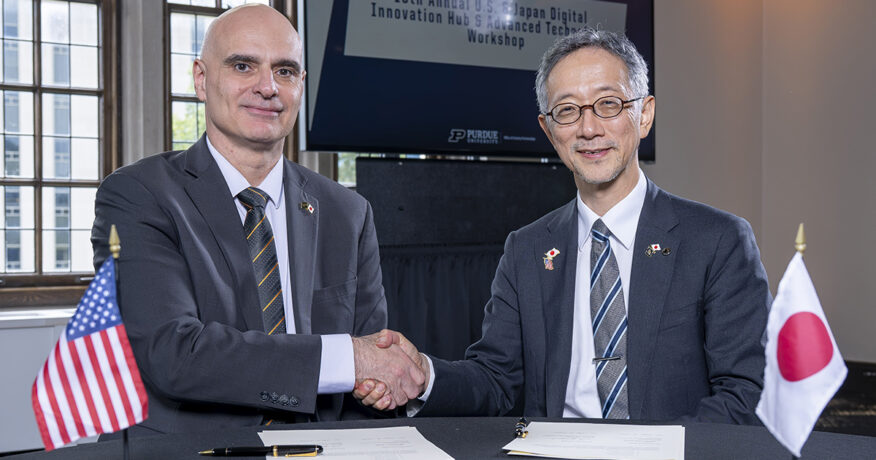
Dimitrios Peroulis, Purdue’s senior vice president for partnerships and online, left, and Naoyuki Maekawa, director and general of the Innovation Department at the Japan External Trade Organization, shook hands after a memorandum of understanding was signed to strengthen innovation collaboration between Japan and the U.S. in fields including semiconductors, quantum technologies, artificial intelligence, advanced manufacturing and life sciences. (Purdue University photo)
WEST LAFAYETTE, Ind. — Purdue University continues to catalyze its international innovation and collaboration network by signing a memorandum of understanding (MOU) with the Japan External Trade Organization (JETRO) and a letter of intent (LOI) with Tohoku University to accelerate research, workforce development and industry in critical technologies. The MOU was signed by Purdue President Mitch Daniels and JETRO Chairman and CEO Norihiko Ishiguro.
Announced during the 10th annual U.S. and Japan Digital Innovation Hub and Advanced Technology Workshop at Purdue, the dual agreements represent a major milestone in global collaboration.
The nonbinding MOU with JETRO — a government-related organization that facilitates trade and investment — will combine Purdue’s world-class research and technology commercialization capabilities with JETRO’s extensive networks in the U.S. and Japan.
Simultaneously, the LOI with Tohoku University, a top-tier research institution in Japan, will expand on three decades of cooperative academic and scientific engagement.
“The agreements pave the way for real-world business integration, student and researcher talent exchanges, and collaborative solutions to urgent global technology needs,” said Dimitrios Peroulis, Purdue’s senior vice president for partnerships and online and a Reilly Professor of Electrical and Computer Engineering. “Together, the partnerships position Purdue and its like-minded Japanese counterparts at the forefront of global tech diplomacy, particularly in crucial fields like energy, artificial intelligence, semiconductors and quantum technology.”
The U.S.-Japan relationship is built not only on shared interests, but also on shared values, mutual trust, and a long-standing commitment to scientific and technological progress, Peroulis noted. As part of Purdue’s relationship with Japan, the Office of Industry Partnerships has held an annual workshop bringing together universities, research institutions and companies from both countries to strengthen collaboration in research and workforce development across critical technologies, including AI, semiconductors, advanced materials and manufacturing, space, and quantum technology.
The new JETRO alliance will help businesses, startups and researchers navigate the U.S. and Japanese markets, driving economic and tech growth. The framework includes collaboration with Purdue Research Foundation’s innovation, incubation, technology transfer and startup support programs.
The Tohoku agreement paves the way for expanded joint research, student and scholar exchanges, and cooperative training, building on an existing synergy in advanced fields like hydrogen energy and semiconductors. That joint effort is already evident through the more recent ASPIRE-Hydrogen project and the UPWARDS Network that Purdue established in 2023 with several Japanese technology companies and universities, including Tohoku, to advance workforce development and R&D in semiconductors.
The academic partners will work together to discover and develop new materials that could make energy technologies, including hydrogen fuel cells and water electrolysis, more efficient, durable and practical. Purdue researchers will bring strengths in AI-driven materials discovery, first-principles modeling and device-level translation, while Tohoku researchers will contribute deep expertise in fundamental interface science and electrochemistry. Together, the teams aim to bridge atomic-scale understanding and real-world energy applications.
“Our next step is to establish a Purdue-Tohoku Joint Institute as a platform for genuine collaboration and then compete together for major joint U.S.-Japan projects, including opportunities under the Genesis Mission,” said Zhenhua Zeng, assistant research professor of chemistry and chemical engineering who leads the Purdue-Tohoku partnership in hydrogen energy. “By working with partners across the U.S. and Japan, we hope to make a giant leap in energy research and AI for science, while building a strategic partnership with Tohoku University and broader Japanese research institutions that can help advance the U.S.-Japan partnership in science and technology.”
About Purdue University
Purdue University is a research institution ranked among the top 10 public universities in the United States. More than 111,000 students study at Purdue across multiple campuses, including more than 57,000 at our main campus locations in West Lafayette and Indianapolis. As a land-grant university committed to affordability and accessibility, Purdue’s main campus has frozen tuition 14 years in a row, enabling more students than ever to graduate debt-free.
Media contact: Wes Mills, wemills@purdue.edu
More Purdue News

Senior international officer Heidi Arola explains new federal immigration rules
September 16, 2026

New book out now: ‘Impatience Is a Virtue’ by President Daniels
September 15, 2026

Boilermaker Fashion Showcase to bring exclusive gear, fan culture to Ross-Ade Stadium
September 15, 2026

Purdue value proposition continues to drive strong demand, undergrad enrollment increases
September 14, 2026