Purdue researchers work to accelerate cancer drug discovery with next-gen tech platform
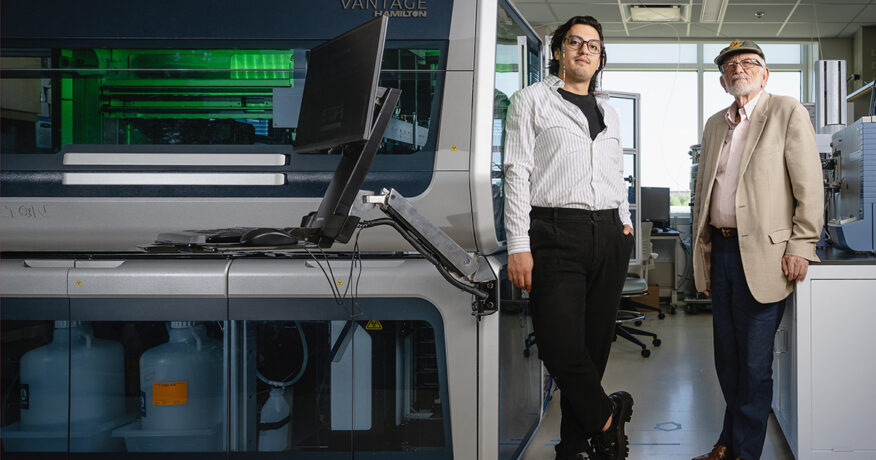
Purdue researchers Nicolás Morato and R. Graham Cooks stand with their state-of-the-art mass spectrometry platform that enables scientists to generate, analyze and test potential cancer therapies within a single integrated workflow, reducing early-stage drug discovery timelines from weeks to hours. (Purdue University photo/Charles Jischke)
WEST LAFAYETTE, Ind. — Researchers at the Purdue Institute for Cancer Research (PICR) have developed a next-generation technology platform designed to dramatically accelerate one of the slowest and most challenging stages of cancer drug discovery: identifying promising compounds that could eventually become new therapies.
The automated, ultrahigh-throughput platform combines chemical synthesis, biological testing and mass spectrometry into a single integrated workflow, allowing researchers to generate, evaluate and refine potential drug candidates within the same system. The research, recently published in the Proceedings of the National Academy of Sciences, represents more than a decade of development at Purdue and could help researchers move more quickly against difficult cancer targets.
“Drug discovery is a fight against probability,” said Nicolás Morato, research assistant professor at the PICR and the study’s lead author. “You’re searching through enormous biological space and even larger chemical space trying to find the right molecule for the right target. If you can’t make compounds fast enough and test them fast enough, it becomes a battle you’re going to lose.”
The platform is built around desorption electrospray ionization mass spectrometry, or DESI-MS, a technology pioneered at Purdue that enables researchers to rapidly analyze and test compounds with extremely small sample volumes and highly automated workflows.
Traditionally, early-stage drug discovery involves disconnected steps handled by separate teams. Chemists synthesize compounds, biologists test them against disease targets, and researchers spend significant time purifying and analyzing results before repeating the cycle.
Morato said chemistry has historically lagged behind the automation already common in biology.
“If you walk through a chemistry building late at night, the lights that are still on are probably organic synthesis labs,” Morato said. “You still see flasks on heating plates waiting overnight for reactions. Meanwhile, biology has evolved into highly automated, instrumentation-driven science. There’s been a disconnect between those worlds.”
The Purdue system aims to collapse those traditionally separate stages into a single integrated workflow to rapidly identify promising drug candidates.
Many newly identified cancer targets emerging from modern genomics, artificial intelligence and computational research still lack effective drugs and therapies, said Purdue’s Andrew Mesecar, the Robert Wallace Miller Director of the Purdue Institute for Cancer Research, the Walther Professor in Cancer Structural Biology and Distinguished Professor of Biochemistry.
“The new DESI-MS platform enables researchers to rapidly screen tens of thousands of molecules against newly identified cancer targets to identify promising therapeutic candidates,” Mesecar said. “Every year we eliminate from the drug development process means we will get new drugs to patients faster and extend their lives.”
The technology has already played a role in ongoing cancer-related research at Purdue. Morato described one project involving a cancer-associated enzyme target in which traditional approaches had led researchers down an unproductive path for years before the DESI-MS platform rapidly revealed that a heavily studied compound was not actually interacting with the target as expected.
“It was difficult because people had invested years of work into it,” Morato said. “But the platform immediately showed us the compound wasn’t doing what we thought it was doing. That allowed the project to change direction much faster instead of continuing to lose time.”
Researchers then used the platform to rescreen and identify stronger candidate compounds against the same target.
The work also became personal for Morato during the platform’s development. Around the time the project shifted more directly toward translational drug discovery, his grandfather was diagnosed with prostate cancer.
“We weren’t just developing technology for the sake of developing technology anymore. We were building something that could hopefully help move treatments to patients faster,” Morato said.
The system can perform several stages of early drug discovery at speeds that would traditionally require days or weeks of laboratory work. In one proof-of-concept workflow described in the paper, researchers completed an integrated discovery cycle in approximately four hours.
For Purdue chemist R. Graham Cooks, whose laboratory invented DESI nearly two decades ago, the platform reflects the latest stage in a long evolution of mass spectrometry technologies increasingly intertwined with medicine and drug discovery.
“Mass spectrometry is now a very important part of drug discovery,” said Cooks, a member of the PICR and the Henry Bohn Hass Distinguished Professor of Chemistry in the James Tarpo Jr. and Margaret Tarpo Department of Chemistry in Purdue’s College of Science. “Every large pharmaceutical company now has hundreds of scientists whose prime instrumentation is a mass spectrometer.”
Cooks said one of the greatest remaining obstacles in drug discovery is low speed.
“The Achilles’ heel of drug discovery is its low speed,” Cooks said. “This platform increases the speed of several distinct aspects of drug discovery.”
Cooks said the technology accelerates the screening of chemical reactions, automatically analyzes reaction products through online mass spectrometry, and allows biological testing to occur more rapidly through automation and so-called “direct-to-biology” testing that avoids lengthy purification steps.
Beyond drug development, Cooks said advanced mass spectrometry technologies are also increasingly important in cancer diagnosis and surgical decision-making. His group has spent years studying the use of mass spectrometry for identifying brain tumors and tumor margins during surgery.
“Increased speed of diagnosis is also highly desirable,” Cooks said. “Intraoperative studies are promising, with metabolite profiles providing actionable information.”
Morato said the broader vision behind the platform is not simply faster chemistry, but a more integrated and iterative approach to discovery — one that becomes increasingly important as artificial intelligence tools generate larger numbers of possible drug candidates.
“AI is only as good as the data you feed it,” Morato said. “What this platform allows us to do is generate huge volumes of high-quality experimental data very quickly. That creates the possibility for faster cycles of prediction, testing and optimization.”
By enabling rapid, large-scale generation of experimental data, the platform could help support emerging AI-driven approaches to drug discovery.
The project grew out of support from the National Center for Advancing Translational Sciences through its ASPIRE (A Specialized Platform for Innovative Research Exploration) cooperative research program. The goal of ASPIRE is to develop cutting-edge advancements in automation technology and data generation and analysis tools to rapidly create and map new chemical space against druggable biological space. The system developed by the Cooks group is among a suite of tools and technologies developed through the ASPIRE program to address a translational gap in preclinical drug development by greatly accelerating the chemical synthesis to biological testing cycle.
This technology was disclosed to the Purdue Innovates Office of Technology Commercialization, which applied for and received several patents through the U.S. Patent and Trademark Office.
Morato said the current platform represents roughly 10 years of focused development layered atop decades of foundational Purdue research in mass spectrometry.
“It really took a village to build this,” Morato said. “This was academic researchers, federal researchers, industry collaborators, engineers, biologists and chemists all working together toward the same goal.”
Researchers hope the technology will continue moving beyond Purdue into broader cancer and drug discovery applications.
“As tool developers, you want people to actually use what you build,” Morato said. “What excites me most now is seeing this technology begin to help researchers working on meaningful disease and discovery challenges.”
The team’s research is part of Purdue’s One Health initiative, which brings together research on human, plant and animal health. It supports the initiative’s focus on advanced chemistry, where Purdue faculty study complex chemical systems and develop new techniques and applications.
About Purdue University
Purdue University is a public research university leading with excellence at scale. Ranked among top 10 public universities in the United States, Purdue discovers, disseminates and deploys knowledge with a quality and at a scale second to none. More than 106,000 students study at Purdue across multiple campuses, locations and modalities, including more than 57,000 at our main campus locations in West Lafayette and Indianapolis. Committed to affordability and accessibility, Purdue’s main campus has frozen tuition 14 years in a row. See how Purdue never stops in the persistent pursuit of the next giant leap — including its integrated, comprehensive Indianapolis urban expansion; the Mitch Daniels School of Business; Purdue Computes; and the One Health initiative — at https://www.purdue.edu/president/strategic-initiatives.
Paper
Early-stage drug discovery in a new-generation ultrahigh-throughput mass spectrometry platform
Proceedings of the National Academy of Sciences
DOI: https://doi.org/10.1073/pnas.253655212
Media contact: Lindsey Macdonald, macdonl@purdue.edu
Research News

Purdue wearable AI device aims to improve epinephrine injections to treat anaphylaxis
October 14, 2026
‘Movies’ of interaction between light and matter help advance quantum tech
October 6, 2026
Purdue expands partnership with Rittal, Eplan with launch of engineering technology labs
September 16, 2026

Provost announces leadership appointments, promotions
September 14, 2026