Purdue-affiliated startup launching educational D-Day simulation
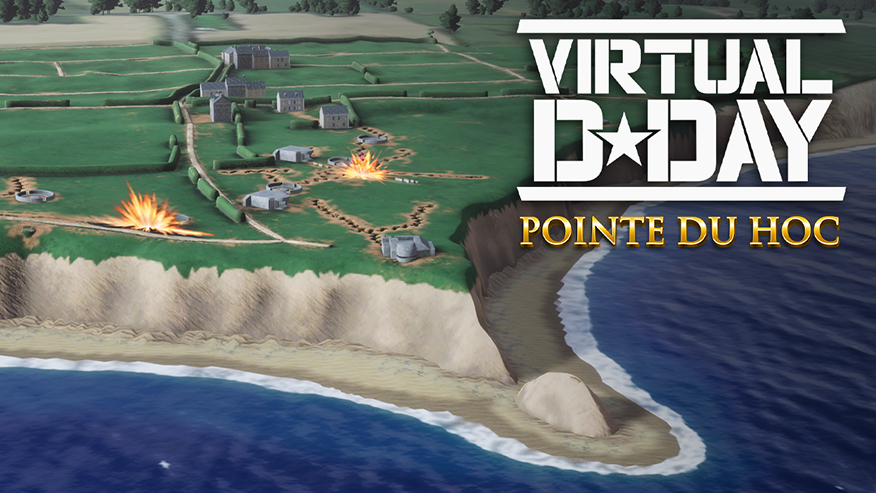
Virtual D-Day is a simulation of the environment and operations carried out on the morning of World War II’s D-Day. The first installment, which will be released on the online gaming platform Steam, reconstructs the seizure of Pointe du Hoc. (Purdue University photo)
WEST LAFAYETTE, Ind. — A startup founded by Purdue University faculty and alumni is releasing a virtual simulation of D-Day operations through the online gaming platform Steam. The launch and demonstration of this learning tool, called Virtual D-Day, will take place Tuesday (June 2) at the Purdue@DC offices.
Virtual D-Day, developed by FORCES Inc., is an immersive simulation of a historic military event. FORCES Inc. is a Purdue-affiliated startup that supports the use of social scientific research to shape strategy and security for global military, political and organizational decision-making. The historically grounded experience of Virtual D-Day is designed for military and civilian learners to study, visualize and explore the environment and conditions during D-Day, an invasion conducted by the Allied nations in World War II along a stretch of beaches in Normandy, France, on June 6, 1944.
Sorin Adam Matei, assistant vice president for Purdue partnerships, professor in the Brian Lamb School of Communication and president of FORCES Inc., conceived the Virtual D-Day project and assembled a team of Purdue faculty and students to build Virtual D-Day as a learning experiment accessible to a range of audiences.
“We’re releasing more than an engaging story; we’re rethinking how our students learn,” Matei said. “This tool demonstrates Purdue’s ability to create value for both academic and marketplace audiences, showing that research products developed in the lab — including in the humanities and social sciences — can be offered to online learners and the broader public as intellectually engaging and entertaining products.”
The simulation reconstructs the terrain, infrastructure, fleet, and specific units and actions from the morning of D-Day.
Released as a guided, narrated experience, including a fully interactive exploration mode, Virtual D-Day will roll out in installments beginning with the seizure of Pointe du Hoc, an Omaha Beach cliff containing German bunkers. The simulation places learners in the middle of the event, focusing on the actions of the U.S. Rangers present that day.
It will then expand to cover additional Omaha Beach sectors, the 101st Airborne Division airdrop near Sainte-Mère-Église and the British glider capture of Pegasus Bridge.
Matthew Konkoly, co-founder of FORCES Inc. and chief software architect for Virtual D-Day, helped to develop the program while earning degrees in computer science and classical studies at Purdue. Konkoly, who is now CEO of Darkmatter Games, said that attention to detail was crucial to their development process.
“We re-created every trench, bunker, weapon installation and landing craft, along with the troop movements,” Konkoly said. “We also represented both German and American losses over the course of the battle, interpolated in real time.”
Virtual D-Day will be integrated into Purdue’s online strategic defense programs, including the Master of Science in strategy in security and defense technologies, which Matei created and directs. It will be embedded in future versions of Technology, War & Strategy, a core course that examines how technologies shape strategy across centuries.
Robert Kirchubel, FORCES Inc. co-founder and instructor for this course, said the goal of the tool in this context is to provide a defense-focused view of strategic technologies in action.
“By placing students inside a historically grounded, technology-driven operational environment, Virtual D-Day allows them to see how strategic decisions emerge,” Kirchubel said. “We spent a significant amount of time on historical accuracy so that learners are able to engage with a credible representation of how strategic technologies functioned in combat.”
The development team for the learning tool also includes the following:
- Jonathan Poggie, professor in the School of Aeronautics and Astronautics, who has helped to develop a simulation engine called Battle Flow that will be incorporated into future releases. In this engine, an AI guide serves as a virtual instructor who provides context and asks questions that drive learning.
- George Takahashi, principal visualization scientist at Purdue’s Envision Center, a division of the Rosen Center for Advanced Computing that builds virtual reality learning and research products, including the Sainte-Mère-Église simulation.
- Ben Baeyens, freelance software developer, who helped to develop the specialized guided camera system for the tool.
The launch and demonstration of Virtual D-Day is part of Purdue’s America250 celebrations, commemorating the 250th anniversary of the signing of the Declaration of Independence. Throughout the day on June 2, the Purdue@DC offices will also host a technology open house featuring additional Purdue defense-learning products, including military data science projects on other World War II campaigns.
The technology underlying Virtual D-Day has been disclosed to the Purdue Innovates Office of Technology Commercialization, which manages the associated intellectual property rights. Virtual D-Day is also part of Purdue Computes, a strategic initiative to advance Purdue’s research and educational excellence in computing.
About Purdue University
Purdue University is a public research university leading with excellence at scale. Ranked among top 10 public universities in the United States, Purdue discovers, disseminates and deploys knowledge with a quality and at a scale second to none. More than 106,000 students study at Purdue across multiple campuses, locations and modalities, including more than 57,000 at our main campus locations in West Lafayette and Indianapolis. Committed to affordability and accessibility, Purdue’s main campus has frozen tuition 14 years in a row. See how Purdue never stops in the persistent pursuit of the next giant leap — including its integrated, comprehensive Indianapolis urban expansion; the Mitch Daniels School of Business; Purdue Computes; and the One Health initiative — at https://www.purdue.edu/president/strategic-initiatives.
Purdue Computes News
Purdue, GCCS partner to scale the future of silicon carbide
May 28, 2026

Purdue launches comprehensive quantum degrees program
May 14, 2026

SCALE expands its national impact, becomes Purdue’s largest federally funded research effort
May 6, 2026

Purdue drone initiatives focus on the future of autonomy in the sky
May 4, 2026