Purdue drone initiatives focus on the future of autonomy in the sky
Ongoing research goals include multi-unmanned aircraft operation, improved air traffic control systems
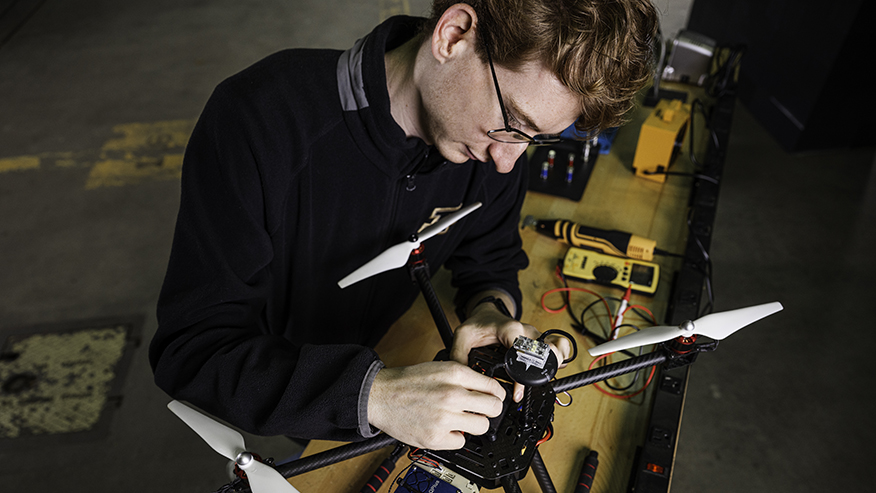
A Purdue University student works with the wiring of a quadcopter drone inside the Purdue UAS Research and Test Facility. The test area is one of several initiatives highlighting Purdue’s expansive work with drones. (Purdue University photo/Becky Robiños)
WEST LAFAYETTE, Ind. — Purdue University’s cutting-edge initiatives and research with drones and unmanned aerial vehicles (UAVs) are combining with the latest artificial intelligence and autonomy to quickly turn ideas and imagination into attainable reality.
Drones have moved far beyond simple radio-controlled quadcopters, shrinking to become the small, fast-moving cameras following Olympic bobsledders at up to 80 mph and expanding to Cessna-size UAVs expected to transform frontiers in fields ranging from transportation, agriculture and safety.
Purdue is a big part of the push leading the way for a future with drones.
“We’ve got it all covered here,” said William Crossley, the Uhrig and Vournas Head of Aeronautics and Astronautics. “Purdue is touching all areas: From designing the vehicles to building the algorithms that will fly them autonomously. Our research is working on precision positioning and tracking all the way down to even preparing current pilots to operate UAVs and drones.”
Purdue was among the lead partners in the state of Indiana’s successful bid to become one of the Federal Aviation Administration’s newest unmanned aircraft systems (UAS) test sites. The site was announced in January.
Drones and physical AI are a core component of Purdue Computes, a comprehensive university initiative that emphasizes four key pillars of Purdue’s extensive technological and computational environment: computing departments, physical AI, quantum science and semiconductor innovation.
AI, the next frontier
January’s test site announcement was the latest chapter in Purdue’s push for drone research and advancement.
The Center on AI for Digital, Autonomous and Augmented Aviation (AIDA3) is building research infrastructure for a new field of science: safe and trustworthy AI for aerial autonomy, also called AIrTonomy. The center, launched through a partnership with Windracers, is pioneering efforts to apply AI and machine learning. AIDA3 wants to ensure the safety and efficiency of autonomous air systems as private and public enterprises race to develop new UAV technologies.
Damon Lercel, an assistant professor in the Purdue Polytechnic Institute’s School of Aviation and Transportation Technology (SATT), is among the core faculty members of AIDA3.
“We’re determining how artificial intelligence, machine learning and additional technologies can assist with managing the entire ecosystem of drones and UAVs,” Lercel said. “Our research continues to explore how these next-generation aviation technologies can either improve safety, improve efficiency or improve public good.”
AIDA3 faculty conduct their research under five pillars:
- Human autonomy teaming
- Onboard intelligence and control
- Supply-chain and airspace intelligence
- Remote sensing
- Cybersecurity
Lercel, a 30-year aviation veteran, is involved in research that meshes the nation’s current air traffic control system with the influx of drones expected to be flying in the coming years. He noted there are close to a million drones already registered in the United States, compared with about 225,000 traditional aircraft.
“Our current air traffic control system model just isn’t going to support the enormous number of autonomous vehicles that are going to eventually be operating in our airspace,” he said.
From the sky to the control room
On the ground, AIDA3 research is working to flip the current ratio of a few people operating one UAV. Inseok Hwang, interim director of AIDA3, said the goal is to utilize AI so that one operator can simultaneously coordinate multiple UAVs.
Students already are working with UAS operation at the Purdue UAS Research and Test Facility (PURT), located on the grounds of Purdue University Airport.

The 600,000-cubic-foot former aircraft hangar was transformed into the world’s largest indoor motion-capture facility with technology that is 100 times more accurate than GPS. The motion-capture system offers unmatched precision to develop the control systems essential for a future of mobility in the skies. The huge interior volume allows students to fly many types of drones, including fixed-wing craft, in a space protected from weather.
“We’re trying to look at how you ensure safe, reliable operations of unmanned vehicles using some artificial intelligence or other kinds of autonomy,” Crossley said. “PURT allows us to build that up in a way that we’re testing everything safely and in a controlled environment so that we know we’ve got a handle on how these aircraft are going to operate.”
On the pilot front, Purdue Polytechnic Institute’s SATT announced in February that the Federal Aviation Administration selected its unmanned aerial systems program for the Unmanned Aircraft Systems-Collegiate Training Initiative. Purdue Polytechnic offers a comprehensive Bachelor of Science in unmanned aerial systems and is charting the path toward advanced air mobility technologies and large-scale, autonomous mission applications. The program aims to provide students with an impactful learning experience focused on next-generation autonomous aviation.
Purdue University also announced an online graduate certificate in advanced unmanned aerial systems to meet the demand for UAV operators and managers. The program provides a foundational understanding of UAS laws and how to operate UAVs safely and ethically within modern airspaces. The graduate certificate will prepare learners to earn the Federal Aviation Administration’s remote pilot certification.
About Purdue University
Purdue University is a public research university leading with excellence at scale. Ranked among top 10 public universities in the United States, Purdue discovers, disseminates and deploys knowledge with a quality and at a scale second to none. More than 106,000 students study at Purdue across multiple campuses, locations and modalities, including more than 57,000 at our main campus locations in West Lafayette and Indianapolis. Committed to affordability and accessibility, Purdue’s main campus has frozen tuition 14 years in a row. See how Purdue never stops in the persistent pursuit of the next giant leap — including its integrated, comprehensive Indianapolis urban expansion; the Mitch Daniels School of Business; Purdue Computes; and the One Health initiative — at https://www.purdue.edu/president/strategic-initiatives.
Media contact: Brian Huchel, bhuchel@purdue.edu
Note to journalists:
A video link is available on Google Drive with b-roll and Damon Lercel sound bites.
Purdue Computes News
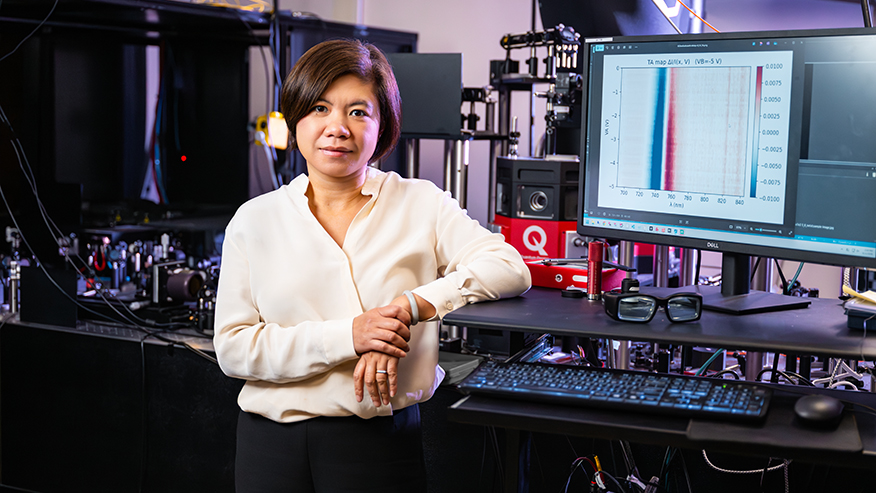
‘Movies’ of interaction between light and matter help advance quantum tech
October 6, 2026

Purdue and University of Illinois, 2 engineering powerhouses, team up to strengthen semiconductor workforce in U.S.
September 22, 2026
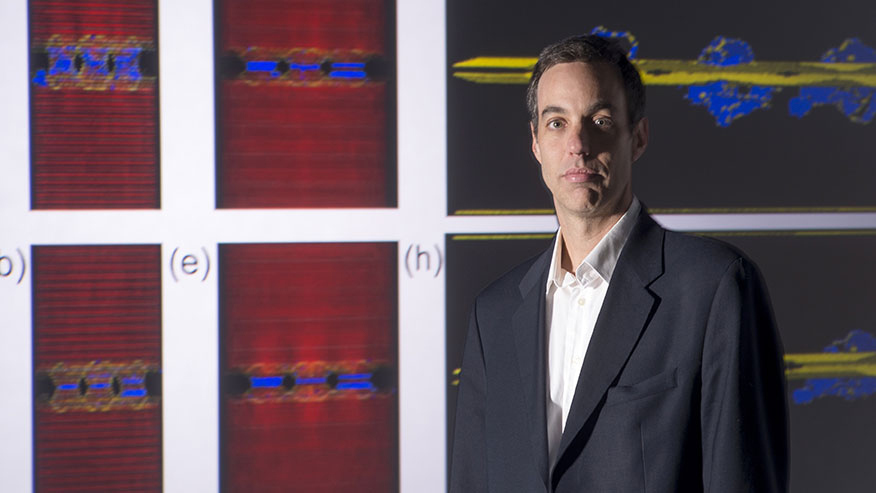
Purdue secures $19M from NSF to develop AI-driven programmable labs for semiconductors, advanced materials
August 5, 2026

Purdue expands semiconductor professional education portfolio to advance global workforce development
July 8, 2026