Faster chemical reactions made possible by tiny droplets
New method allows mass spectrometry to perform better using fewer resources
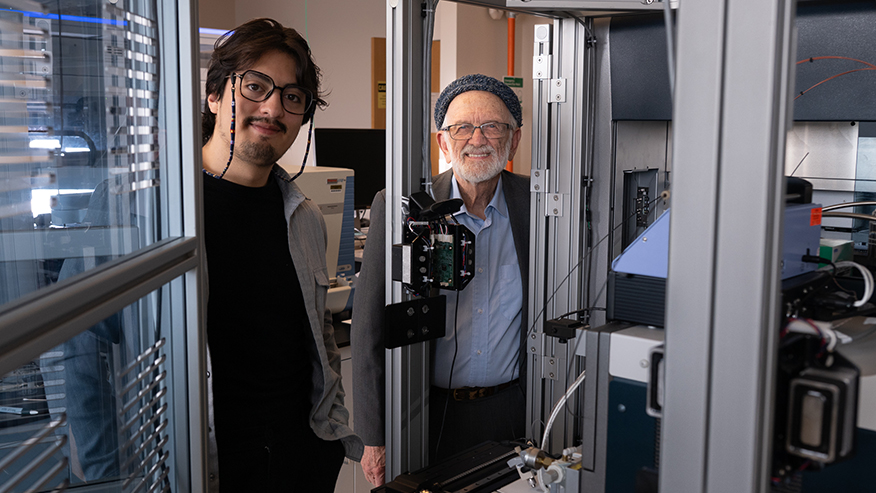
Analytical chemistry experts Graham Cooks, right, and Nicolás Morato use Cooks’ state-of-the-art mass spectrometry system to speed up chemical reactions for faster drug development. (Purdue University photo/John Underwood)
WEST LAFAYETTE, Ind. — Chemical reactions are the backbone to nearly all biological processes, including those used to make new medicines. However, these reactions can often take considerable time and require harsh conditions or materials — potentially inhibiting the timely development of life-changing drugs.
Purdue University researcher Graham Cooks and his team at Aston Labs have developed a method that uses tiny, fast-moving droplets to speed up chemical reactions without the use of high temperatures or catalysts — substances that are typically needed to accelerate chemical reactions.
“Our lab has cultivated the ability to synthesize new compounds that can be used for a variety of purposes,” said Cooks, the Henry Bohn Hass Distinguished Professor of Chemistry in the James Tarpo Jr. and Margaret Tarpo Department of Chemistry in Purdue’s College of Science and a member of the Purdue Institute for Cancer Research (PICR). “Mass spectrometry, the technique that we use is conventionally viewed as a purely analytical tool, but we have been able to use it to not only rapidly screen materials but also to perform novel chemical reactions that lend themselves to pharmaceutical and agricultural products.”
The new technique is based on an advanced platform Cooks developed for mass spectrometry, which is used to identify compounds based on the mass and charge of their molecules. In a traditional mass spectrometer, charged particles or ions are generated from a sample of the material — a process called ionization — which are then entered into the instrument. Once inside, an electric or magnetic field then separates these ions based on the ratio between their mass and charge. This analysis results in a type of graph called a mass spectrum, which helps identify all the different types of molecules within the sample material.
Mass spectrometry is used for a variety of purposes, such as detecting biomarkers or drugs in blood, identifying pollutants in the environment, and detecting chemicals or hazardous materials. However, it is typically slowed down by the time it takes to prepare a sample — which must be cleaned and purified — for analysis.
Faster, better analysis
Cooks has developed a more advanced platform — an automated, high-throughput desorption electrospray ionization (DESI) mass spectrometry system — that is nondestructive and can work with “dirty” materials, meaning samples can be plucked directly from the field and reused for future experiments. The system also uses a robotic arm to transfer samples between its various components, thereby automating the workflow and limiting intervention.

Samples are arranged on a slide, and the DESI’s nozzle sprays them with a solvent containing charged droplets. The impact between the spray and the sample “lifts” component molecules — a process called desorption — and directs them into a tube that then transports the molecules to the mass spectrometer for analysis.
Because no preparation is required, the system can analyze approximately one sample per second. It can also run thousands of experiments rapidly with high-density slides that hold thousands of tiny, precisely placed droplets of materials within a tightly packed grid.
“A traditional mass spectrometry platform can take minutes to analyze just one sample. With our system, we can generate one reaction per second, meaning it’s possible for us to complete around 3,600 experiments per hour,” Cooks said. “When a process, such as drug development, can take up to 10-15 years, anything you can do to speed up that timeline is critical.”
This technology was disclosed to the Purdue Innovates Office of Technology Commercialization, which applied for and received several patents through the U.S. Patent and Trademark Office.
Synthesis on the fly
In addition to its analytical advantages, Cooks’ DESI platform can synthesize compounds. The system is programmed to switch between two modes: analysis and synthesis. The only difference between the modes is the distance between the sample spot and the inlet or entry point of the instrument. For analysis, the inlet is closer to the slide, so the charged droplets have a shorter distance to travel. For synthesis, the inlet is farther from the slide, so the droplets travel a longer distance. With that additional length and time, the droplets act as tiny, ultrafast microreactors.

Nicolás Morato, research assistant professor at PICR and a member of Aston Labs, says this phenomenon occurs because the chemicals come together at the surface of these tiny DESI droplets. This is a unique environment where compounds can react more quickly as the droplets fly through the air before entering the mass spectrometer.
“These reactions proceed up to a million times faster than those in a bulk solution,” Morato said. “We are using this capability to rapidly synthesize libraries of chemicals that can be used to develop a variety of drugs, such as cancer treatments and antibiotics, as well as agricultural materials that protect crops. The same DESI system can also be used to test these chemicals’ activities right after creating them. We can generate thousands of anticancer drug candidates and test how well they work against a cancer-related enzyme, or even directly in cancer cells, all using the same technology.”
In a study published in the Journal of the American Chemical Society, Cooks and his team used the DESI system to synthesize nitrogen-based heterocycles, compounds key to developing certain types of drugs and industrial products. Creating these compounds can be time-consuming and expensive because they typically require high temperatures, long incubation times and catalysts. However, the DESI system enables the same chemical transformation to occur under ambient conditions and without additional materials.
“Our system requires fewer resources to do the same amount of work,” Morato said. “Using microdroplet chemistry, we’ve eliminated the need for heat, catalysts, and other harsh conditions or materials.”
Cooks’ research is part of Purdue’s One Health Initiative, which brings together research on human, plant and animal health. It supports the initiative’s focus on advanced chemistry, where Purdue faculty study complex chemical systems and develop new techniques and applications.
This work was funded by the National Institute of Health’s National Center for Advancing Translational Sciences (NCATS) as part of the ASPIRE (A Specialized Platform for Innovative Research Exploration) cooperative research program. The goal of ASPIRE is to develop cutting-edge advancements in automation technology and data generation and analysis tools to rapidly create and map new chemical space against druggable biological space. The system developed by the Cooks group is amongst a suite of tools and technologies developed through the ASPIRE program to address a translational gap in preclinical drug development by greatly accelerating the chemical synthesis to biological testing cycle.
About Purdue University
Purdue University is a public research university leading with excellence at scale. Ranked among top 10 public universities in the United States, Purdue discovers, disseminates and deploys knowledge with a quality and at a scale second to none. More than 106,000 students study at Purdue across multiple campuses, locations and modalities, including more than 57,000 at our main campus locations in West Lafayette and Indianapolis. Committed to affordability and accessibility, Purdue’s main campus has frozen tuition 14 years in a row. See how Purdue never stops in the persistent pursuit of the next giant leap — including its integrated, comprehensive Indianapolis urban expansion; the Mitch Daniels School of Business; Purdue Computes; and the One Health initiative — at https://www.purdue.edu/president/strategic-initiatives.
Paper
Accelerated and green synthesis of N,S- and N,O-heterocycles in microdroplets
Journal of the American Chemical Society (JACS)
DOI: https://doi.org/10.1021/jacs.5c12522
Media contact: Lindsey Macdonald, macdonl@purdue.edu
One Health News
Purdue researchers study cancer in canines to help advance treatments for humans
August 27, 2026
Purdue to expand research footprint in Indianapolis with new facility
July 20, 2026
Purdue-backed consortium wins National Science Foundation’s Regional Innovation Engines competition
July 15, 2026

Purdue Institute for Cancer Research secures $9.4M in renewal of its National Cancer Institute Cancer Center Support Grant
June 11, 2026