New chemistry helps make the medicines people need

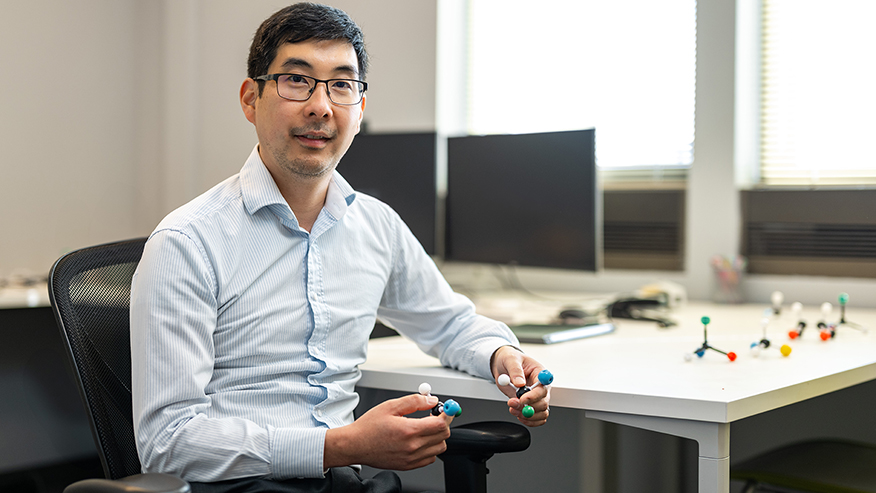
Catalysis expert Christopher Uyeda designs reactions and catalysts for manufacturing pharmaceuticals, materials for energy applications and agrochemicals. (Purdue University photo/Kelsey Lefever)
WEST LAFAYETTE, Ind. — Imagine that a new lifesaving medication is invented, but its unusual structure makes it difficult to manufacture. The drug might turn out to be prohibitively expensive or supply might be scarce, and so it might not be made at all. At Purdue University, chemist Christopher Uyeda is working to head off this problem. In at least one instance, he already has.
Uyeda, the Herbert C. Brown Chair in Chemistry in the College of Science, is an expert in catalysts, substances that accelerate chemical reactions. He aims to use substances that are safe and readily available in his development of chemical reactions for manufacturing pharmaceuticals, materials for energy applications and agrochemicals.
“In my lab, we think about what structures are very important in organic chemistry but are currently very difficult to make, and then how can we design a catalyst to accomplish that,” Uyeda said.
His work builds on a long-standing strength in organic chemistry at Purdue, including Nobel Prize-winning work on designing new reactions. Uyeda’s work is part of Purdue’s One Health initiative, which brings together research on human, animal and plant health. His research supports the initiative’s focus on advanced chemistry, where Purdue faculty study complex chemical systems and develop new techniques and applications.
Uyeda’s lab specializes in two areas of research: designing small synthetic catalysts that can tackle tough reactions without compromising on precision, and designing new reactions to manufacture cyclopropanes — a triangle of three carbon atoms, often found in drug compounds.
A reaction he designed is now used as part of Pfizer’s process for manufacturing Paxlovid, the first-in-line treatment for COVID-19 initially authorized for use by the Food and Drug Administration in December 2021. The molecule requires a cyclopropane that is difficult to synthesize and not easily obtained from natural sources.
Fortunately, Uyeda’s lab developed a reaction, years before COVID, that uses a cobalt catalyst to make the exact type of cyclopropane needed from safe and commonly available materials, facilitating a cost-effective manufacturing process.
Uyeda produces cyclopropanes by combining one point in the carbon triangle — a single-carbon component called a carbene — with an existing two-carbon component. To do so, he must first generate the carbene, which is a highly reactive molecule. The carbene used in Paxlovid, for example, sprouts two methyl groups from its carbon, which also bonds to the two-carbon component. Chemists typically rely on high-energy reagents to generate carbenes, a process that poses safety risks. Uyeda is developing reactions that use new catalysts to generate carbenes from stable molecules.
One of his research goals is to develop what he calls a universal set of coupling reactions that will allow him to attach any type of carbene to a molecule as needed.
“Our approach allows industries to think about this type of chemistry without the safety concerns associated with high-energy reagents,” Uyeda said. Additionally, the new catalysts he uses take advantage of common metals, like cobalt and nickel, which are abundant, readily accessible and inexpensive.
A really good catalyst drives a lot of the reaction that’s desired and nothing else, traits known as activity and selectivity. Uyeda works with homogeneous catalysts: small, synthetic molecules prized for their selectivity. These types of catalysts can lack raw muscle when contrasted with another type, heterogeneous catalysts — often used in industrial processes — that rely on large metal particles to drive a reaction. Like sticking molecules to a piece of packing tape, the broad surface area of heterogeneous catalysts catches the molecule at multiple points, stabilizing it during tough reactions. The downside is that the broad surface area can also breed unwanted reactions. Uyeda’s work is incorporating the strength of heterogeneous catalysts into the world of homogeneous catalysts.
“We design systems that allow you to incorporate more than one metal into a homogeneous catalyst. That gives us much more control over the active site of the catalyst — we know exactly what reaction it’s going to do. And that’s something that people haven’t been that successful at doing before,” Uyeda said.
Uyeda’s research on carbene transfer reactions is funded by the National Institutes of Health, and his work on stronger catalysts is funded by the National Science Foundation and U.S. Department of Energy, Office of Science.
About Purdue University
Purdue University is a public research university leading with excellence at scale. Ranked among top 10 public universities in the United States, Purdue discovers, disseminates and deploys knowledge with a quality and at a scale second to none. More than 106,000 students study at Purdue across multiple campuses, locations and modalities, including more than 57,000 at our main campus locations in West Lafayette and Indianapolis. Committed to affordability and accessibility, Purdue’s main campus has frozen tuition 14 years in a row. See how Purdue never stops in the persistent pursuit of the next giant leap — including its integrated, comprehensive Indianapolis urban expansion; the Mitch Daniels School of Business; Purdue Computes; and the One Health initiative — at https://www.purdue.edu/president/strategic-initiatives.
Papers
Cobalt-catalyzed reductive dimethylcyclopropanation of 1,3-dienes
Angewandte Chemie
DOI: https://doi.org/10.1002/anie.201807542
Development of the commercial manufacturing process for nirmatrelvir in 17 months
ACS Central Science
DOI: https://doi.org/10.1021/acscentsci.3c00145
Dinickel active sites supported by redox-active ligands
Accounts of Chemical Research
DOI: https://doi.org/10.1021/acs.accounts.1c00424
Media contact: Trevor Peters, peter237@purdue.edu
One Health News
Purdue-backed consortium wins National Science Foundation’s Regional Innovation Engines competition
July 15, 2026

Purdue Institute for Cancer Research secures $9.4M in renewal of its National Cancer Institute Cancer Center Support Grant
June 11, 2026
Faster chemical reactions made possible by tiny droplets
June 1, 2026
A year of advancing the Lilly-Purdue $250M research partnership to accelerate medicine discovery and manufacturing
May 11, 2026