Exploring the machinery that surrounds DNA to stop cancer
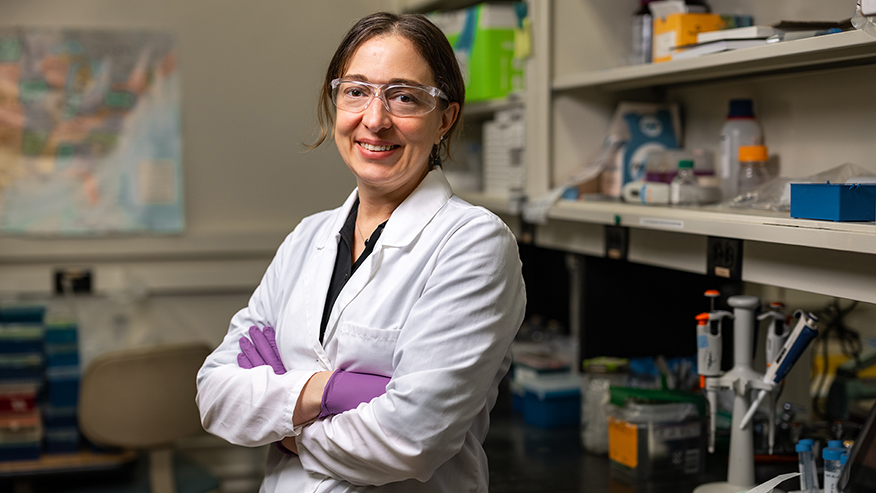
Emily Dykhuizen explores the link between cancer and the machinery that surrounds DNA. (Purdue University photo/Kelsey Lefever)
WEST LAFAYETTE, Ind. — Cancer therapies that work with the immune system are already saving lives, but to develop more immunotherapies, researchers need a better handle on how cancer sidesteps the immune system in the first place.
At the core of cancer’s most pernicious powers — evading the immune system, resisting conventional therapies, spreading through metastasis — are subtle changes to the genetic machinery of cells. Understanding these molecular mechanisms is the domain of Purdue University researcher Emily Dykhuizen.
“Cancer is really a problem in cells becoming a different cell type than they should be,” said Dykhuizen, a professor in the Borch Department of Medicinal Chemistry and Molecular Pharmacology in the College of Pharmacy at Purdue. “They lose their identity and use their own DNA to take on functions of other cell types, harnessing processes that are normal and useful in different situations in our body — like the ability to regenerate, to migrate — but are obviously bad when it comes to cancer.”
Dykhuizen’s work is part of Purdue’s presidential One Health initiative, which involves research at the intersection of human, animal and plant health and well-being.
Every human cell contains a full set of instructions for all the functions in the body. The instructions are written in a chain of DNA that is 2 meters long but must be housed in a nucleus only a few millionths of a meter in diameter. A complex system of control, known as chromatin regulation, organizes the chain so that it fits into the nucleus while still allowing the cell to access and read the genes — sections of DNA that encode instructions for specific proteins — that it requires for proper function.
Dykhuizen is an expert in chromatin regulation, exploring the cellular machinery that controls access to genes and developing molecules that selectively inhibit access as the basis of new cancer therapies. Her research findings include discovering a previously unknown regulator that plays a role in prostate cancer, designing an inhibitor that could wipe out HIV and one that helps researchers understand therapy resistance. Her lab is currently testing inhibitors they designed to control metastasis in breast cancer. Her background in organic chemistry is a unique advantage in a complicated biological field, as she brings a deep understanding of chemical interactions to her work designing effective molecular inhibitors.
The control system is difficult to envision, but one way to make sense of it, Dykhuizen said, is to imagine the cell’s DNA as a vast wardrobe in which the genes represent all the different articles of clothing a person might wear in life — a warehouse of clothing in different sizes and styles with some representing specific roles like a pilot’s uniform, surgeons’ scrubs or a mechanic’s overalls. Throughout the person’s life, only a portion of the outfits will be used, but the wardrobe must remain intact, carefully labeled and organized so that appropriate clothes are hanging accessibly exactly when needed, while others are densely packed into stacks of boxes.
In this analogy, “it’s a whole organizational system that doesn’t just keep the things that I need out and the things that I don’t need packed. Things I might need sooner are also packaged differently than things I will never need versus things I might need, maybe,” said Dykhuizen, a member of the Purdue Institute for Cancer Research. “Everything has to be marked differently depending on those possibilities. And that’s why chromatin is so complicated.”
A cast of proteins collectively known as chromatin regulators organizes this genetic “wardrobe” inside the nucleus, physically coiling and packing the chain of DNA into a compact structure called chromatin. To do this, the DNA is wrapped around histone proteins to form a nucleosome, the basic subunit of chromatin, and the nucleosomes are further folded and coiled into chromatin. Small molecules attached to the histones serve as a code that guides chromatin regulators with some of the molecules signaling for regulators to approach and alter access to the DNA, while others tell the regulator to leave.
Chromatin modifiers can change these molecular modifications during the lifetime of a cell, altering access to specific genes and production of the proteins they encode. And while these so-called epigenetic modifications alter access to the DNA, the DNA itself is not mutated. Nevertheless, when the process goes awry, it can lead to cancer, therapy resistance or metastasis.
“When the chromatin regulators are misregulated, they pull up all this stuff, and now, all these parts of the genomes that before were really shut down, to prevent replication or movement, may be opened and launched,” Dykhuizen said.
Dykhuizen explores the two classes of chromatin regulators most active in accessing genes: BRG1/BRM-associated factor (BAF) complexes, which move nucleosomes to allow or block gene expression; and Polycomb, a class of springy proteins that aid in compacting the nucleosomes. Although simpler organisms may have only a few variations in each class, the human body, with its many cell types and larger genome, produces hundreds of variations of both BAF and Polycomb, each with different combinations of subunits that interact with chromatin in a unique manner. Much of Dykhuizen’s work uses painstaking genetic analysis, biochemistry and spectroscopy to define the variations of BAF and Polycomb that are active in cancer cells and then develop molecules that will selectively inhibit the complexes based on their subunits.
She frequently collaborates with researchers who have noticed an interaction between cells that promotes cancer, and they want to trace it back to its origins in genetic expression.
For example, in an ongoing collaboration with Purdue researcher Michael Wendt, who studies metastasis, experiments showed that breast cancer cells that normally metastasize to lung tissue no longer spread when the gene for a chromatin remodeling protein is silenced. They suspect the change enables an immune response that had somehow been suppressed in the normal cancer cells and want to pin down the epigenetic changes that allow the immune system to find the altered cells.
“All these signals require changes in gene expression, and our work is to figure out how that’s happening,” Dykhuizen said. “We can sort out the chromatin modifiers that respond to the incoming signal and change the marks on the histones and what chromatin regulators that recognize these marks are showing up during these events to facilitate this transition.”
About Purdue University
Purdue University is a public research university leading with excellence at scale. Ranked among top 10 public universities in the United States, Purdue discovers, disseminates and deploys knowledge with a quality and at a scale second to none. More than 106,000 students study at Purdue across multiple campuses, locations and modalities, including more than 57,000 at our main campus locations in West Lafayette and Indianapolis. Committed to affordability and accessibility, Purdue’s main campus has frozen tuition 14 years in a row. See how Purdue never stops in the persistent pursuit of the next giant leap — including its integrated, comprehensive Indianapolis urban expansion; the Mitch Daniels School of Business; Purdue Computes; and the One Health initiative — at https://www.purdue.edu/president/strategic-initiatives.
Papers
Glioma tumor suppressor candidate region gene 1 (GLTSCR1) and its paralog GLTSCR1-like form SWI/SNF chromatin remodeling subcomplexes
Journal of Biological Chemistry
DOI: https://doi.org/10.1074/jbc.RA117.001065
BRD9 is a critical regulator of androgen receptor signaling and prostate cancer progression
Cancer Research
DOI: https://doi.org/10.1158/0008-5472.CAN-20-1417
Small molecule targeting of specific BAF (mSWI/SNF) complexes for HIV latency reversal
Cell Chemical Biology
DOI: https://doi.org/10.1016/j.chembiol.2018.08.004
ARID1A suppresses R-loop-mediated STING-type I interferon pathway activation of anti-tumor immunity
Cell
DOI: https://doi.org/10.1016/j.cell.2024.04.025
Rational design and development of selective BRD7 bromodomain inhibitors and their activity in prostate cancer
Journal of Medicinal Chemistry
DOI: https://doi.org/10.1021/acs.jmedchem.3c00671
Media contact: Trevor Peters, peter237@purdue.edu
One Health News
Canine cancer patients contribute to next-generation minimally invasive cancer therapies for dogs and humans
October 22, 2026
Study details surprising human immune cell link to HIV
October 21, 2026
New molecular diagnostics instruments provide improved accuracy
October 14, 2026

Purdue, Elanco, partners celebrate One Health Research Institute groundbreaking
October 7, 2026