Blueprints for a molecular machine more powerful than CRISPR

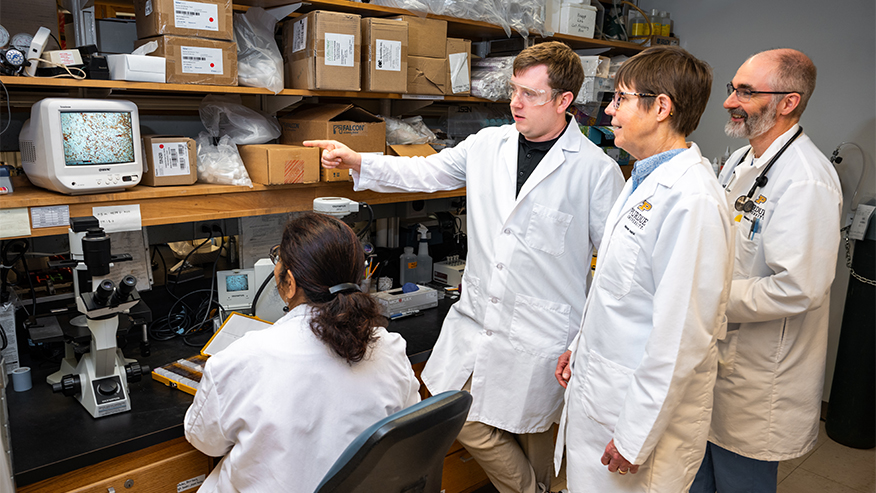
Purdue University researcher Leifu Chang is working to better understand a natural gene-editing tool more powerful than CRISPR. (Purdue University photo/Alisha Willett)
WEST LAFAYETTE, Ind. — More than a decade ago, scientists harnessed a bacterial molecular machine that identifies and cuts specific sections of DNA, revolutionizing the ability to edit genes and accelerating research into treatments for all manner of diseases with a genetic link. But the technology known as CRISPR-Cas9 works by cutting DNA, not moving it. At Purdue University, researchers are investigating a similar molecular machine that moves so-called “jumping genes” into new locations in bacterial DNA, laying the groundwork for a more powerful gene-editing tool.
The team, led by Leifu Chang, a Purdue associate professor of biological sciences, has produced high-resolution structural snapshots of the Tn7-like transpososome, a complex of nucleic acids and proteins that can accurately cut and paste an entire gene from one location to another in the genome of a cell. This structural information is analogous to an exploded parts diagram for an engine, showing all the parts in atomic-level detail and how they work together. In a pair of papers published in the journal Cell in 2023 and 2024, the team captured the structure of all the components needed to understand how the molecular machine recognizes a jumping gene and the location in the genome where it will insert that gene.
“We’ve captured all the components that are really essential in this structure. This is a quite complicated process, requiring recognition of specific DNA in the gene and in the target and, while previous research has shown many partial structures, it’s important to see the whole picture,” said Chang, a member of the Purdue Institute for Cancer Research. “We’re providing a lot of information to understand how that process happens.”
Chang’s research is part of Purdue’s presidential One Health initiative, which involves research at the intersection of human, animal and plant health and well-being.
There are many similarities between the Tn7-like transpososome and the CRISPR system. CRISPR, which evolved as part of a bacterial defense system against known viral invaders, identifies and stores snippets of DNA from invaders between DNA brackets in a pattern called “clustered regularly interspersed short palindromic repeats,” hence CRISPR. Using the stored DNA as a template, the system generates an RNA mirror image of the viral DNA and surveils the cell looking for a match. When a match is made and an invader identified, a protein cuts the DNA of the viruses, blocking replication. The beauty of the system, from the standpoint of researchers, is that it uses RNA — a molecule easily synthesized in a lab — to identify and target DNA. By synthesizing an RNA snippet that searches for its own targets, researchers can use the system to snip DNA with precision.
But while CRISPR is great at what it does in bacteria, Chang said, it’s not a one-stop gene editing tool in human cells. For starters, cutting DNA in humans triggers a DNA repair pathway that could undo the cut or unintentionally introduce a mutation as part of the repair. Also, once the DNA is cut, it might not be repaired in which case the cell would die. Researchers have devised various workarounds, but they aren’t yet efficient and only work in dividing cells, putting repairs to cells that don’t divide, like neurons, out of reach.
By contrast, the transpososome is a complete package that includes the machinery for inserting genes. The transpososome facilitates the movement of transposons, or “jumping genes,” that can be copied and moved to different locations in the genome. Jumping genes make up about half of the genome in animal cells, including in humans, and are believed to increase genetic diversity.
“In general, breaking DNA to achieve genome editing is not ideal,” Chang said. “The transposon system is a more efficient approach because the proteins insert DNA seamlessly, so that avoids the harmful consequence of breaking DNA.”
Scientists who study the Tn7-like transpososome have discovered two pathways that it uses to find its target. The first uses a protein to directly recognize specific DNA sequences. The second is similar to CRISPR-Cas9, in that it uses a snippet of RNA as a guide to find the target. Chang, who is an expert in CRISPR-Cas systems, is interested in understanding how the CRISPR-type pathways work.
The two Cell papers taken together present complete cryo-electron microscopy structures of essential components in atom-by-atom detail. The structures show the point at which DNA attaches to two proteins, which triggers formation of the entire transpososome complex, and initiate transposition. As the 2024 paper states, “The findings provide mechanistic insights into targeted DNA insertion by Tn7-like transposons with implications for improving the precision and efficiency of their genome-editing applications.”
Chang said researchers are already trying to use the Tn7-like transpososome to edit animal cells but, so far, the process isn’t effective. While much work needs to be done to arrive at systems useful in nonbacterial cells, the full structural information he has provided will accelerate that work.
Chang disclosed the research to the Purdue Innovates Office of Technology Commercialization, which vets, protects and licenses intellectual property developed by Purdue inventors.
“Molecular mechanism for Tn7-like transposon recruitment by a type I-B CRISPR effector,” published in Cell in 2023, and “Structure of TnsABCD transpososome reveals mechanisms of targeted DNA transposition,” published in Cell in 2024, were supported by the National Institutes of Health. At Purdue, Chang was joined in the research by Mark Hall, professor and associate head of biochemistry in the College of Agriculture; Thomas Klose, an assistant research scientist in Bindley Bioscience and technical director of the Purdue Cryo-EM Facility; and graduate students Shukun Wang, Romana Siddique and Clinton Gabel.
About Purdue University
Purdue University is a public research university leading with excellence at scale. Ranked among top 10 public universities in the United States, Purdue discovers, disseminates and deploys knowledge with a quality and at a scale second to none. More than 107,000 students study at Purdue across multiple campuses, locations and modalities, including more than 58,000 at our main campus locations in West Lafayette and Indianapolis. Committed to affordability and accessibility, Purdue’s main campus has frozen tuition 14 years in a row. See how Purdue never stops in the persistent pursuit of the next giant leap — including its integrated, comprehensive Indianapolis urban expansion; the Mitch Daniels School of Business; Purdue Computes; and the One Health initiative — at https://www.purdue.edu/president/strategic-initiatives.
Papers
Structure of TnsABCD transpososome reveals mechanisms of targeted DNA transposition
Cell
DOI: 10.1016/j.cell.2024.09.023
Molecular mechanism for Tn7-like transposon recruitment by a type I-B CRISPR effector
Cell
DOI: 10.1016/j.cell.2023.07.010
Media contact: Trevor Peters, peter237@purdue.edu
One Health News
Purdue researchers study cancer in canines to help advance treatments for humans
August 27, 2026

Purdue to expand research footprint in Indianapolis with new facility
July 20, 2026
Purdue-backed consortium wins National Science Foundation’s Regional Innovation Engines competition
July 15, 2026

Purdue Institute for Cancer Research secures $9.4M in renewal of its National Cancer Institute Cancer Center Support Grant
June 11, 2026