October 21, 2019
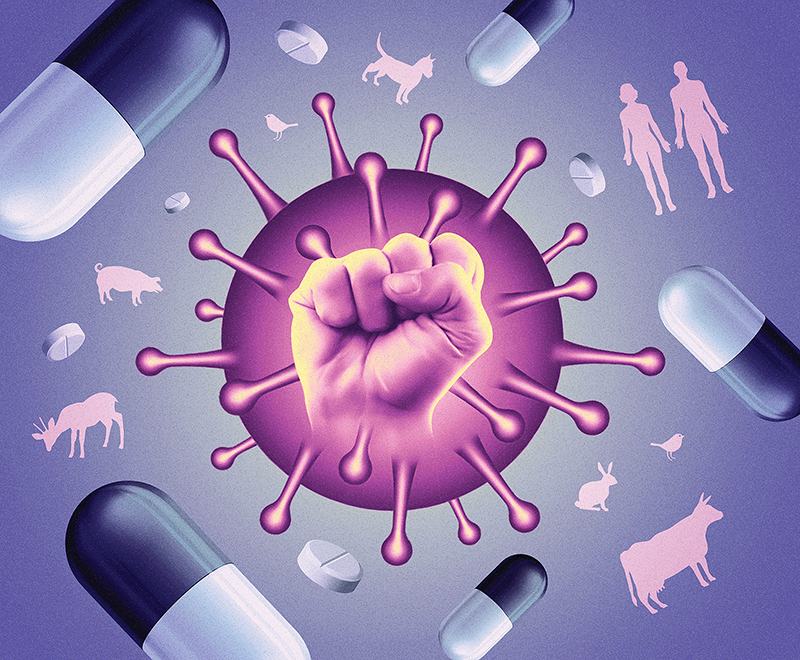
There are too few antibiotics being developed to keep up with the rise of antibiotic-resistant infections, and the world is starting to run out of antibiotics. This means that hospitals will begin seeing patients with infections they can’t treat, and infections that were once easily treated becoming fatal. Mohamed Seleem, DVM, MS, PhD, a professor of microbiology at Purdue University’s College of Veterinary Medicine, is trying to keep that from happening, according to a university release. Dr. Mohamed Seleem (Purdue University photo/Mark Simons) Dr. Seleem is studying whether FDA-approved drugs can treat antibiotic-resistant infections.
October 15, 2019
An estimated 46.6 million U.S. adults struggle with mental illnesses, such as anxiety disorder, according to the National Institute of Mental Health. About half of millennials and 75% of Gen-Zers report having quit jobs for mental health reasons. Now, Purdue University scientists have created a platform focused on finding new medication options for people dealing with mental illnesses. The Computational Analysis of Novel Drug Opportunities (CANDO) drug discovery platform is designed to predict the effectiveness of certain psychoactive drugs, which act primarily upon the central nervous system. Details about the platform are published in the Sept. 11 edition of Scientific Reports.
Drug discovery platform may provide new options for treating mental health illnesses
October 15, 2019
With too few antibiotics under development to keep up with the rise of antibiotic-resistant infections, the world is starting to run out of antibiotics. That also means hospitals will start seeing more patients with infections they can’t treat, and more infections that were once easily treated are becoming fatal. A Purdue University scientist is trying to keep that from happening.
The world is running out of antibiotics. This researcher is working on finding a solution.
October 14, 2019
An app developed by professors at Purdue University allows first responders to monitor social media posts to find people in need of help during disasters. The platform, known as SMART, helps first responders better monitor areas during large events and natural and man-made disasters. "We have launched a pilot program with a dozen of agencies across the country,” said David Ebert, director of Purdue’s Visual Analytics for Command, Control and Interoperability Environments (VACCINE) Center and the Silicon Valley Professor of Electrical and Computer Engineering. “They are taking our platform and using it in their command centers to monitor big events, disasters and other public safety concerns.”
Purdue University Develops App to Help First Responders During Natural Disasters
October 11, 2019
The National Institutes of Health’s (NIH’s) latest foray into turning emerging technologies into useful data sets is focusing on how the body’s trillions of cells interconnect and interact. The Human BioMolecular Atlas Program (HuBMAP) aims to describe the biochemical milieu and the locations of individual cells in the body’s major organs, researchers write this week in Nature. It uses technology heralded by Science as the 2018 Breakthrough of the Year. The goal is to “establish a baseline of what constitutes a healthy system,” says HuBMAP grantee Julia Laskin, an analytical chemist at Purdue University in West Lafayette, Indiana. That way, she says, researchers will be able to see what goes awry in disease.
An ambitious effort to map the human body’s individual cells gets backing from NIH
October 11, 2019
Haley Oliver has spent years working toward developing the first food technology program in Afghanistan. The project is one of the many reasons Oliver, an associate professor of food science at Purdue University, will receive the 2019 Corinne Alexander Spirit of the Land-Grant Mission Award on Oct. 24. Along with developing the program at Herat University in Afghanistan, Oliver has partnered with multiple sectors to improve that region’s food production industry and raise a greater awareness of food safety.
October 9, 2019
How the human body’s trillions of cells are organized and interconnected and how they interact with each other are factors critical to good health, yet science does not understand the fine details of this intricate system. The National Institutes of Health aims to tackle this complex problem by working to create a comprehensive map of individual cells throughout the entire body. The seven-year effort is called the Human BioMolecular Atlas Program (HuBMAP), a nationwide consortium of universities and research institutions. A paper describing the HuBMAP consortium is appearing on Oct. 9 in the journal Nature.
National effort to focus on mapping human body on cellular level
October 8, 2019
The promise of earlier detection of diseases such as Alzheimer’s is welcome news to the millions of families in the United States already affected by the various types of dementia. Emerging techniques such as spinal taps have shown success, but they are not effective for everyone. Now, Tymora Analytical Operations, a Purdue University-affiliated company, has received a $225,000 SBIR grant from the National Institutes of Health for its approach to using blood and plasma for earlier detection of Alzheimer’s disease.
National Institute on Aging awards $225,000 for work to improve Alzheimer’s diagnoses
October 8, 2019
Forum on Industry/Academia Collaborations The Chemistry Department at Purdue has led Purdue in patent activity and start-ups with several larger companies (Pete Kissinger’s Bioanalytical Systems and Phil Low’s Endocyte) and a host of smaller ones. The Purdue Research Park was one of the earliest in the US, and the university is amongst US leaders in patent filings. I have never had financial interests in any company (makes things simpler!) but my research group has produced 1116 publications and >50 US patents. Key discoveries early on included mixture analysis by MS/MS 1975, MRM and ion soft landing—(unfortunately!) none patented. Patents do include some key aspects of miniature mass spectrometers, ion traps, surface induced dissociation, desorption electrospray ionization, on-line monitoring by MS and reaction acceleration in droplets.
October 8, 2019
The promise of earlier detection of diseases such as Alzheimer's is welcome news to the millions of families in the United States already affected by the various types of dementia. Emerging techniques such as spinal taps have shown success, but they are not effective for everyone. Now, Tymora Analytical Operations, a Purdue University-affiliated company, has received a $225,000 SBIR grant from the National Institutes of Health for its approach to using blood and plasma for earlier detection of Alzheimer's disease.
