UNSA–Purdue Partnership Strengthens Research, Innovation, and Community Development in Southern Peru
August 6, 2026
Phase III of the Arequipa Nexus Institute has reinforced a model of applied research with territorial impact, generating practical solutions in sustainable agriculture, alpaca breeding, regenerative tourism, and renewable energy, while delivering direct benefits to high-Andean communities in Arequipa.
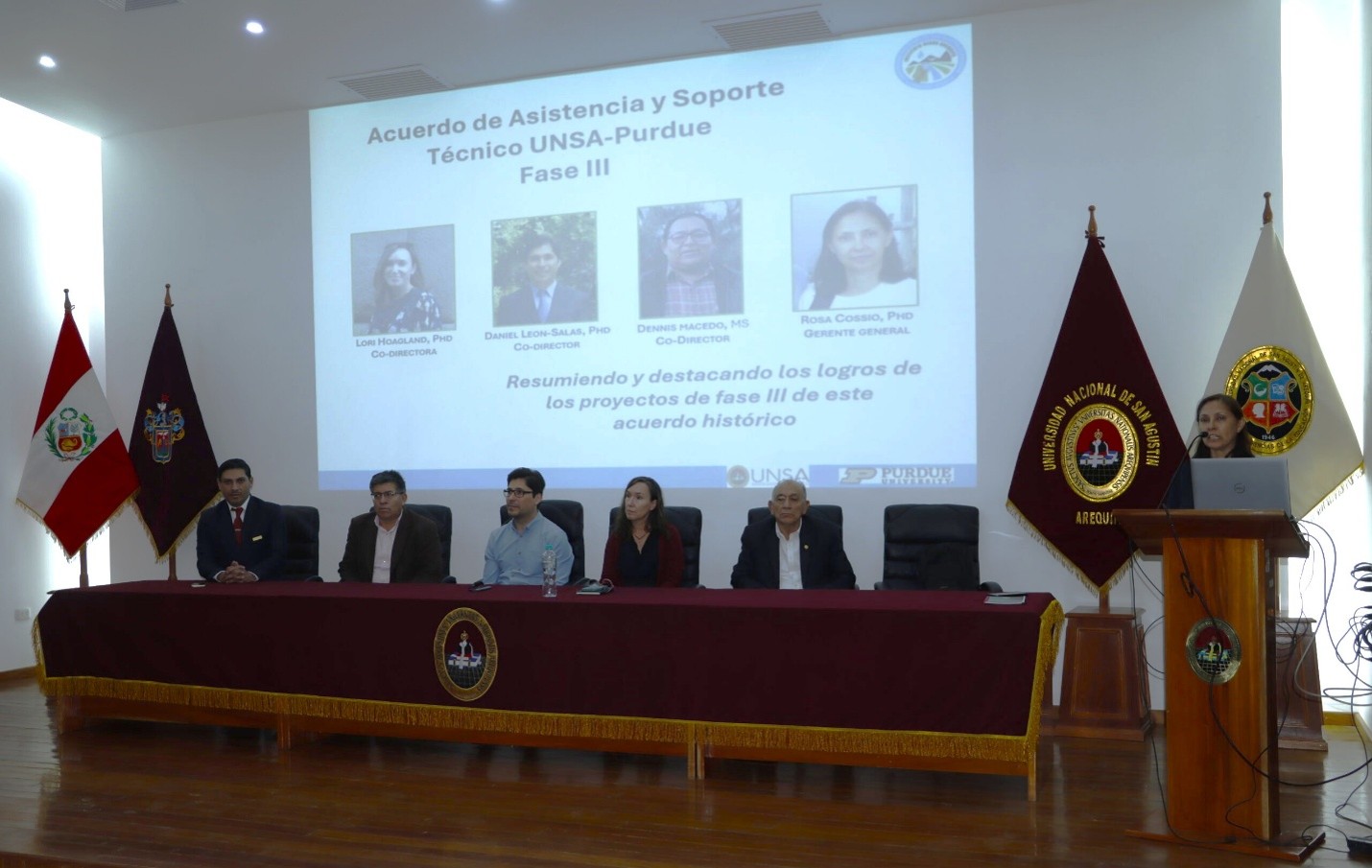
The achievements of Phase III were presented during the public event “Science with a Social Purpose: Results and Opportunities of the UNSA–Purdue University Partnership,” held on July 30 at the Universidad Nacional de San Agustín de Arequipa (UNSA). More than 50 participants, including faculty, students, and researchers, attended the session, which highlighted the progress and outcomes of the four strategic projects developed under the partnership.
The event opened with remarks from Dr. Cossio, Program Manager of the Nexus Institute, who provided an overview of the UNSA–Purdue collaboration. Project leaders then shared results demonstrating how scientific research can address local challenges while strengthening institutional capacity and community development.
The Organic Farming Systems Project, presented by Dr. Hoagland and MS Macedo, focused on supporting smallholder farmers in the Colca Valley. Facing challenges such as soil degradation, pest pressures, changing rainfall patterns, and concerns related to contamination near an abandoned mine in Madrigal, the project combined local knowledge with scientific innovation. Through surveys, soil and crop assessments, customized soil reports, training programs, and field trials using organic amendments such as biochar and bokashi, farmers gained tools to improve productivity, profitability, and long-term sustainability.
The Regenerative Tourism Project, presented by MS Juan Banda, promoted sustainable tourism development in Sibayo, Yanque, and Madrigal. The initiative strengthened local capacities to design and manage regenerative tourism experiences, fostered collaboration among stakeholders, and created resources including destination plans, visitor profiles, methodological toolkits, and a web-based knowledge center. These efforts help preserve the region’s natural and cultural heritage while supporting local economic opportunities.
Dr. Victor Pacheco presented the Camelids Project, which addressed key challenges facing alpaca production in the Andes. By integrating genomics, nutrition, phenotyping, and pasture management, the project improved herd productivity, fiber quality, and climate resilience. Notable achievements included the genomic characterization of 604 alpacas, the establishment of a fiber phenotyping laboratory at UNSA, improved pasture infrastructure, and specialized training programs.
Finally, Dr. Leon-Salas highlighted the Renewable Energy Project, which strengthened the CIBCI research station through solar and wind energy systems, battery storage, connectivity solutions, remote monitoring technologies, and waste-to-energy infrastructure. These innovations increased energy autonomy, operational capacity, and environmental sustainability while benefiting nearby communities.
Together, the four projects demonstrate the value of the UNSA–Purdue partnership as a platform for co-developing solutions with local communities. Beyond advancing scientific knowledge, Phase III expanded research infrastructure, strengthened human capital, and created lasting pathways toward sustainable development in southern Peru.
Contact Details
- ROSA E COSSIO
- rcossio@purdue.edu
- 765-494-0721