Nearly 75 Purdue faculty attend AI Academy to explore the instructional use of AI
During the week-long event, a series of teaching and interactive sessions prepared faculty to navigate through a rapidly changing learning landscape.

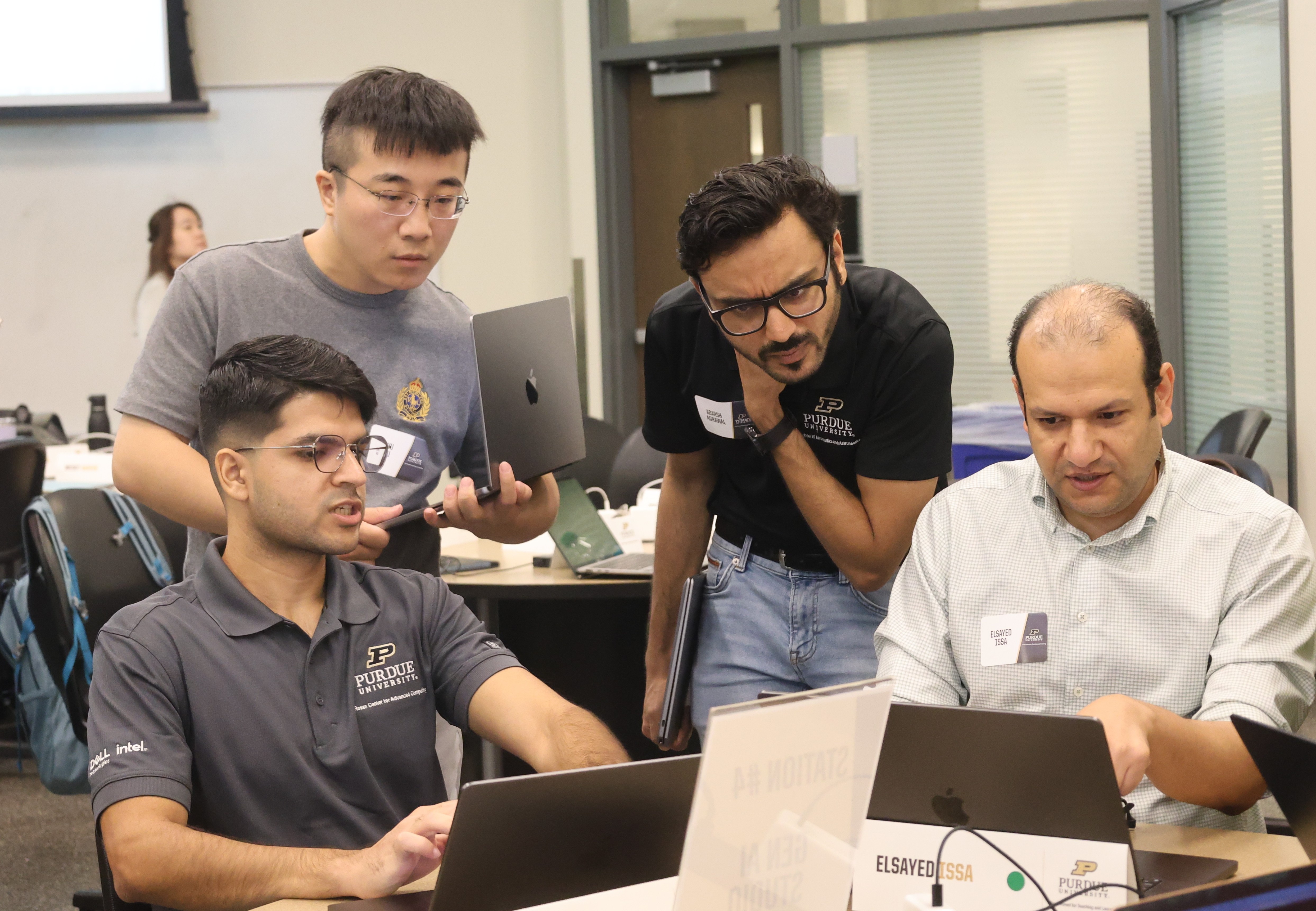
Nearly 75 faculty members from every college across campus gathered for a weeklong workshop to increase their understanding of generative artificial intelligence (AI) to harness it for instruction and coursework without compromising learning and individual effort.
The event, facilitated by members of the Innovative Learning community, included a series of teaching and interactive sessions to help faculty consider ethical questions, adjust teaching styles and evaluate new tools so they and their students can more effectively use AI.
As part of the academy, participants developed AI-assisted course enhancements including several new AI-focussed assignments to benefit Purdue learners in the year ahead.
The academy was hosted to help faculty adjust to rapid developments in generative AI, says David Nelson, an event facilitator and associate director for the Center for Instructional Excellence.
“By showing faculty how AI affects learning, they can more directly work with and involve students who want to use AI in the learning process,” he says.

Generative AI has given students many innovative tools, like Purdue GenAI Studio and Microsoft CoPilot, to use in the classroom, but an overreliance on these tools can compromise their learning.
Robin Tanamachi, associate professor with the Department of Earth, Atmospheric, and Planetary Sciences, has seen AI’s impact on students — for better and worse. Part of her job as a teacher, she says, is to guide students toward its productive uses.
“I want students to use things like chatbots to assist in their coursework. AI tools can be used to instruct, write computer code, or brainstorm and generate ideas, but they should not short-circuit the learning process," she explains.
With support from faculty experienced in generative AI and from Purdue’s culture of innovation, students will be prepared to approach AI strategically and creatively, says Zoeanna Mayhook, assistant professor in the School of Information Studies.
“The opportunity to critically evaluate AI tools and their outputs in the classroom will position students ahead of their peers graduating from other institutions,” adds Mayhook, who served as another event facilitator, focusing on algorithmic and information literacy.
Purdue is also preparing other tools and instructions to guide generative AI use in the broader Purdue community. Discover more about these resources by exploring Artificial Intelligence at Purdue University.