April 20, 2020
Murphy Award winner: Libby Richards
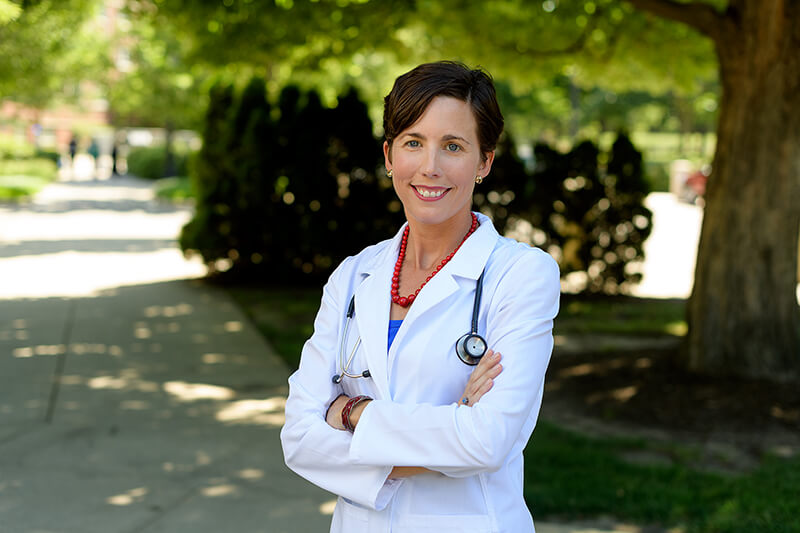
Libby Richards, associate professor in the School of Nursing. (Purdue University photo)
Note: The profile below is part of Purdue Today's ongoing series on Purdue's winners of the 2020 Outstanding Undergraduate Teaching Award in Memory of Charles B. Murphy, Exceptional Early Career Award and Excellence in Instruction Award for Continuing Lecturers.
Passionate and enthusiastic. Inspirational and caring. Zealous and positive. These are just some of the superlatives students used when describing the teaching style of Libby Richards, an associate professor in the Purdue University School of Nursing.
Richards, who received her PhD from Purdue and has served as a visiting instructor and faculty member since 2005, recently was named a 2020 winner of the Murphy Award, Purdue's highest undergraduate teaching honor. The award recognizes up to five recipients each year as models in excellent undergraduate education.
“I can't fully put into words how lucky I feel to receive such amazing recognition,” Richards says. “I have been very fortunate to have been mentored by several previous Murphy Award winners. So, the honor of receiving the award is truly a dream.”
Richards currently teaches population health at the undergraduate level, and in her research, she mentors undergraduate and graduate students across disciplines. She is also a faculty associate at the Center on Aging and the Life Course, a faculty partner at the Center for Families and a fellow of the Purdue University Teaching Academy.
As an educator, Richards has two primary goals: teaching public health and health promotion concepts to the next generation of professionals, and encouraging her students to become informed advocates for health priorities in their daily lives. To achieve these goals, Richards has enriched the student learning experience by focusing on three main areas of instructional improvement and innovation:
- Integration of population health education into the undergraduate Nursing curriculum.
- Use of technology to enhance student learning.
- Experiential learning through academic-community partnerships and interprofessional education.
“Nursing is the most trusted health profession. We are recognized leaders,” Richards says. “We need to prepare our nurses through an understanding of the complex, interwoven factors that impact health and health care, regardless of their area of specialty. Nursing education has gone through a tremendous transformation over the past decades, but we still have more work to do.”
For Richards, educating students goes beyond teaching classes. She has served as a mentor, a Nursing Student Council advisor and a Glenwood Cooperative advisor. In 2019, she was named an honorary member of the Purdue Old Masters program.
An Old Master is an exceptional person who has made significant contributions to their field of study and to society. An Honorary Old Master is a chosen Purdue faculty or staff member who shares the same passion for mentoring students as the other Old Masters, and has achieved high levels of success at the University. Each year, the Old Masters visit campus to share their ideas and experiences with the student body.
“I love being in the classroom, but what I love most is interacting with students outside the classroom,” Richards says. “When I interact with students more informally, I share with them about my personal struggles early on in my career. Real-world nursing is extremely rewarding but also really tough. It took me several years after graduation to find my niche, so I want my students to know that it's OK if they don’t love their first job and that there are many career possibilities — they just need to learn from each experience and keep trying until they find their fit.”
The worldwide breakout of the new coronavirus in early 2020 has disrupted American society and forced Purdue educators to alter their normal, in-person teaching methods. These changes have thrust Richards' area of expertise — public health — into the spotlight, while also testing her abilities as an instructor.
“Currently, the U.S. has fairly poor health outcomes compared with peer nations — this can clearly be seen with the COVID-19 outbreak — and nurses play an increasingly critical role in improving these disappointing health outcomes,” she says. “In regard to teaching, I'm very fortunate because I've been teaching a hybrid course for many years. So, the shift to teaching entirely online wasn't too bad for me.”
Writer: Aaron Martin, mart1517@purdue.edu