Novel materials engineering course emphasizes fundamentals for hypersonic vehicle design
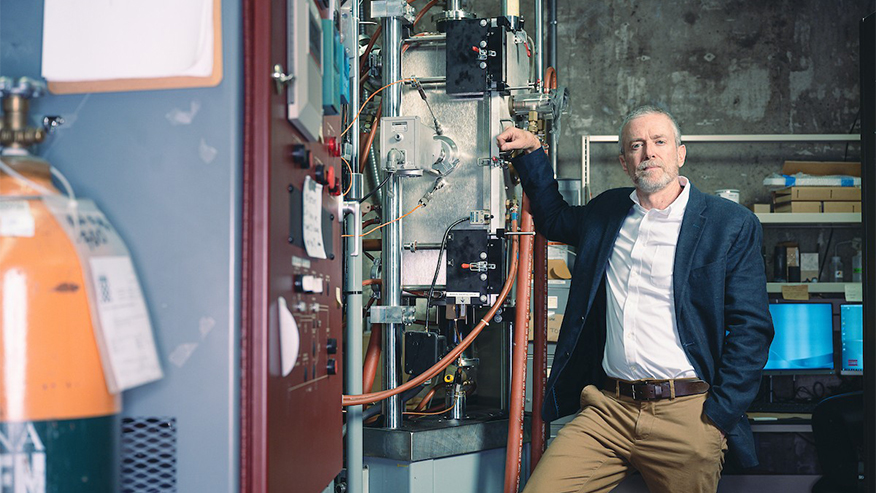
Rodney Trice, professor of materials engineering, stands with a high-temperature load frame in his ceramic processing lab in Armstrong Hall. (Purdue University photo/Charles Jischke)
Hypersonic vehicles — aircraft that can reach speeds of Mach 5 and beyond — are subject to extreme conditions while they are in flight, requiring strong yet aerodynamic materials to keep them both in the air and intact.
Rodney Trice, a professor of materials engineering at Purdue University, realized there was no course that focused on materials for hypersonic applications — so he took on the task of developing the first one, geared toward both current Purdue engineering students and industry professionals. Since its inception in spring 2021, Materials for Hypersonics has helped to fill a critical need by educating nearly 400 individuals in this vital and emerging technology area.
Advancing the nation’s hypersonic capabilities has been a key priority for the U.S. Department of Defense. However, a study conducted by the National Defense Industrial Association’s Emerging Technologies Institute indicates that the United States faces a worker shortage across the hypersonics industry. In 2024 it was estimated that the hypersonics workforce consists of fewer than 3,000 people, down from a peak of approximately 10,000 in the 1980s and ’90s.
Now, with increased international competition and commercial interest, hypersonics is experiencing a resurgence and cultivating a skilled workforce of technically trained scientists and engineers is more urgent than ever.
“My hope is that students will see this critical application for high-temperature materials and get interested in hypersonics, and those already involved in the field will take the opportunity to step back and examine the broader landscape,” Trice said. “I created Materials for Hypersonics to offer a foundational technical perspective on the topic for both seasoned professionals and beginners to understand the field’s complex challenges.”
The course, which is currently taught through Purdue University Online, synthesizes core technical knowledge from publicly available sources on high-temperature materials — specifically ceramics. Ceramics are ideal materials for hypersonic vehicles as they provide high-temperature resistance and thermal protection while being relatively lightweight.
During the course, Trice helps students develop a fundamental understanding of ceramic properties and hypersonic applications. He also provides a history of hypersonic flight and covers how hypersonic conditions affect the components of a vehicle.
“My unit on the hypersonic environment and design implications is perhaps the most important as it dives into the technical challenges associated with hypersonic flight,” Trice said. “It provides a vocabulary for students to understand concepts such as boost/glide versus scramjet aircraft flight trajectories, aerothermal heating and cooling, and the role of leading-edge geometry on convective heat flux during flight. It also introduces thermal protection systems, which are designed to protect the aircraft from extreme temperatures.”
The course originally was designed for Purdue graduate and undergraduate students across disciplines, including materials engineering, aeronautics and astronautics, mechanical engineering, chemical engineering, chemistry, and engineering technology. Joseph Jewell, the John Bogdanoff Associate Professor of Aeronautics and Astronautics and nominee for assistant secretary of defense for science and technology, praises the course for its interdisciplinary approach.
“As an aerodynamicist, I appreciate my students being able to get the perspective on hypersonic materials that isn’t part of my own background,” Jewell said. “This course is an excellent introduction to the myriad materials issues that are drivers of practical hypersonic vehicle design.”
The course has since evolved to also cater to industry professionals who are already immersed in the hypersonics ecosystem. The information is delivered asynchronously so participants can complete lessons on their own time.
“Many experienced professionals may not have had prior exposure to this material,” Trice said. “This course offers them a valuable opportunity to explore it in depth while continuing their full-time work.”
The course also has been adapted into various one- to three-day short courses that Trice has taught to over 300 hypersonics practitioners at defense industry labs and conferences. Trice credits a former PhD student, Cole Davis, for inviting him to give his first short course at Naval Surface Warfare Center, Crane Division, where Davis is now a materials engineer.
“The field of high-speed flight has its own terminology and language that can’t be learned in your typical engineering course. Professor Trice’s course provided me with the background needed to enter this field and significantly reduced the time for me to start making an impact,” Davis said. “Getting more minds thinking about this topic helps the field progress with new, innovative solutions. The course was a great way to raise awareness and introduce more Navy engineers to this topic.”
Faculty-Staff News

This week’s ‘Thumbs Up’ recipients
June 22, 2026

In Print: ‘Integrated Sensing and Communications: Theory, Algorithm and Applications’
June 22, 2026

One Hour with HR’s June session to focus on internal advancement
June 17, 2026

Researchers in various studies looking for participants
June 16, 2026