April 5, 2023
Purdue research: Water droplets hold secret ingredient for building life
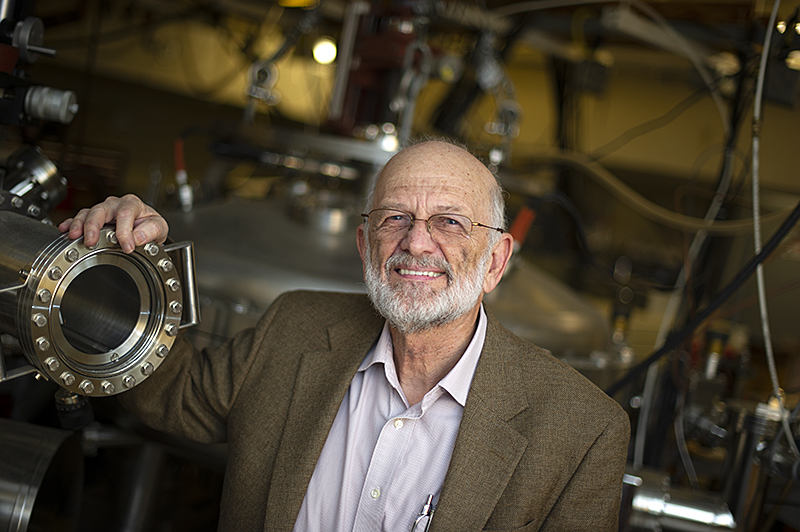
Graham Cooks, the Henry Bohn Hass Distinguished Professor of Analytical Chemistry in Purdue’s College of Science.
A team led by distinguished chemistry professor Graham Cooks published a paper in Proceedings of the National Academy of Sciences that examined a mechanism for peptide-forming reactions that occur in water — uncovering “essentially the chemistry behind the origin of life,” Cooks says.
Article Title
A (New) World in a Droplet of Water
Author(s)
R. Graham Cooks, Distinguished Professor, Analytical Chemistry
Dylan T. Holden, PhD Student, Analytical Chemistry
Nicolás M. Morato, PhD Student, Analytical Chemistry
Journal
Proceedings of the National Academy of Sciences, 2022
Full Article
https://pubmed.ncbi.nlm.nih.gov/36191178/
Article Summary
The molecules of life, biomolecules, underlie the functioning of all organisms, simple and complex. Proteins are essential biomolecules and we know that they are made up of amino acids which link together with the loss of water molecules. We also know that meteorites deliver amino acids to earth in prodigious amounts.
All this makes it reasonable to suppose that life developed after amino acids assembled into proteins on the primitive oceanic earth. But here we run into a problem sometimes known as the ‘water paradox’: one can’t remove water from amino acids to form proteins in a watery medium. The reaction simply reverses direction putting water back and separating the amino acids:

The solution to this problem was described in a paper in PNAS a few months ago (1). There our group demonstrated that simple proteins (peptides) are produced from amino acids in microdroplets of pure water (think of waves splashing against rocks). Microdroplets are not wet everywhere, in particular their surfaces are dry and strongly acidic. This allows loss of water and other reactions to occur at highly accelerated rates.
In fact, the acceleration of chemical reactions in microdroplets is being used to make new drugs in a new Bindley Biosciences facility for High Throughput Synthesis and Bioanalysis. It is remarkable how much mystery there is in simple things, like a drop of water. And how understanding in one area of science drives technology in another area. We are indeed fortunate at Purdue in having an infrastructure for development of chemical instruments that is second to none.
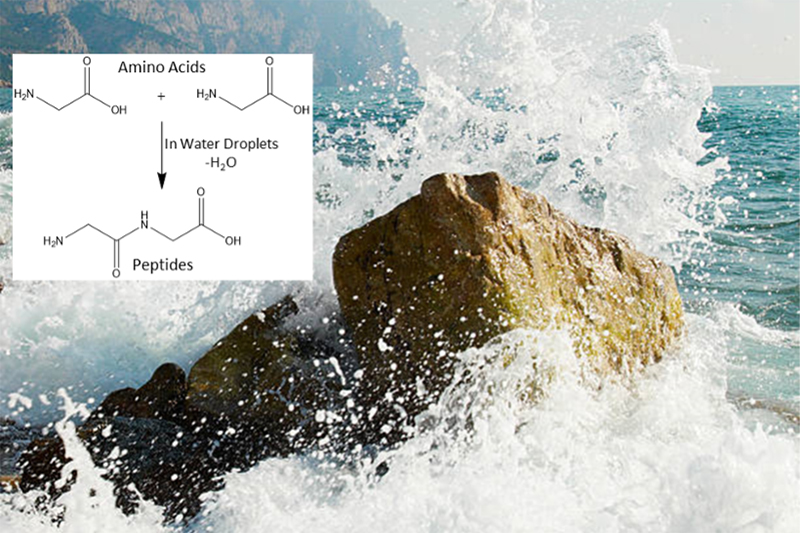 Protein formation from amino acids in primordial sea spray. Adapted from Proceedings of the National Academy of Sciences (2022) 119 (42) e2212642119 and Vice October 3, 2022.