May 1, 2023
Purdue research buzzing about construction lessons taken from bees, honeycombs
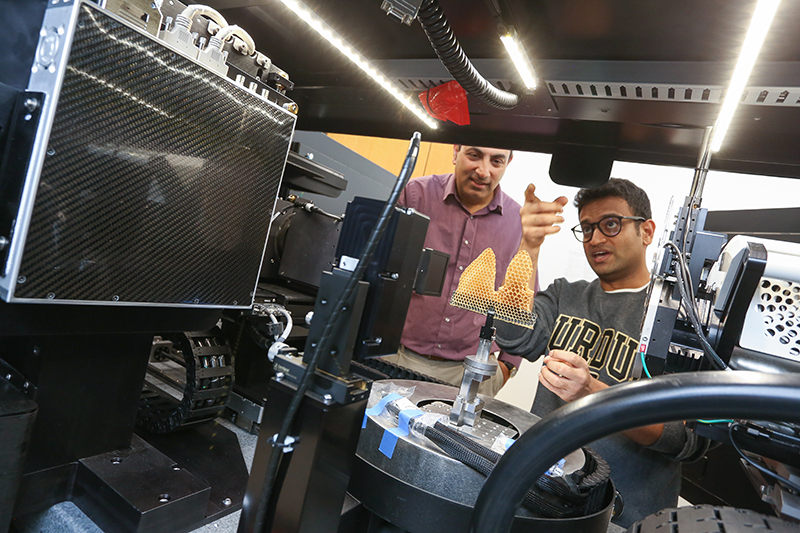
Purdue University engineers and entomologists are making some sweet discoveries about how honeybees build and structure their honeycombs, which could lead to new fabrication techniques taken from the buzzing builders. Nikhilesh Chawla, the Ransburg Professor of Materials Engineering at Purdue, is one of the first to utilize four-dimensional (4D) imaging to delve further into the complexities of the honeycomb.
Article Title
Unraveling the Construction of Honeycomb in the Apis mellifera Using Time-Resolved X-ray Microscopy (XRM)
Author(s)
Nikhilesh Chawla, Ransburg Professor and Acting Head School of Materials Engineering
Brock Harpur, assistant professor, Entomology
Rahul Franklin, PhD student, Materials Engineering
Journal
Advanced Materials
Full Article
https://onlinelibrary.wiley.com/doi/full/10.1002/adma.202202361
Article Summary
Honeycomb has fascinated humans for millennia. It is a naturally engineered structure that serves as storage for the bees, a place for the queen to lay eggs, rear their brood, among a multitude of additional functions. It is a model system for learning and mimicking the design of new materials and structure. Even though honeycomb construction has been studied, results have been limited to two-dimensional and surface-level observations. X-ray microscopy is a very powerful tool to characterize structures in three-dimensions non-destructively. When a time element is added, one can obtain valuable data in four-dimensions (4D).
In this interdisciplinary study, combining investigators from engineering and entomology, 4D X-ray microscopy was used to answer many fundamental questions related to how bees build hexagonal cells. Hexagonal cells were seen to grow additively, directly based on a preformed hexagonal pattern formed on the central spine of the comb. Further, several seminal but previously unreported features were observed such as the formation of a corrugated spine of the comb. This work is providing us with new lessons for how to engineer new materials and structures, while paving the way for the development of new materials and resource-limited design.