June 14, 2023
Purdue launches Defense Civilian Training Corps
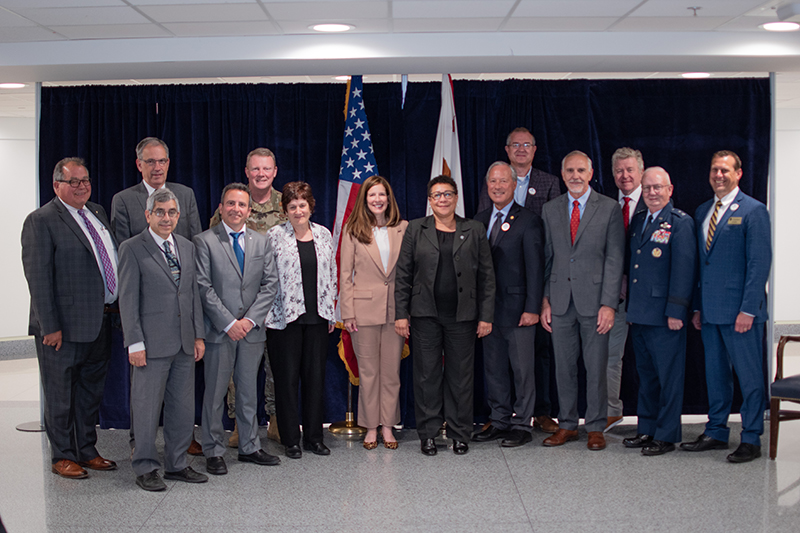
Front row: Mark Lewis, chief executive officer of the Purdue Applied Research Institute; Dan DeLaurentis, vice president for Discovery Park District at Purdue institutes; Karen Plaut, Purdue executive vice president for research; Tanya Skeen, Office of the Under Secretary of Defense for Acquisition & Sustainment; Tonya Smith-Jackson, North Carolina Agricultural and Technical State University; Austin Yamada, University of Arizona Applied Research Corporation; Cyril Clarke, Virginia Tech; Randal Fullhart, Virginia Tech; Eric Muth, North Carolina Agricultural and Technical State University. Second row: Mark Krzysko, Office of the Under Secretary of Defense for Acquisition & Sustainment; Jim Woolsey, Office of the Under Secretary of Defense for Acquisition& Sustainment; Col. Ken Callahan, commander of Air Force Reserve Officer Training Corps at Purdue; David Hahn, University of Arizona; Eric Paterson, Virginia Tech. (Photo provided)
Purdue students with an eye on national security work can now get career guidance and financial help for studies, thanks to the university’s part in the recently debuted Defense Civilian Training Corps (DCTC) program.
Full tuition, career mentoring and security clearance application are among the benefits of DCTC to eligible rising juniors. Defense officials formally announced the program Thursday (June 8) at the Pentagon with representatives from Purdue, one of four U.S. universities chosen for the pilot program.
“As a land-grant university, Purdue has a long history of serving the military that dates back to shortly after our founding,” said Karen Plaut, executive vice president for research, who was among Purdue representatives at the Pentagon announcement. “Purdue is proud to be among the first universities to host DCTC, which has great potential to grow into an important civilian training corps. DCTC will provide our undergraduates with valuable opportunities to apply their studies while also serving the needs of our country.”
The DCTC program at Purdue will be led by Dan DeLaurentis, vice president for Discovery Park District Institutes, assisted by a team of faculty and staff deeply experienced in related programs.
There will be 20 Purdue students in the pilot cohort beginning fall 2023. DCTC runs much like the Reserve Officer Training Corps programs at universities, but this first DCTC cohort has no service obligation. Subsequent cohorts will have the obligation, though length of service has not yet been revealed. Eligible students must be in good standing, with a minimum cumulative 3.0 GPA. They also must be U.S. citizens and obtain and keep a DoD security clearance.
DCTC is open to a broad range of undergraduate majors, including business, supply-chain management, contracting and pre-law, among others. The curriculum is designed for interdisciplinary, project-based learning in which students from varied academic backgrounds can collaborate to solve complex, real-life problems.
DCTC joins other Purdue workforce development programs, such as the Scalable Asymmetric Lifestyle Engagement effort, which DoD funds and Naval Surface Warfare Center-Crane manages. This preeminent program aims to bolster the U.S. semiconductor workforce in defense.
“Working for DoD is not just a job; it comes with an incredible sense of mission,” said Mark Lewis, CEO of the Purdue Applied Research Institute, himself a former acting deputy secretary of defense for research and engineering, among other federal defense roles he has held. “You work on existential challenges facing our nation alongside incredibly talented coworkers. I am personally very proud to know that so Purdue students will help grow this essential workforce.”
Workforce development is a watchword in defense circles these days. Currently, DoD counts about 950,000 civilian employees worldwide, with a 5% annual attrition rate. In the 2023 National Defense Science and Technology Strategy report, released in May, education is cited as a “cornerstone for building enduring advantage” in national security. “We cannot create 21st-century capabilities using 20th-century equipment, education and employment policies,” the report stated.
The other DCTC pilot schools are North Carolina Agricultural and Technical State University, the University of Arizona and Virginia Polytechnic Institute and State University. Congress approved DCTC as part of the fiscal 2023 National Defense Authorization Act.
Visit this link for more information about the Purdue DCTC program, and this link for general DCTC information.
Writer/Media contact: Evamarie Socha, ecsocha@purdue.edu
Source: DoD