April 20, 2023
Overall campus recycling efforts continue; electronic and construction waste recycling on track with sustainability master plan
Fifty thousand tons. That’s how much waste material Purdue University was able to divert from landfills over the past decade.
Materials and waste is a topic addressed in the 2020 Physical Facilities Sustainability Master Plan. The plan includes a goal to achieve an annual campus waste recycling rate of 50% by fiscal year 2025. The university achieved a 32% landfill diversion rate for fiscal year 2022. With help from several campus departments, the university is working to increase that rate for the current fiscal year.
“A good example is the efforts by the Grounds department. Not only do they divert mixed recycling, they also sell cardboard and office paper from select locations to help a portion of the recycling operations costs,” said Tony Gillund, director of sustainability. “Additionally, the Grounds department has been diverting an average of 2,000 tons per year of mixed organic waste, including leaves and landscaping debris, to an on-campus compost operation.”
Additionally, the master plan outlines a goal that requires all construction projects with a project cost greater than $5,000,000 to recycle at least 75% of their construction and demolition waste by fiscal year 2025. The university’s 13 LEED-certified buildings have surpassed the 75% goal, achieving an overall average diversion rate greater than 80%.
Gillund says those within the campus community play an essential part in increasing the diversion rate by knowing what items can and cannot be recycled. The following items are not currently recyclable through the mixed recycling bins on campus:
- Soft plastics, like candy wrappers, chip bags, single-use storage bags, shopping/grocery bags, etc., are not accepted in the campus mixed recycling bins since they can get caught in the Material Recovery Facility’s sorting equipment. Using reusable bags while shopping is a way to help.
- Food waste and containers are not accepted in the campus recycling bins because the containers are typically contaminated with food debris and remnants. Depending on the material type of the food containers, they may be possible to recycle if empty, clean and dry.
- Cups for hot and cold liquids are also not accepted in campus recycling bins. This is because most single-use paper and plastic beverage cups are manufactured in ways that make them difficult to be sorted and recycled alongside other materials. To help, bring reusable bottles, cups and mugs where allowed.
- Napkins, paper towels and tissues are not accepted in campus recycling bins. These paper products are commonly used to collect contaminants such as food, grease and bodily fluids. When possible, use reusable products, such as handkerchiefs and cloth towels.
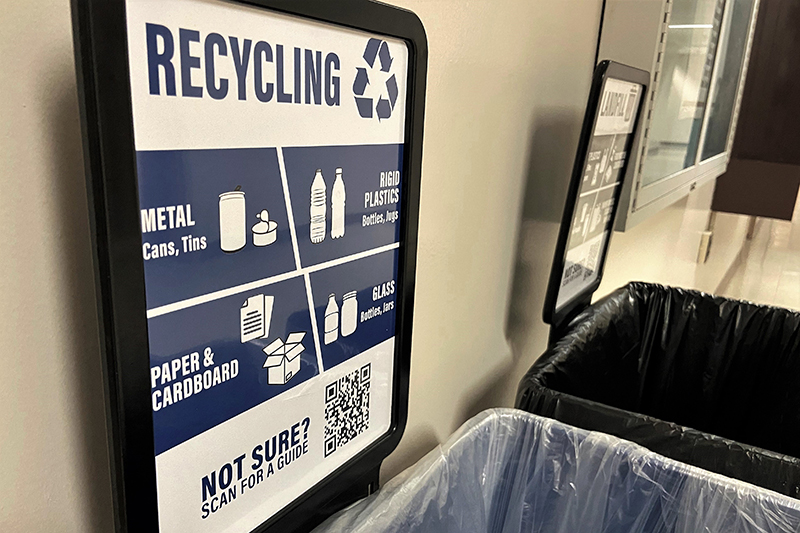
New signage posted throughout several campus buildings should also help the campus community remember what items are recyclable. The signs were installed late last year to increase awareness about recycling.
“We really wanted to make it easier for students, faculty, staff and visitors to know what to put in each receptacle, especially when they might be in a hurry to get about their day,” Gillund said. “We firmly believe that small actions can create a significant impact.”
Another small action the campus community can take is to participate in electronic waste drives when they occur on campus. Campus Planning, Architecture and Sustainability is hosting an e-waste collection drive today (April 20). The unit is partnering with University Surplus and Oscar Winski to collect personal and university-owned items, including computer screens, laptops and printers.
“We are excited to be partnering with Campus Planning, Architecture and Sustainability for this event,” said Susan Ticen, materials operations manager. “Purdue Surplus has a long history of enhancing efforts to reduce, reuse and recycle. In FY22, the store recycled nearly 500 tons of materials, including 250 tons of metals and over 200 tons of mixed recycling.”
The e-waste collection drive will take place from 10 a.m. to 2 p.m. at the northwest corner of Oval Drive, across from Schleman Hall (formerly the Recitation Building). More information is available on the Sustainability website.
To learn more about updates on the 1869 Tree Planting Master Plan, which is also part of the 2020 Physical Facilities Sustainability Master Plan, please review this recent Purdue Today article.
Campus Planning, Architecture and Sustainability; Grounds; and University Surplus are all part of the Administrative Operations organization. Administrative Operations supports the university through safe, reliable and transformative services. Reducing waste production and enhancing recycling efforts are just a few ways the organization continues to power Purdue.