May 4, 2023
Hardin Award celebrates Purdue agronomy professor’s global research success
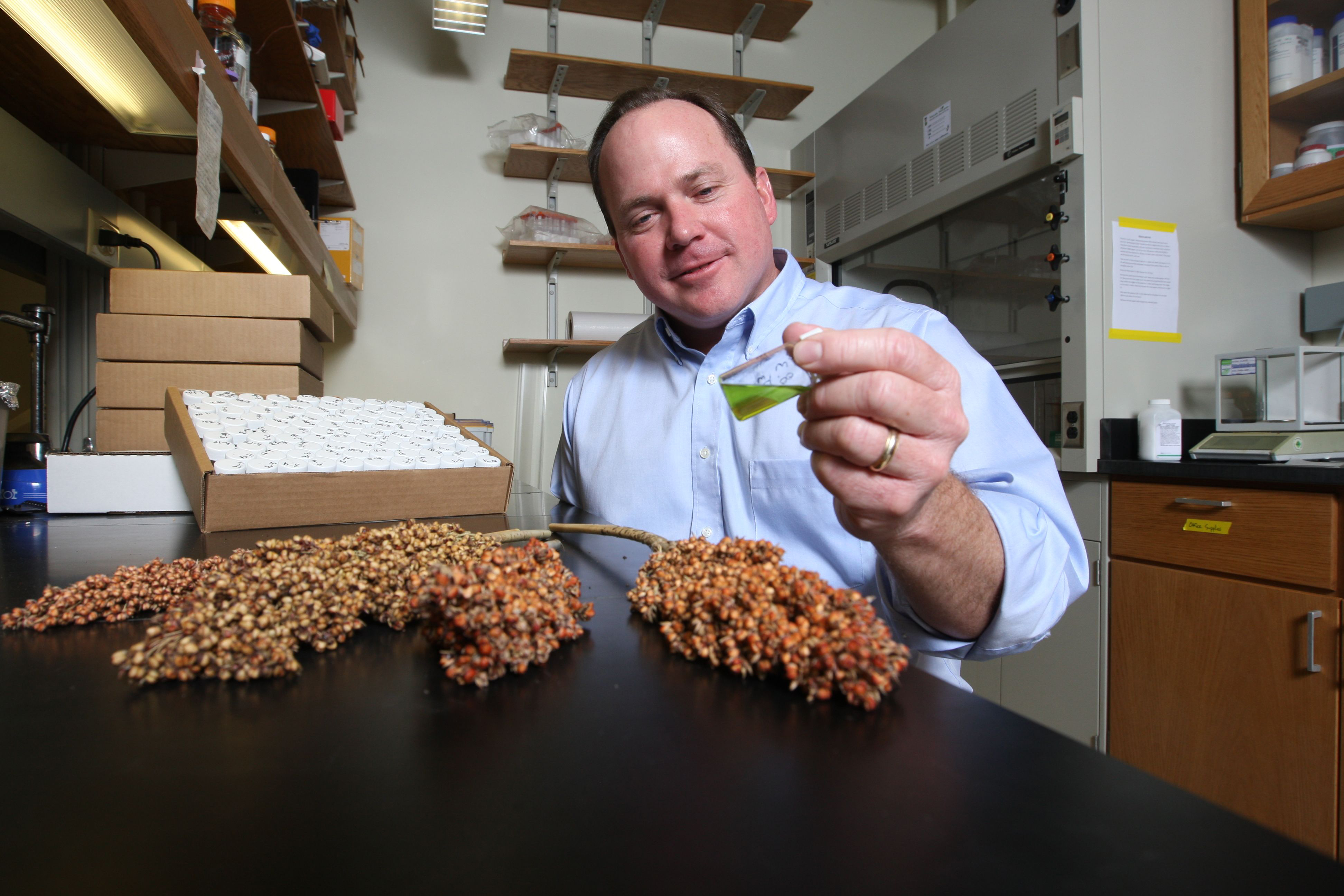 Mitch Tuinstra analyzing sorghum qualities in lab. (Purdue Agricultural Communications photo/Tom Campbell)
Download image
Mitch Tuinstra analyzing sorghum qualities in lab. (Purdue Agricultural Communications photo/Tom Campbell)
Download image
Purdue University’s College of Agriculture will award Mitch Tuinstra the 2023 Lowell S. Hardin Award for Excellence in International Agriculture on Friday (May 5).
International Programs in Agriculture (IPIA) will host a ceremony and reception in Pfendler Hall, Room 241 – the Deans Auditorium – from 9:30-10:30 a.m. ET to honor Tuinstra, the Wickersham Chair of Excellence in Agricultural Research, for his contributions to international agriculture. Join the live Zoom here: https://purdue-edu.zoom.us/j/93426072372.
Throughout his career, Tuinstra has demonstrated a passion for and commitment to global agriculture and food systems. His path in agriculture began with working on his family’s vegetable and flower farm in Shelbyville, Michigan. He attended Calvin College in Grand Rapids, Michigan, and received his master’s in horticulture and his doctorate in agronomy from Purdue University. Originally, Tuinstra planned to return to the family business and help with vegetable and flower production. During his time in graduate school, however, he became motivated to stay within academia because he was passionate about teaching others.
“I was fully funded by a research assistantship, but I signed up to be a teaching assistant for a lot of the professors I worked with,” Tuinstra says. “I was a teaching assistant for Horticulture 101, Horticulture 301, and Agronomy 511 and 611 because I wanted to learn the best teaching methods and how to become a better teacher.”
As a doctoral student at Purdue, he was inspired while working with many international peers and with Purdue’s Gebisa Ejeta, the 2009 World Food Prize Laureate and Distinguished Professor of Plant Breeding and Genetics and International Agriculture.
“Mitch entered the field of plant breeding and genetics with excitement and determination to become a global scientist who would do well and do good. It has been an honor watching Mitch achieve his aspirational goals,” Ejeta says. “He is a passionate and motivated individual who will continue doing great work globally.”
After finishing graduate school, Tuinstra studied sorghum adaptation to drought with the International Crops Research Institute for the Semi-Arid Tropics (ICRISAT) in India. This was his first time traveling outside of North America.
“My first trip to South Asia was a real eye-opening experience,” Tuinstra says. “So many people and so many communities are connected with agriculture. It came as a shock that my new friends and colleagues were looking to me for answers to their questions and solutions to their challenges.”
After returning home, he was hired as a faculty member at Kansas State University, focusing on sorghum breeding. He received his first U.S. Agency for International Development (USAID) grant as part of the International Sorghum and Millet (ISM) Collaborative Research Support Program (CRSP). His research focused on developing new sorghum varieties that were drought stress tolerant. In 2007, he was offered a faculty position in Purdue’s Department of Agronomy as professor of plant breeding and genetics and the Wickersham Chair of Excellence in Agricultural Research.
“Although farmers have faced the challenges of droughts and heat waves for thousands of years, there is mounting concern that changes in our climate may hamper agricultural productivity in the United States and around the world,” Tuinstra says. “Responding to these concerns with efforts to develop ‘climate resilient’ cultivars of maize and sorghum will help contribute to the adaptation of agriculture to warmer and drier environments.”
His research at Purdue focuses on identifying genes and genetic resources that contribute to improved crop performance in stressful environments. He has been highly successful in initiating international collaborations with scientists and breeders to improve crop performance in numerous locations throughout North America, Africa and Asia.
“Mitch has demonstrated excellence in international research and collaboration through his work studying how crop plants grow in stressful environments,” says Gerald Shively, associate dean and director of International Programs in Agriculture. “Through these projects, he has established a commitment to global agriculture and food systems, delivering high-impact capacity building with food producers and processors as well as government officials and consumers.”
Tuinstra mentors numerous undergraduate and graduate students, launching them onto impactful international career paths of their own. He currently teaches one of the most popular undergraduate courses in the College of Agriculture: AGRY 285 (World Crop Adaptation and Distribution).
“His class exposes students to a deeper knowledge and understanding of the world outside the United States,” says Ronald Turco, professor and head of the Department of Agronomy. “In class, they explore environmental factors, including climate, climate change, water, soils, and major food crops’ global distribution and use. His objective in the class is to show how human intervention has maintained or modified the productivity of food crops in agricultural communities worldwide and how this intervention has affected the environment.”
“Working with professor Tuinstra for the past six years in Senegal and in his lab at Purdue University, I have had the privilege of working with a multinational group of scholars from India, Niger, Taiwan, Germany and the United States, all with diverse interests and skills in the discipline of agronomy,” says Elizabeth Diatta-Holgate, a former doctoral student in Tuinstra’s research group and a current research scientist with CERAAS in Senegal. “Professor Tuinstra has developed a community for us to learn not just from him but from each other as well. This has allowed me to advance my knowledge and skills in my own area of interest but in other areas as well. He provides both the resources and support needed for his mentees to succeed, which is personally empowering for me as an early-career female scientist.”
Writer/Media contact: Nyssa Lilovich, 765-494-7077, nclilovi@purdue.edu
Sources: Gerald Shively, shivelyg@purdue.edu
Mitch Tuinstra, mtuinstr@purdue.edu