March 27, 2023
Top-ranked agricultural and biological engineering programs bridge partnerships to address intersections of food, energy, water and health
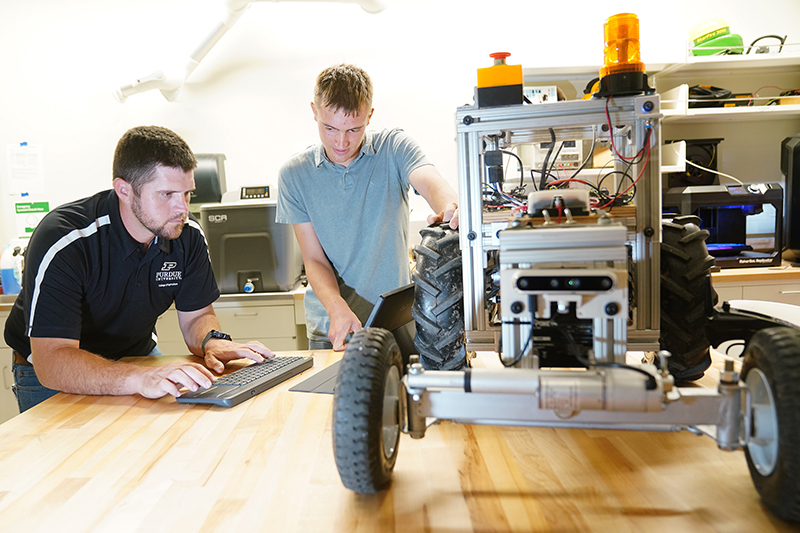
John Evans, assistant professor of agricultural and biological engineering, works with graduate student Nathan Sprague to develop a robot capable of autonomously collecting data from a cornfield. (Purdue University photo/Tom Campbell)
About this series: This story is part of an ongoing Purdue Today series highlighting programs ranked in the Top 10 or Top 10th percentile among our peers nationally, demonstrating the university’s persistent pursuit of excellence, innovation and transformative learning.
Purdue University’s Agricultural and Biological Engineering Department’s innovative research focuses on the application of engineering principles to develop new technologies for more sustainable food production and processing, novel bio-based products, and better environmental stewardship.
Digital technology is changing how food, energy, water and health are being managed and maintained. ABE is a significant partner bridging the partnerships between agriculture and engineering to design the next improvements in data analysis, automation and decision-support tools for agriculture.
Dedicated to extending diverse research and learning opportunities to students, ABE’s undergraduate and graduate programs have been ranked highly in the annual U.S. News & World Report rankings for over a decade. ABE’s undergraduate program was ranked second in 2022, the 12th consecutive year at the top of the rankings.
Nate Mosier, department head and professor of agricultural and biological engineering, describes what he views as the program’s standout features.
“The longevity of our rankings can really only be attributed to one thing: our people,” Mosier says. “The impact that our faculty members make in food and agriculture and on our students is extremely important. Our ABE alumni make an enormous difference around the globe. Our talented staff members are dedicated to the success of our students and to supporting our research and extensions programs. Purdue ABE is what we are because of all these people.”
 Shweta Singh, a professor of agricultural and biological engineering and environmental and ecological engineering, developed a tool to find hidden connections across industrial sectors to identify opportunities to reduce waste and lower carbon emissions by mapping the physical economy for a region. (Purdue University photo/Tom Campbell)
Download image
Shweta Singh, a professor of agricultural and biological engineering and environmental and ecological engineering, developed a tool to find hidden connections across industrial sectors to identify opportunities to reduce waste and lower carbon emissions by mapping the physical economy for a region. (Purdue University photo/Tom Campbell)
Download image
Ranked No. 1 in the 2022 U.S. News & World Report rankings of Best Graduate Schools, Purdue’s graduate ABE program combines fundamental research and practical applications in machine systems, ecological engineering, bioprocessing and biological engineering.
Students consistently praise the opportunities to collaborate with others from many different disciplines and backgrounds across the university.
“I chose to attend Purdue because Purdue offered biological engineering with a food process engineering concentration, which is top ranked in the country, as well as the Food Science Department that also offered classes that interested me,” says biological engineering major Natalia Rodriguez.
“Being in Purdue ABE helped me get internships that have been pivotal in helping me choose a career direction. I interned at General Mills’ headquarters in Minneapolis. At the end of the internship, I received a job offer and will be returning there after I graduate this May as a research and development engineer.”
During the past four years, ABE faculty members have been inventors on 34 patents and founders of seven startup companies. This is especially impressive considering that the number of faculty in ABE has averaged 32 over that same time period. This emphasis on practical technological solutions permeates the department’s undergraduate and graduate education.
Several ABE alumni have applied what they learned at Purdue to start their own companies or develop new technologies at existing companies to advance technology for food production and processing, pharmaceutical manufacturing, and protecting our natural resources.
Mosier also credits the new ABE building, which opened in 2021, for making a significant impact on the quality of all students’ experiences.
“We have new research, teaching and collaboration spaces that will make the work we do easier to do together,”he says. “These spaces will enable more collaboration across engineering and agriculture, food and pharmaceuticals, and spanning the physical to the cyber.”
Writer: Purdue Agricultural Communications