Purdue researcher leads group advising the nation on future of lunar exploration
Committee recommends 4 locations for humans to begin investigating the moon
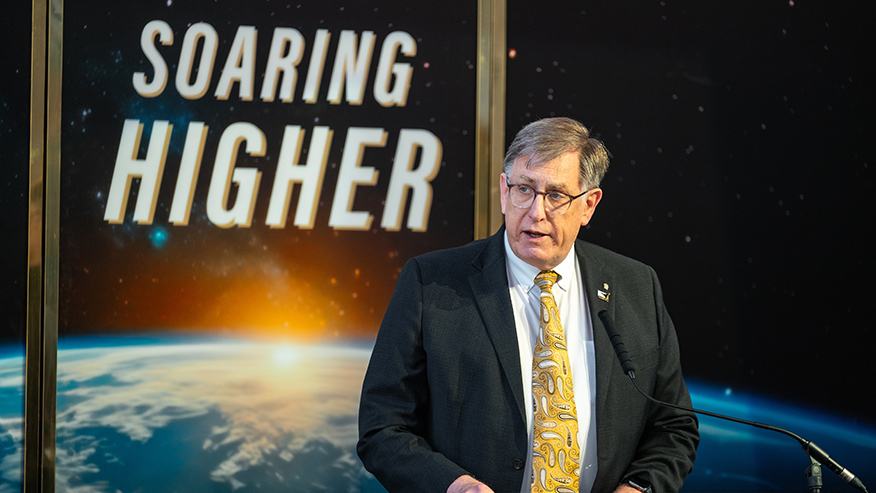
Daniel Dumbacher, a professor of engineering practice in Purdue University's School of Aeronautics and Astronautics, announced new research for the National Academies of Sciences, Engineering, and Medicine regarding recommended lunar sites for human exploration. (Purdue University photo/Kelsey Lefever)
WEST LAFAYETTE, Ind. — A Purdue University professor is playing a key role for the National Academies of Sciences, Engineering, and Medicine in its task of providing recommendations and strategies to explore potential high-value locations on the moon.
Daniel Dumbacher, a professor of engineering practice in Purdue’s School of Aeronautics and Astronautics, co-chaired an ad hoc committee for the academies tasked with identifying priority locations beyond the moon’s lunar poles. Dumbacher and the committee presented the culmination of 18 months of research, “Human Exploration Across the Moon,” on Wednesday (Oct. 21).
Four locations were identified in the research: Bhabha Crater, Mons Hadley, Orientale Basin and Aristarchus. Mons Hadley is close to where the original Apollo 15 mission landed and could provide new information for the NASA Artemis program missions, including the potential for a space weather observatory. Future missions also could study the Apollo hardware and biological materials left exposed to the moon environment.
Dumbacher said the locations give astronauts the chance to study questions that include how to use lunar soil to grow plants and understanding the sources of gravitational waves.
“Humans for generations have aspired to explore, with the moon being the next logical step,” said Dumbacher, former chief executive officer of the American Institute of Aeronautics and Astronautics. “This research outlines where humans could explore and why each location is important.”
Each location offers opportunities to study questions regarding moon geology, space weather and radiation hazards, according to the report. Also recommended was the development of an observational tool that could be placed in orbit around the moon to assist in planning lunar missions and to provide continuous communications with future human habitats.
At Purdue, Dumbacher specializes in program and project management; complex, state-of-the-art systems engineering; and propulsion and power systems engineering. He formerly served as deputy associate administrator for the Exploration Systems Development Division in the Human Exploration and Operations Mission Directorate at NASA.
The study was sponsored by NASA. The 13-member ad hoc committee was supported by researchers in four subcommittees examining aspects of planetary sciences, physics, applied sciences and biology.
Despite being only a quarter of Earth’s diameter, the moon presents several important opportunities for scientific research, including its ancient impact basins and volcanic landscapes. Initial human explorers could map out potential habitat locations and new vantage points for observing the universe.
The locations determined by the committee were based on several criteria, including key science objectives and NASA’s Moon to Mars Strategy and Objectives. Required justifications for the sites ranged from understanding the history of the solar system in lunar geology, measuring solar weather impacts on Earth, finding lunar resources available for potential utilization, and understanding the origins of dark matter and our universe.
The committee addressed why human exploration would be more effective than robotic rovers and prioritized potential landing sites based on how humans would benefit and what important science questions would be answered.
The academies released a similar report in December regarding high-priority locations for human exploration on Mars. Barrett Caldwell, a professor in Purdue’s Edwardson School of Industrial Engineering, and Ali Bramson, an associate professor in the Department of Earth, Atmospheric, and Planetary Sciences, served on contributing panels for that research.
Known as the Cradle of Astronauts, Purdue has 30 alumni who have flown in space or have been selected as NASA astronaut candidates. Five Boilermakers will fly on a research journey into space aboard a Virgin Galactic suborbital flight, dubbed Purdue 1, in 2027. The groundbreaking flight will include real-time research on board, making Purdue the first university to do so in space. The university recently awarded the inaugural Neil Armstrong Space Prize to the SpaceX Falcon 9 Booster Landing Team, recognizing their globally impactful work on the Falcon 9 reusable two-stage rocket system.
About Purdue University
Purdue University is a research institution ranked among the top 10 public universities in the United States. More than 111,000 students study at Purdue across multiple campuses, including more than 57,000 at our main campus locations in West Lafayette and Indianapolis. As a land-grant university committed to affordability and accessibility, Purdue’s main campus has frozen tuition 14 years in a row, enabling more students than ever to graduate debt-free.
Media contact: Brian Huchel, bhuchel@purdue.edu
Space News

Purdue 1 essay competition invites Indiana fifth graders to imagine the future of space exploration
September 30, 2026

Falcon 9 Booster Landing Team receives first Neil Armstrong Space Prize for reusable rocket research
September 16, 2026

A smarter way to track satellites beyond Earth’s orbit
August 11, 2026
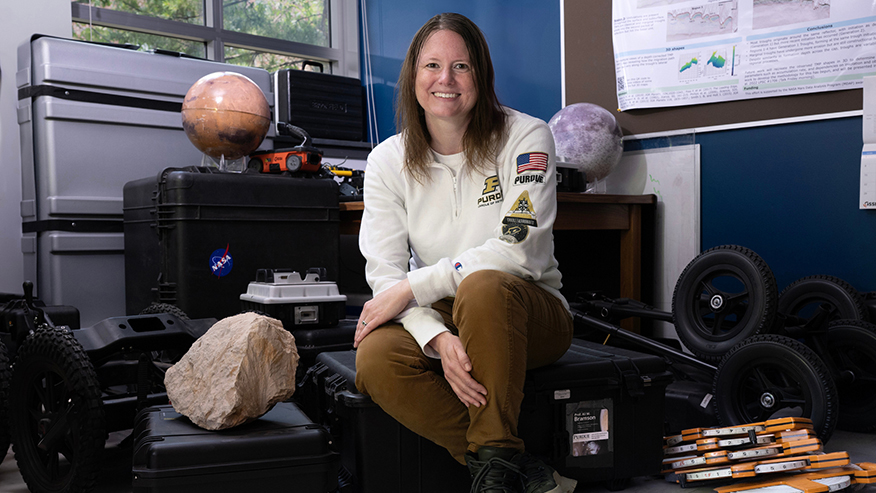
Keys to future human exploration, past planetary conditions hide under surface of moon, Mars
July 29, 2026