New space telescope data decodes death throes of stars
Analysis of dust from the James Webb Space Telescope reveals changes deep inside star shortly before it exploded
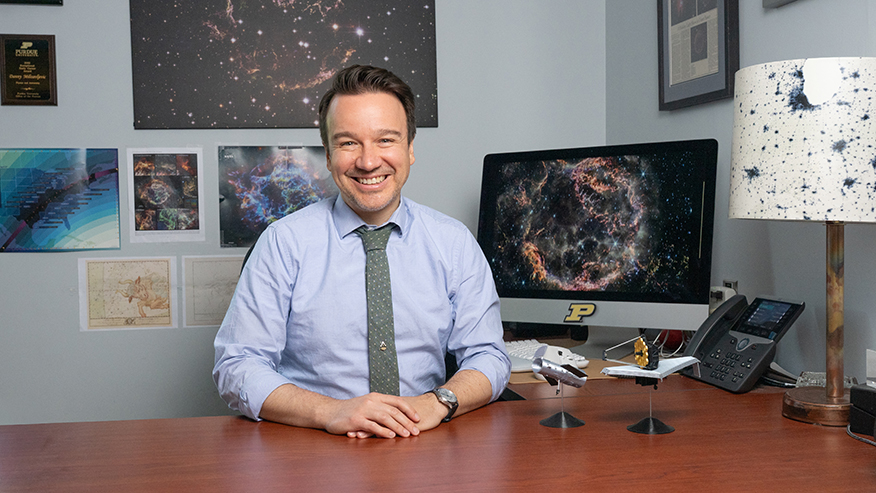
Danny Milisavljevic, a supernova expert at Purdue University, studies the death throes of stars to better understand the distribution of matter in the universe. (Purdue University photo/John Underwood)
WEST LAFAYETTE, Ind. — New insights into the final stages of a massive star’s life are helping scientists understand the distribution of matter across the universe — including the formative building blocks of planets and even life itself.
Danny Milisavljevic, an associate professor of physics and astronomy in Purdue University’s College of Science, works with astronomers across the globe to decode unprecedented observations from the James Webb Space Telescope (JWST).
“By understanding the process of exploding stars, we are reading our own origin story,” Milisavljevic said. “The raw materials necessary for life are forged in supernova explosions. They seed the formation of new stars and planets.”
One project just uncovered structural shifts that happened inside a star shortly before it exploded. The research, led by Columbia University astronomer Tea Temim, was co-authored by Milisavljevic and supported by his ongoing work with JWST observations of a supernova debris field known as Cassiopeia A. By studying the dust in this debris, the team traced the star’s internal makeup at the moment it exploded.
To astronomers, “dust” means tiny solid grains, far smaller than the width of a human hair, that form as the hot gas from an explosion cools. Because different parts of the star produce different kinds of grains, the dust acts as a record of what was inside. The team used spectroscopy from JWST to analyze the composition and distribution of dust with precision that was previously impossible. They found that the star didn’t just suddenly explode. Before exploding, it experienced a brief period of instability in which the inner composition of the star changed significantly.
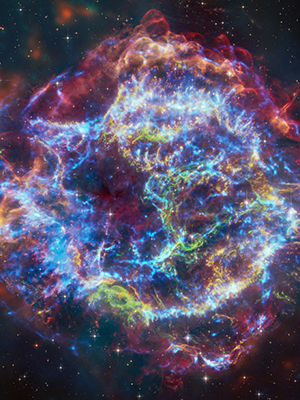
The rainbow connection: Spectroscopy decodes the clouds
At the end of its life, a massive star’s collapse can trigger a brilliant supernova explosion. For reasons that scientists don’t fully understand, some stars appear to undergo a period of violent instability just before exploding.
“One of the key unknowns is what’s happening to stars right before they explode,” Milisavljevic said. “In many instances, before they explode, layers deep inside the star can churn and merge in ways we long assumed didn’t happen.”
JWST’s mirror is nearly three times wider than that of the famous Hubble Space Telescope, letting it collect more than six times as much light, and it is tuned to different wavelengths. Hubble looks mainly at ultraviolet and visible light. JWST looks at infrared wavelengths, which reveal structures that Hubble misses, including dust made of the heavy elements that build planets and life itself.
“Using JWST, we can separate out the clumps of gas and dust, like a surgeon using a scalpel, and analyze the composition of each one,” Milisavljevic said. “What’s amazing is that the dust, which we are testing hundreds of years after the explosion, tells us about what’s happened to the star potentially only hours before it exploded.”
Behind each JWST image released to the public is a carefully calibrated blend of data from multiple filters, each tracing light from different elements, gas temperatures and dust. Those images help scientists study the anatomy of the explosion and extrapolate back to the star that caused it.
The colors aren’t just art; they are a code.
“Once Tea and the team made this very detailed dust map using spectroscopy of small regions, that gave us the decoder ring needed to understand the picture,” Milisavljevic said. “The colors in our images reflect different gases at a wide range of temperatures and densities. But you can’t make sense of an image until you know the composition of the clouds. The spectroscopy let us crack the code.”
A new perspective on stars
Cassiopeia A has been the subject of many of Milisavljevic’s projects with JWST, including some conducted during the first year of the telescope’s research and some several years later.
Studying a supernova remnant is not unlike arriving late to a fireworks show. Flashes of light and flares contrast with the shadows of smoke and showers of shards from the exploding ordnance. The longer the show continues, the more smoke develops and the more clouds shroud the shining lights. Even after the rockets have finished bursting, the drifting smoke and scattered embers still record how many went off, how forcefully and in what directions. For astronomers, Cassiopeia A’s gas and dust play the role of that lingering smoke, preserving a record of how the star exploded.
“By imaging over many years, we can monitor what structures have changed and how their densities and shapes have shifted,” Milisavljevic said. “It gives you a sense of how dynamic the remnant remains hundreds of years after the supernova. Debris is still moving outward at 5,000 kilometers per second, so we can see it move in just a couple of years. I think it’s remarkable that we can watch these changes and understand what they mean from thousands of light-years away.”
For all its power, JWST shares a limitation with every telescope: Its images are flat snapshots of three-dimensional objects seen from a single vantage point.
“Typically we can only see stars from one perspective,” Milisavljevic said. “Think about Orion’s belt. From Earth, it looks like three stars in a row. But if you could fly there, as you approach the constellation, you see the stars are not lined up.”
Spectroscopy supplies the missing dimension by revealing how fast each clump of debris is moving toward or away from Earth. Milisavljevic worked with Purdue’s Envision Center to turn data on remnants like Cassiopeia A into immersive three-dimensional visualizations. Researchers and the public can effectively fly into a dead star and view its debris from angles no telescope on Earth can offer.
From Cassiopeia A to the Crab Nebula, the remnant of a star that exploded in A.D. 1054, to a star torn apart by a supermassive black hole, Milisavljevic’s research is helping scientists rewrite their understanding of stellar life cycles and uncover the story of the universe.
Milisavljevic’s research is funded by NASA and the National Science Foundation.
About Purdue University
Purdue University is a research institution ranked among the top 10 public universities in the United States. More than 111,000 students study at Purdue across multiple campuses, including more than 57,000 at our main campus locations in West Lafayette and Indianapolis. As a land-grant university committed to affordability and accessibility, Purdue’s main campus has frozen tuition 14 years in a row, enabling more students than ever to graduate debt-free.
Media contact: Brittany Steff, bsteff@purdue.edu
Note to journalists:
Photos are available on Google Drive.
Space News
Moon dust and recycled materials could help insulate future lunar habitats
November 16, 2026
Purdue researcher leads group advising the nation on future of lunar exploration
October 21, 2026
Purdue 1 essay competition invites Indiana fifth graders to imagine the future of space exploration
September 30, 2026
Falcon 9 Booster Landing Team receives first Neil Armstrong Space Prize for reusable rocket research
September 16, 2026