Canine cancer patients contribute to next-generation minimally invasive cancer therapies for dogs and humans
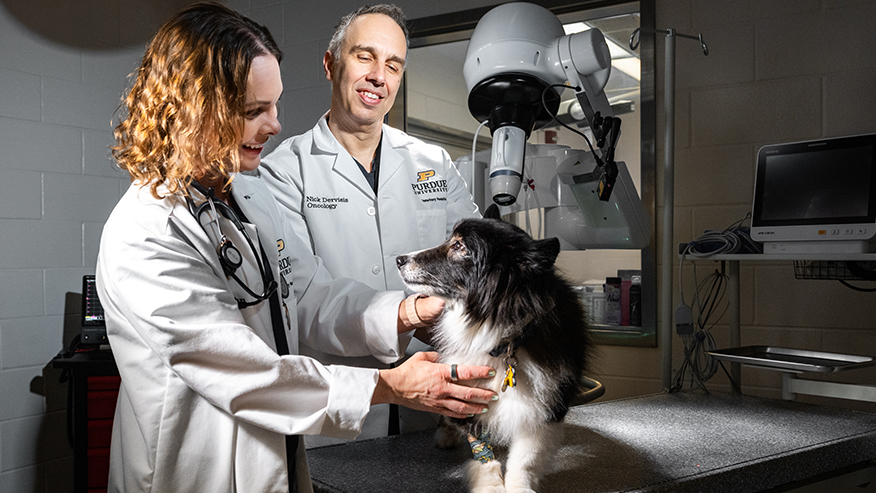
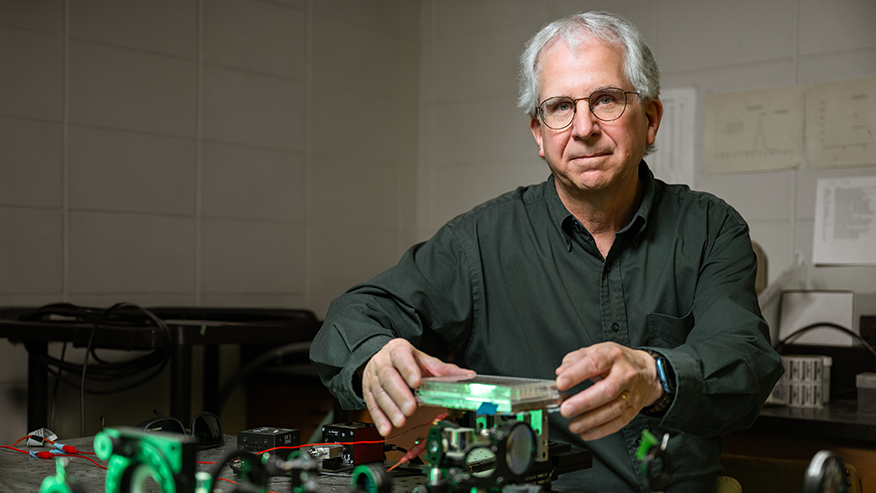
Comparative oncologists Shawna Klahn and Nikolaos Dervisis at Purdue University’s College of Veterinary Medicine study and pioneer protocols for tumor ablation, a less invasive way of treating cancer that can be more effective than surgery, radiation or chemotherapy. Their research benefits dogs and humans alike, improving care and outcomes for cancer patients. (Purdue University photo/Kelsey Lefever)
WEST LAFAYETTE, Ind. — Natural disasters. Hikes. Long, dark nights alone. For many people, dogs offer a sense of safety and comfort in challenging or uncertain times. Cancer researchers at a new lab at Purdue University are partnering with dogs to make cancer less frightening — and less deadly — to some of humanity’s very best friends using a technique called tumor ablation.
Shawna Klahn and Nikolaos Dervisis, both associate professors of comparative oncology at Purdue University College of Veterinary Medicine’s Department of Veterinary Clinical Sciences, have set up a lab at the Evan and Sue Ann Werling Comparative Oncology Research Center to study and pioneer protocols for tumor ablation, a less invasive way of treating cancer that can be more effective than surgery, radiation or chemotherapy.
“Tumor ablation uses highly targeted energy to treat tumors with remarkable precision,” Klahn said. “We use advanced imaging such as CT to plan procedures and real-time ultrasound guidance during treatment to deliver focused ultrasound or pulsed electric field therapies directly to the tumor while minimizing damage to surrounding healthy tissues.”
The benefits of tumor ablation include preserving as much healthy tissue as possible, which can decrease recovery time. Most tumor ablations are outpatient procedures thanks to the amazing accuracy a directed ultrasound machine provides.
“Tumor ablation with some of the technologies to be used here is so accurate that you can potentially slice a cell in half,” Dervisis said. “It’s like using a tiny scalpel to separate the healthy tissue from the tumor — but without having to break any skin.”
A targeted approach
Tumor ablation is used in humans as well as dogs, though its availability varies widely by geographical location, medical facility and practitioner. And as with dogs, its effectiveness varies with the location and type of cancer and with the health of the patient.
Compared to surgery, tumor ablation is less invasive. It can have fewer side effects than radiation and chemotherapy.
The oncology team uses advanced imaging to identify and plan for how to treat tumors.
“Different cancers may respond better to different forms of energy delivery,” Dervisis said. “Some ablation techniques use heat, while others mechanically disrupt tissue without relying on temperature changes. One emerging focused ultrasound approach works by generating microscopic bubble activity within tissues, producing powerful mechanical forces that can selectively disrupt tumor tissue with remarkable precision.”
The targeted and strategic nature of the ablation, added to its noninvasive nature, is what helps make it so successful, especially in sensitive patients or sensitive areas of the body.
Like cutting the bad parts out of an avocado, oncologists want to focus on eliminating only the tumor, leaving as much healthy tissue as possible. Every bit of healthy tissue patients can keep bolsters their body and helps them maintain their health.
Further, the ablation itself may help turn on the patient’s own immune response, alerting it to the cancer’s presence.
“As medical oncologists, we’re very interested in the whole body, not just the primary tumor,” Klahn said. “It’s fascinating the way that the tumor ablation may actually change the immune environment in the tumor and could generate an antitumor immune response in the patient.”
Like a vaccine, the bits of the tumor that are killed may warn the immune system, equipping it to react against the cancer, a longtime goal of oncologists. If the patient’s immune system can begin to identify and remove the cancer cells on its own, the treatment effectively becomes a self-perpetuating anticancer immunization system.
“By killing the cancer, you wake up the immune system,” Dervisis said.
Walking together
In addition to improving outcomes for canine patients, studying cancer in dogs can help unlock the mysteries of human cancer, too. Dervisis and Klahn have been tackling this enigma jointly for more than a decade.
“There are a handful of cancers in dogs that are genetically almost identical to cancers in humans, including bladder cancer and some forms of particularly dangerous bone cancer,” Klahn said. “And those cancers behave clinically the same way they do in humans. Those parallels mean that discoveries in canine cancer translate to human cancer treatments.”
One of the most heartbreaking facts about dogs — their curtailed lifespan compared to humans’ — helps the vets study cancer progression. They can study how cancer risk is passed along through generations and how environmental factors, including lawn chemicals and secondhand smoke, affect dogs’ cancer risk and lifespans.
The goal is to increase both quality and quantity of life: to keep the dogs, and the humans, healthy as long as possible.
“‘Cure’ is often a relative term in oncology,” Dervisis said. “Our goal is not simply to extend life, but to help patients live longer while maintaining excellent quality of life, minimal discomfort and fewer treatment-related side effects. At the same time, we hope to advance the science behind more precise and less invasive cancer therapies.”
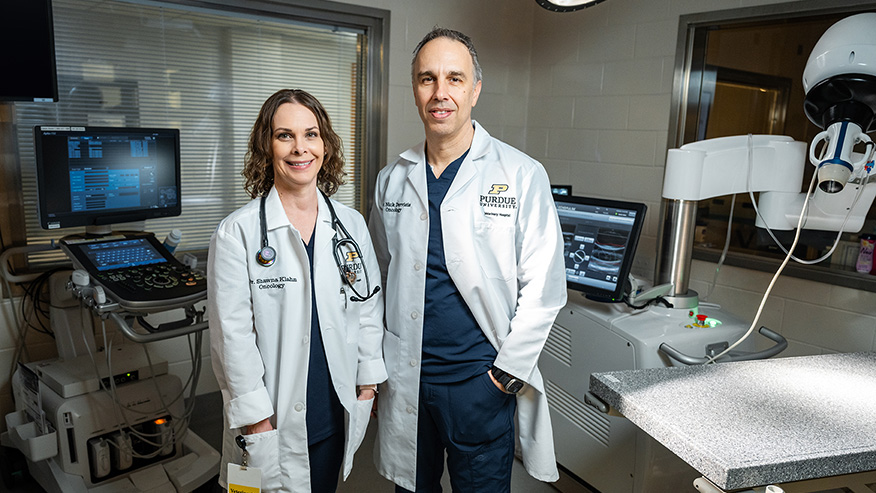
This research, and both Dervisis and Klahn, are part of the Purdue Institute for Cancer Research, one of only eight National Cancer Institute-designated Basic Laboratory Cancer Centers in the United States. The research is funded and supported by Purdue, the National Institutes of Health and the Focused Ultrasound Foundation.
The research is also part of Purdue’s One Health initiative, which focuses on solving complex challenges at the intersection of human, animal and plant health and delivering real-world impact. Purdue is working to improve health outcomes and foster economic growth through four key pillars: academic programs, research, facility infrastructure and industry partnership.
About Purdue University
Purdue University is a research institution ranked among the top 10 public universities in the United States. More than 111,000 students study at Purdue across multiple campuses, including more than 57,000 at our main campus locations in West Lafayette and Indianapolis. As a land-grant university committed to affordability and accessibility, Purdue’s main campus has frozen tuition 14 years in a row, enabling more students than ever to graduate debt-free.
Media contact: Brittany Steff, bsteff@purdue.edu
Note to journalists:
Additional photos are available on Google Drive.
One Health News
Study details surprising human immune cell link to HIV
October 21, 2026
New molecular diagnostics instruments provide improved accuracy
October 14, 2026

Purdue, Elanco, partners celebrate One Health Research Institute groundbreaking
October 7, 2026
Lasers, Doppler effect personalize chemotherapy drug selection for cancer tumors
September 29, 2026