Purdue’s new graduate certificate prepares professionals for success in growing drone industry
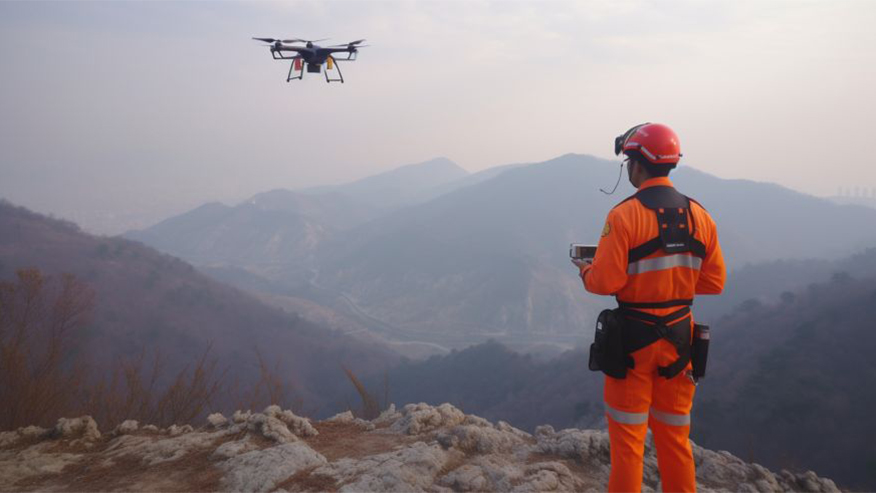
Purdue University's online graduate certificate in advanced unmanned aerial systems will meet the growing demand for operators as drones become an established tool in many facets of everyday life. (Photo/Adobe)
WEST LAFAYETTE, Ind. — Drones have become a staple of modern business, used in real estate, precision farming, infrastructure inspection, public safety, and even package and grocery delivery. Drones — also called unmanned aerial vehicles or UAVs — are an essential tool used to improve safety and efficiency in commercial, civilian and defense businesses, and the UAV industry is projected to experience rapid growth over the next decade — reaching a value of over $182 billion by 2033, according to Grand View Research.
To meet the demand for skilled, knowledgeable UAV operators, managers and innovators, Purdue University is launching an online graduate certificate in advanced unmanned aerial systems. This new program will provide learners with a comprehensive, technology-focused education in unmanned aerial systems (UAS) and prepare them for careers in aviation, defense, public safety, agriculture, videography and more.
The program helps learners navigate the UAS landscape through a technological and policy-based lens, giving them a foundational understanding of UAS laws and how to operate UAVs safely and ethically within modern airspaces. The graduate certificate will also prepare learners to earn the Federal Aviation Administration’s remote pilot certification.
Understanding UAS is important for operators, managers and anyone else working in a role where the systems are utilized, said Mary Johnson, professor and associate head for graduate education and research at Purdue Polytechnic Institute’s School of Aviation and Transportation Technology (SATT). According to Johnson, the ubiquity of UAS has made building expertise in the technology more important than ever before.
“While UAS is not a new technology, it is a technology that is rapidly increasing in both capabilities and usage,” Johnson said. “More people in many roles need improved skills in digesting large amounts of data, understanding the results and using these results for improving the outcomes. Even if a person in decision-making roles does not operate a UAS, they do need to understand technical details, mission planning, data management and reporting of results.”
Through engaging online coursework, learners in the graduate certificate program will design data acquisition missions, select appropriate sensors, and process and interpret aerial data using Geographic Information System software. Learners will also explore the intersection of UAS and cybersecurity, learning how to mitigate threats like GPS spoofing and signal jamming.
According to Joseph Hupy, associate professor in Purdue Polytechnic Institute’s SATT, the graduate certificate can help professionals in security, law enforcement and other industries navigate consequential security issues in mission-critical environments. Plus the coursework is dynamic and responsive to industry needs.
“Perhaps the most beneficial aspect of the certificate is that it is designed to change with the rapid changes in both UAS technology and policies,” Hupy said. “As UAS adoption accelerates, there is a growing need for leaders who understand both the technology and the regulatory environment and who can safely integrate drones into the national airspace system.”
The graduate certificate consists of three online courses, which translates to nine credit hours. All credits from the graduate certificate in advanced unmanned aerial systems can be applied toward Purdue’s online Master of Science in Aviation and Aerospace Management.
“Purdue’s online format and stackable design align with its mission to provide high‑quality, industry‑relevant professional education that advances careers,” Hupy said. “Drones are not going away. They are here to stay, and by pursuing UAS technology at the graduate level, we are ensuring a skilled workforce that will continue to harness ways in implementing this technology.”
Learn more about Purdue’s new online graduate certificate in advanced unmanned aerial systems at the program’s webpage.
About Purdue University
Purdue University is a public research university leading with excellence at scale. Ranked among top 10 public universities in the United States, Purdue discovers, disseminates and deploys knowledge with a quality and at a scale second to none. More than 106,000 students study at Purdue across multiple campuses, locations and modalities, including more than 57,000 at our main campus locations in West Lafayette and Indianapolis. Committed to affordability and accessibility, Purdue’s main campus has frozen tuition 14 years in a row. See how Purdue never stops in the persistent pursuit of the next giant leap — including its integrated, comprehensive Indianapolis urban expansion; the Mitch Daniels School of Business; Purdue Computes; and the One Health initiative — at https://www.purdue.edu/president/strategic-initiatives.
Media contact: Brian Huchel, bhuchel@purdue.edu
More Purdue News

Purdue to host early and Election Day voting
October 19, 2026

Search for Amelia Earhart’s plane continues after Taraia Object expedition on Nikumaroro rules out latest hypothesis
October 18, 2026

Earhart expedition update: Weather prevents shore work for third straight day; crew to extend trip
October 16, 2026

Earhart expedition update: Weather prevents shore work Thursday; ID update expected in next 48 hours
October 15, 2026