NASA associate administrator visits Purdue, tours research facilities
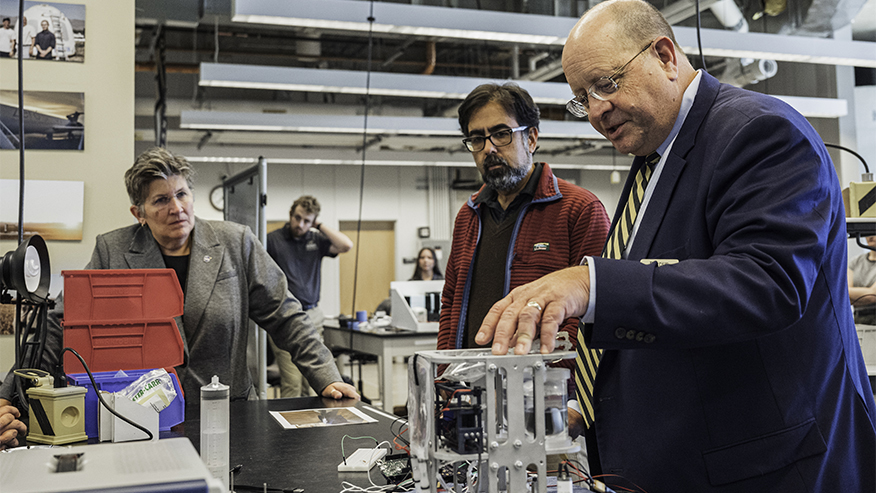
NASA Associate Administrator Amit Kshatriya, center, tours a low-gravity lab in the Neil Armstrong Hall of Engineering with Steven Collicott, a professor in the School of Aeronautics and Astronautics, and Julie Kramer White, director of engineering at NASA’s Johnson Space Center and a Purdue alumna. Kshatriya toured additional labs in Neil Armstrong Hall along with facilities in the Hypersonics Applied Research Facility; Maurice J. Zucrow Laboratories; Ray W. Herrick Laboratories; and labs affiliated with the Department of Earth, Atmospheric, and Planetary Sciences. (Purdue University photo/Becky Robiños)
WEST LAFAYETTE, Ind. — NASA Associate Administrator Amit Kshatriya visited Purdue on Tuesday (April 21) to learn more about the university’s state-of-the-art research facilities that support key NASA programs.
Purdue’s robust aerospace and planetary science ecosystem provides research strengths that span the entire arc of space systems and areas aligned with NASA’s mission needs, including atmospheric entry, in-space propulsion, mission design, planetary surface exploration and human habitation. Kshatriya toured labs in the colleges of Engineering and Science that help advance high-impact research central to NASA’s future missions.
Across these labs, researchers study conditions associated with extreme flight environments to develop tools that make complex missions possible and advance technologies that support sustained human activity beyond Earth.
For instance, cutting-edge capabilities like hypersonic wind tunnels and rocket combustion test cells help generate data that inform hypersonic flight and propulsion in space.
Purdue teams are also translating complex orbital mechanics into visual insights that support mission design and analysis, as well as operating instruments that interpret surface composition and contribute to real-time decisions on Mars rovers.
At the same time, researchers are performing experiments to explore how fluids and systems behave in low-gravity environments and are developing smart, autonomous deep-space habitats capable of operating far from real-time support on Earth.
Taken together, the work on display illustrates Purdue’s role in contributing foundational research, validated technologies and systems-level insight across multiple phases of space exploration.
Kshatriya serves as the highest-ranking civil servant and chief operating officer at NASA. He leads the agency’s 10 center directors as well as the mission directorate associate administrators at NASA headquarters in Washington, D.C.
In addition to touring research facilities, Kshatriya attended the inaugural Neil Armstrong Space Prize winner announcement. This transformative prize leverages Purdue’s unparalleled space heritage, having produced numerous astronauts and developing pioneering aerospace education and research.
Known as the Cradle of Astronauts, Purdue has 30 alumni who have flown in space or been selected as NASA astronaut candidates. With the upcoming Virgin Galactic Purdue 1 suborbital flight mission, the university is set to send five more Boilermakers into space.
About Purdue University
Purdue University is a public research university leading with excellence at scale. Ranked among top 10 public universities in the United States, Purdue discovers, disseminates and deploys knowledge with a quality and at a scale second to none. More than 106,000 students study at Purdue across multiple campuses, locations and modalities, including more than 57,000 at our main campus locations in West Lafayette and Indianapolis. Committed to affordability and accessibility, Purdue’s main campus has frozen tuition 14 years in a row. See how Purdue never stops in the persistent pursuit of the next giant leap — including its integrated, comprehensive Indianapolis urban expansion; the Mitch Daniels School of Business; Purdue Computes; and the One Health initiative — at https://www.purdue.edu/president/strategic-initiatives.
Media contact: Trevor Peters, peter237@purdue.edu
Space News

Purdue’s space work is featured at NASA Science Showcase
April 28, 2026

SpaceX team wins Purdue’s first Neil Armstrong Space Prize for its reusable rocket system
April 21, 2026
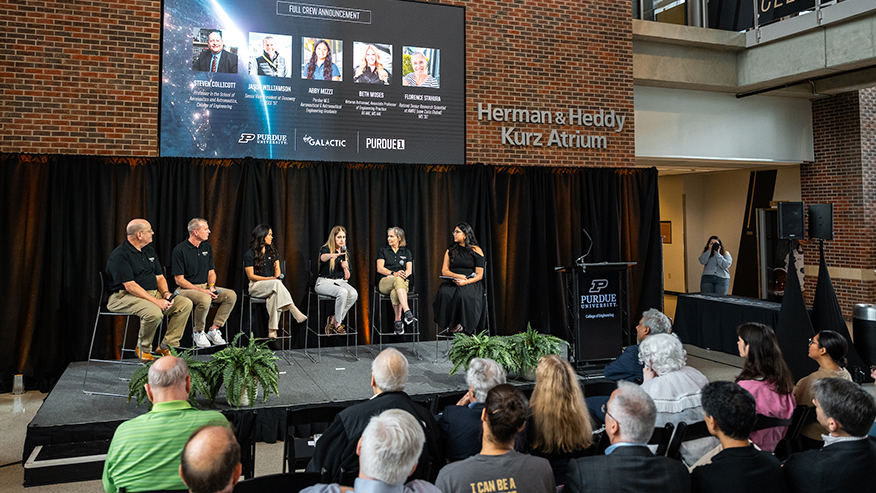
2 Purdue alumnae complete the crew of the Virgin Galactic all-Boilermaker spaceflight
April 15, 2026
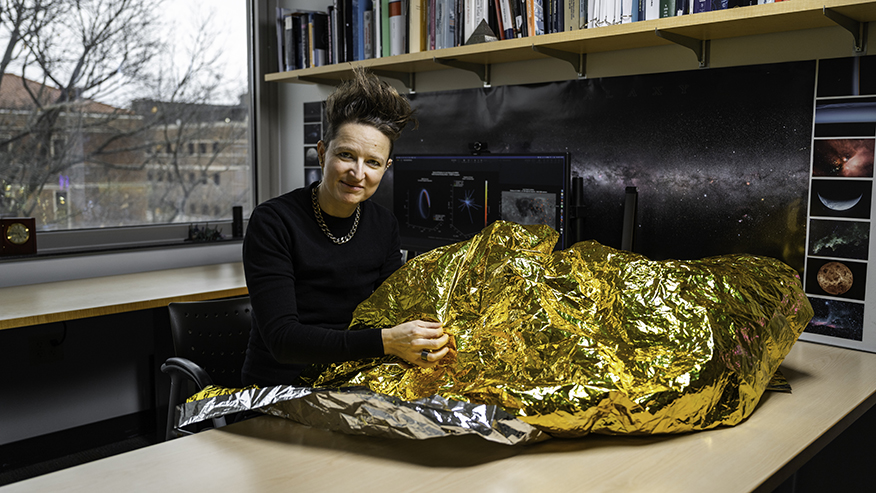
Limiting space junk’s threat by predicting its mess in the Earth-moon neighborhood
March 26, 2026