Small segments of RNA halt cancer in multiple ways
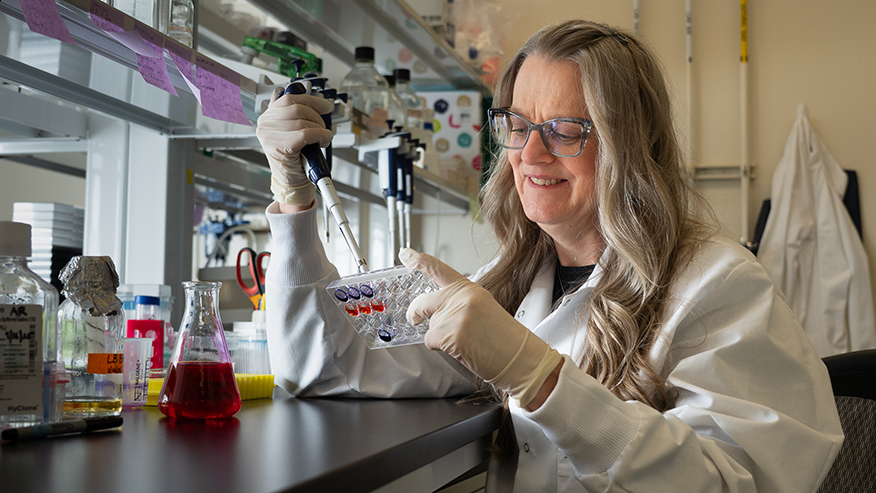
Andrea Kasinski, Purdue University’s Walther Professor of Cancer Biology, is developing cancer drugs based on microRNAs — small, noncoding segments of RNA. (Purdue University photo/John Underwood)
WEST LAFAYETTE, Ind. — Like tiny superheroes, small, naturally occurring segments of RNA can block multiple molecular paths that cancer cells use to grow and spread, a substantial advantage over even the most advanced medicines available. Harnessing the complex interactions of these so-called microRNAs could form the basis for powerful new cancer drugs. Purdue University researcher Andrea Kasinski is leading work on the relationship between microRNAs and cancer, including developing a modified microRNA that curbs at least three genes known to drive cancer and therapy resistance.
“Cancer is never just a single mutation in a single gene. You can downregulate one gene with a drug, but the cancer is evolving — it’s going to find another way,” said Kasinski, the Walther Professor of Cancer Biology in the Department of Biological Sciences and deputy director of the Purdue Institute for Cancer Research. “This is where microRNA has the power. With one microRNA I can hit seven or eight genes. And the ones we’re working on hit many genes that cancer cells depend on.”
RNA is perhaps best known for its role serving as a carbon copy of genes, the instructions for assembling all the materials of life written in the molecular code of DNA. But other types of RNA regulate which genes will be accessed, copied and assembled as proteins, in the process known as gene expression. Cancer thrives by hijacking genes it shouldn’t be able to use, following forbidden instructions on how to multiply, evade the immune system and spread. Kasinski’s research explores the role small noncoding RNAs play in that process and uses that knowledge to develop RNA-based medicines.
While therapies based on one type of noncoding RNA, short-interfering RNA, have made it to market — including a Food and Drug Administration-approved treatment that informed Kasinski’s own work — those drugs have only one target. Kasinski’s lab is the first to draft the powerful multitarget microRNAs, many of which serve as a natural check on cellular processes that cancer seeks to commandeer.
The modified microRNA Kasinski created, microRNA-34a, suppresses the activity of the cancer-promoting MET, CD44 and AXL genes. When cancer cells access and copy these genes, microRNA-34a binds to the RNA copy, blocking the remaining steps in the process that converts instructions into materials. Kasinski designed microRNA-34a to last longer inside the cell than its naturally occurring ancestor and combined it with an ingenious delivery system that targets cancer cells. Combining microRNA-34a with existing cancer treatments could exert enough braking power to halt tumor growth.
“We’re unique in that we’re trying to explore more complicated small RNA therapeutic modalities,” Kasinski said. “We’re the furthest along in the pipeline because after a clinical trial using an early formulation failed, we were the only ones in this space.”
Kasinski is developing microRNA-34a in the lab and through LigamiR Therapeutics, a company she founded to advance RNA therapeutics. LigamiR has obtained the rights to the technology from the Purdue Innovates Office of Technology Commercialization, which has received a patent on the intellectual property. She recently won funding from the V Foundation for continued research on microRNA-34a as a treatment for triple-negative breast cancer and a Dr. Ralph and Marian Falk Medical Research Trust Catalyst Award focused on ovarian cancer and non-small cell lung cancer. Kasinski’s research is part of Purdue’s One Health initiative, which involves research at the intersection of human, animal and plant health and well-being.
Kasinski’s work also addresses questions about how cancer cells take over normal cell processes and evade safeguards in the first place. Part of their strategy, and another area of Kasinski’s research, appropriates a sort of cellular postal system wherein cells package materials into bundles of membrane, called extracellular vesicles, and disgorge them from the cell. Cells use extracellular vesicles to communicate with one another, but cancer cells use them to drive cancer progression and to dump RNAs — including microRNAs — DNA and proteins. Kasinski, who is presently investigating a previously unknown source of extracellular vesicles, says the process offers another opportunity for therapeutics.
Her work on noncoding RNAs has also brought her to a surprising but entirely different avenue of research on how epigenetics — the machinery that surrounds DNA — drives resistance to an existing non-small cell lung cancer drug. Her lab is investigating a protein known for its abundant presence at areas of the genome that are securely locked down and generally unstudied. But KMT5C is also found in lower levels at more interesting areas of the genome and, as Kasinski’s team discovered almost by accident, a small drop in levels of KMT5C is sufficient to activate these areas.
Kasinski said her lab’s ongoing work on KMT5C and extracellular vesicles illustrates the importance of “following the science.”
“This is one of the more exciting projects we’re working on, and it has nothing to do with RNA,” Kasinski said. “But if we think a little differently, if we ask questions about how cancer is turning normal cell processes to their advantage and we understand more of that fundamental biology, perhaps we can also intervene differently than what we’re already doing.”

About Purdue University
Purdue University is a public research university leading with excellence at scale. Ranked among top 10 public universities in the United States, Purdue discovers, disseminates and deploys knowledge with a quality and at a scale second to none. More than 106,000 students study at Purdue across multiple campuses, locations and modalities, including more than 57,000 at our main campus locations in West Lafayette and Indianapolis. Committed to affordability and accessibility, Purdue’s main campus has frozen tuition 14 years in a row. See how Purdue never stops in the persistent pursuit of the next giant leap — including its integrated, comprehensive Indianapolis urban expansion; the Mitch Daniels School of Business; Purdue Computes; and the One Health initiative — at https://www.purdue.edu/president/strategic-initiatives.
Papers
Redesigning miR-34a: Structural and chemical advances in the therapeutic development of an miRNA anti-cancer agent
Biochemical Society Transactions
DOI: https://doi.org/10.1042/BST20253010
Extracellular vesicles released by non-small cell lung cancer cells drive invasion and permeability in non-tumorigenic lung epithelial cells
Scientific Reports
DOI: https://doi.org/10.1038/s41598-022-04940-6
Loss of KMT5C promotes EGFR inhibitor resistance in NSCLC via LINC01510-mediated upregulation of MET
Cancer Research
DOI: https://doi.org/10.1158/0008-5472.can-20-0821
Insight into the mechanisms and dysregulation of KMT5C-H4K20me3 in cancer
Epigenetics
DOI: https://doi.org/10.1080/15592294.2025.2574007
Media contact: Trevor Peters, peter237@purdue.edu
One Health News
Protein modification discovery opens cancer therapy possibilities
March 25, 2026
Exploring the machinery that surrounds DNA to stop cancer
March 5, 2026

NIH Director Fireside Chat
February 16, 2026

Purdue’s new online master’s in radiopharmaceutical manufacturing gives students hands-on experience in growing field
February 11, 2026