Expanded accessibility, flexibility helping Purdue Global Law School address Indiana’s legal deserts
Purdue Global Law School aims to keep students living and working in areas where the need for attorneys is high
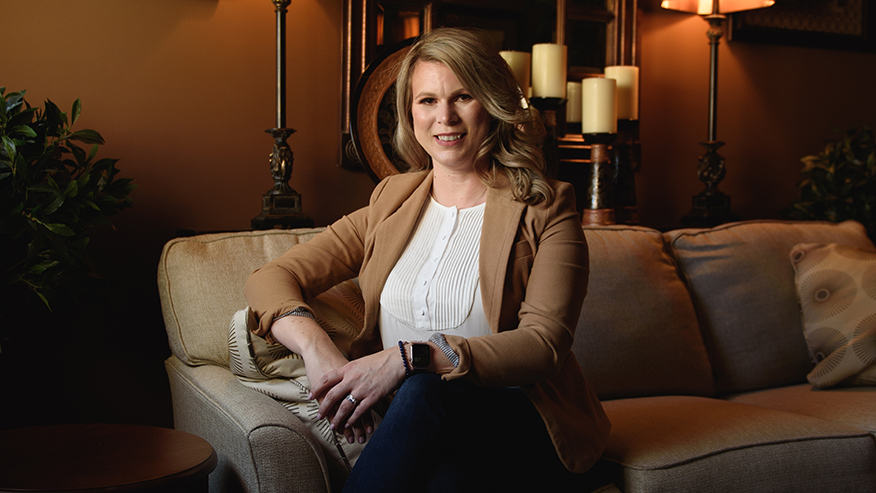
Purdue Global Law School student Holly Hall is working toward her law degree with the goal of helping people with estate planning in her community, which is considered a legal desert. (Photo provided)
WEST LAFAYETTE, Ind. — Holly Hall recalls first hearing about wills as a preschooler, following her grandmother’s death. Hall remembers learning that a will meant giving your most treasured possessions to people you loved.
“I sat down and created my own will, carefully assigning dolls and toys to family members in case something happened to me,” said Hall, a Purdue Global Law School student from Osceola, Indiana. “At that age, I didn’t know the legal complexities behind estate planning, but I understood its heart — protecting what matters most and showing love through preparation.”
That simple act planted the seed for Hall’s lifelong passion.
For many Indiana residents in rural communities and northwest Indiana, access to various legal specialties — or to any legal counsel at all — is an increasing challenge.
Kim Kass, Purdue Global Law School’s director of employment and community outreach, emphasized the impact.

“The shortage of attorneys in Indiana heightens the ongoing access-to-justice issue and impacts both those in rural areas and those who do not have financial resources to afford an attorney,” Kass said. “It also impacts the legal community in specific areas of the state because the demand for legal representation is high but the supply of lawyers is low, which results in a higher workload for attorneys in those legal deserts.”
The national and local challenge of legal deserts
According to Martin Pritikin, dean and vice president of Purdue Global Law School, most rural counties in the U.S. and many urban ones are “legal deserts,” with fewer than one attorney per 1,000 residents, whereas the national average is four per 1,000.
“Indiana has been particularly hard hit, not only because it has a significant rural population, but also because within the last decade, it lost two of its five law schools,” Pritikin said. “Indiana needed a way to broaden the pipeline to the legal profession.”

Purdue Global Law School has focused its outreach on the parts of Indiana that don’t already have a campus-based law school nearby.
“We are telling people in northwest Indiana, the Fort Wayne region and rural areas that there is a flexible option online for working adults who want to be attorneys,” he said.
Opening the door to the bar
Purdue Global Law School’s success in addressing the shortage hinges on advocating for bar eligibility and leveraging its online format.
Previously, the most significant barrier for Indiana residents attending a non-ABA-approved online school like Purdue Global Law School was the ineligibility to sit for the state’s bar exam. Pritikin successfully advocated for the Indiana Supreme Court to amend the rules, creating a pathway for non-ABA law school graduates to apply for a waiver for the Indiana bar exam.
This ruling took effect in July 2024, allowing Purdue Global Law School graduates to sit for Indiana’s bar exam in February 2025, and the first five eligible graduates successfully passed and were admitted to the Indiana bar. Purdue Global Law School graduates are also exam-eligible in California and Connecticut.
This change directly enables more residents to pursue licensure in Indiana, offering a solution to addressing access to justice.
“It’s going to take a few more years before the current students choosing to attend Purdue Global Law School because of the new pathway will begin sitting for Indiana’s bar exam and practicing, but we’re already seeing the impact with the recent success of the alumni who have taken Indiana’s bar exam,” Pritikin said.
The online model makes legal education accessible to working adults and parents who cannot relocate to traditional, on-campus sites. This model attracts students who already have deep roots in the communities they will likely serve.
“I have long believed the best way to get more lawyers in underserved areas is to make it feasible for people who already live there to stay there while they attend law school,” he said.
Pritikin said the data support this approach, as 8% of the state’s lawyers find themselves working in legal deserts while 22% of the population lives in a legal desert.
“Just under 30% of the state’s population lives in rural areas or small towns, but 37% of our Indiana-based students are in such areas,” Pritikin said. “Five counties in northwest Indiana account for 12% of the state’s population, but 13% of our Indiana students live there.”
Leveraging coursework and faculty
Purdue Global Law School offers rural law and virtual law courses, which equip students with the tools to address local legal issues efficiently and affordably by leveraging technology to reduce costs and expand access.
Kass, with over 20 years of experience practicing and teaching law and living in northwest Indiana, is actively building connections within the Indiana legal community by leveraging her extensive local background to create opportunities.
“My role allows me to be a small part of the solution in addressing the shortage of attorneys, particularly in legal deserts and rural areas,” Kass said. “I am building relationships with judges, legal aid organizations, small firms, pro bono providers and bar associations.”
These efforts are making inroads to fill the gap in areas where legal deserts exist, much to the benefit of students, like Hall, who can take classes while living and working in the areas where it’s needed most.
“Very few attorneys in my community focus on estate planning and estate administration — critical services for families,” Hall said. “After graduation, I plan to establish a practice dedicated to estate planning and administration, providing personalized, affordable services to those who might otherwise go without.”

Stefan May, a recent Purdue Global Law School graduate from Crown Point, Indiana, is proof that the model and the school’s efforts to educate students and launch careers where they already live are working. He is scheduled to take the Indiana bar exam in February 2026.
“Without Purdue Global Law School and its flexible, online setting, I would not have been able to attend law school at all,” May said. “The closest physical school to me was approximately two hours away. Purdue Global Law School gave me a chance, and I ended up graduating with honors. I currently hold a law clerk position at Robbins and Seville LLC, where I fully intend on accepting a position as an associate lawyer upon being licensed.”
About Purdue Global Law School
Purdue Global Law School is part of Purdue Global, the public, nonprofit, online school for working adults backed by Purdue University. Founded in 1998, Purdue Global Law School was the first to offer students a traditional law school program in an affordable, online format. For more information, please visit PurdueGlobalLawSchool.edu.
Media contact: Adam Bartels, adam.bartels@purdueglobal.edu
Purdue Global News

Purdue Global Law School’s Distinguished Speaker Series to discuss ‘nuclear’ verdicts
March 19, 2026
Purdue Global’s nursing simulation program receives INACSL endorsement
February 25, 2026

U.S. Olympians with Guild and Team USA Learning Network celebrate strong showings at Milano Cortina 2026
February 18, 2026

U.S. Olympian with Guild and Team USA Learning Network celebrates bronze medal at Milano Cortina 2026
February 11, 2026