Smart pacifier could offer natural option to monitoring infant breathing
Purdue professor awarded $1.19M to develop device using sound waves
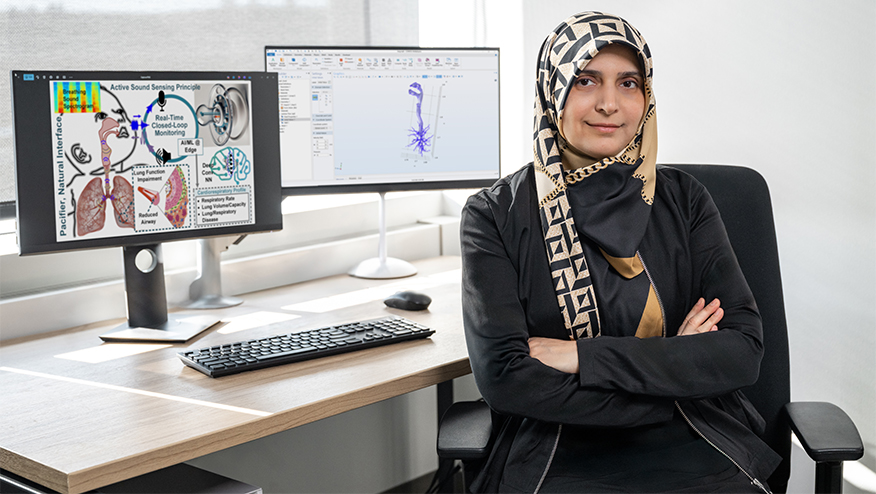
Miad Faezipour, an associate professor in Purdue Polytechnic Institute’s School of Engineering Technology, sits in front of diagrams of her research into infant breathing. Faezipour is researching a “smart pacifier” to help monitor potential breathing complications in newborn or premature infants. (Purdue University photo/Kelsey Lefever)
WEST LAFAYETTE, Ind. — Purdue University research is transforming the pacifier from a parental necessity for quieting a baby to a cutting-edge medical device that uses sound to diagnose breathing issues in infants.
Miad Faezipour, an associate professor in Purdue Polytechnic Institute’s School of Engineering Technology, is developing a patent-pending “smart pacifier” to help hospital neonatal units overcome the daily issue of detecting potential breathing complications in newborn or premature infants.
“Babies are so fragile and there’s no way that we can communicate with them,” she said. “You can’t just ask a baby to breathe into a device to collect the breathing pattern. So we thought of something that is a natural interface for infants, and what better than a pacifier?”
Faezipour and her team recently received a $1.19 million grant toward developing the smart pacifier from the National Institutes of Health’s (NIH) National Heart, Lung, and Blood Institute.
The four-year smart pacifier project led by Purdue will utilize sound sensing technology and artificial intelligence-based analysis to track babies’ breathing in real time, safely and noninvasively. The device analyzes breathing sounds to assess the infant’s cardiopulmonary function and wirelessly transmits data to a parent’s phone or a physician’s laptop, making it easier to detect problems early at home or in the hospital.
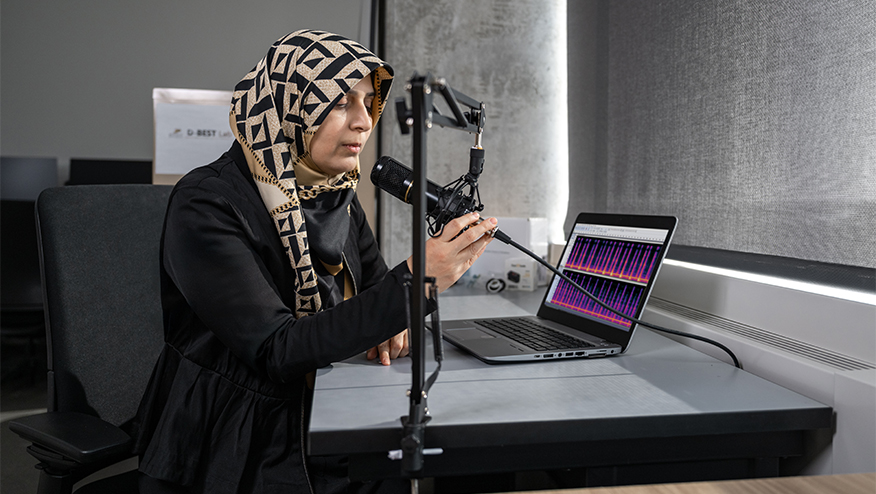
Faezipour said sound waves are emitted into the respiratory airway and then reflected back. That sound reflection is an echo — similar to radar or sonar — that can tell doctors a lot of meaningful information about the breathing pattern of the infant patient.
“A particular frequency could give us information about the heart rate, while another frequency could give us information about the lung volume, the lung capacity, respiratory rate and other details,” said Faezipour, who is also a member of the Regenstrief Center for Healthcare Engineering and a core faculty member of the Applied AI Research Center at Purdue.
The research links two important university initiatives: Purdue Computes, which emphasizes AI as one of four pillars of an expanding technological and computational environment, and Purdue One Health, driven by its goal of delivering real-world impacts by solving problems in human, animal and plant health and fostering economic growth through industry partnerships and programs.
Faezipour disclosed the smart pacifier to the Purdue Innovates Office of Technology Commercialization, which has applied for a patent to protect the intellectual property. Industry partners interested in developing or commercializing the work should contact Patrick Finnerty, assistant director of business development and licensing, life sciences, at pwfinnerty@prf.org about track code 70507.

The smart pacifier expands upon Faezipour’s previous research regarding breathing sounds with adults. She said the first two years of the project will be used to fine-tune the smart pacifier and AI model, followed by two years of testing. The grant is one of two Faezipour received in September for her research. She also received funds from a $1.2 million grant funded by the NIH’s National Center for Complementary and Integrative Health for her work on a cutting-edge implant for diabetes care that targets the body’s nerve pathways using advanced circuitry and AI.
This is a collaboration with Smriti Bhatt, assistant professor at Purdue Polytechnic’s School of Applied and Creative Computing, and with the University of Alabama at Birmingham’s S. Abdollah Mirbozorgi, electrical and computer engineering, and neonatologists Namasivayam Ambalavanan and Colm P. Travers, UAB School of Medicine.
About Purdue University
Purdue University is a public research university leading with excellence at scale. Ranked among top 10 public universities in the United States, Purdue discovers, disseminates and deploys knowledge with a quality and at a scale second to none. More than 106,000 students study at Purdue across multiple campuses, locations and modalities, including more than 57,000 at our main campus locations in West Lafayette and Indianapolis. Committed to affordability and accessibility, Purdue’s main campus has frozen tuition 14 years in a row. See how Purdue never stops in the persistent pursuit of the next giant leap — including its integrated, comprehensive Indianapolis urban expansion; the Mitch Daniels School of Business; Purdue Computes; and the One Health initiative — at https://www.purdue.edu/president/strategic-initiatives.
Media contact: Brian Huchel, bhuchel@purdue.edu
One Health News

Lasers, Doppler effect personalize chemotherapy drug selection for cancer tumors
September 15, 2026

Provost announces leadership appointments, promotions
September 14, 2026
Purdue researchers study cancer in canines to help advance treatments for humans
August 27, 2026

Purdue to expand research footprint in Indianapolis with new facility
July 20, 2026