Explaining a quantum oddity with 5 atoms
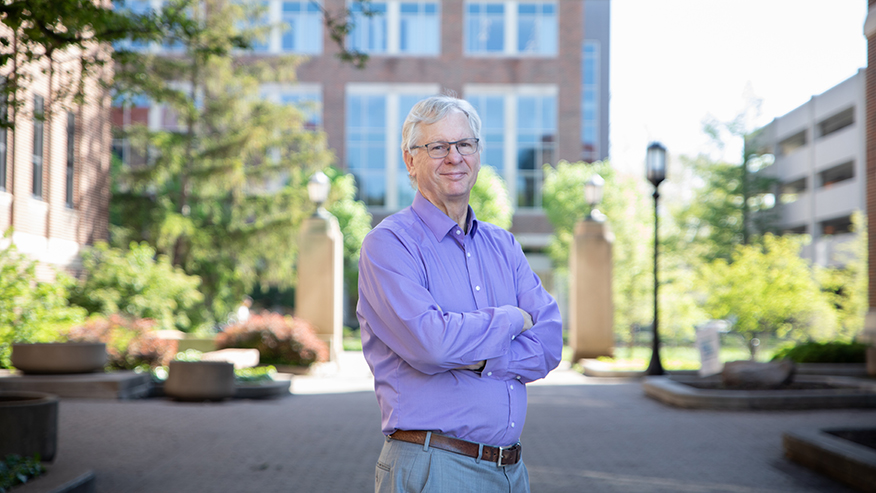
Purdue University physicist Christopher Greene completed the immense quantum calculations required to represent a quantum effect with five atoms. (Purdue University photo/Alisha Willett)
WEST LAFAYETTE, Ind. — Matter gets weird at the quantum scale, and among the oddities is the Efimov effect, a state in which the attractive forces between three or more atoms bind them together, even as they are excited to higher energy levels, while that same force is insufficient to bind two atoms. At Purdue University, researchers have completed the immense quantum calculation required to represent the Efimov effect in five atoms, adding to our fragmented picture of the most fundamental nature of matter.
The calculation, which applies across a broad range of physical problems — from a group of atoms being studied in a laser trap to the gases in a neutron star — contributes to our foundational understanding of matter and may lead to more efficient methods for confining atoms for study.
For Christopher Greene, the Albert Overhauser Distinguished Professor of Physics at Purdue, who modeled the problem with four atoms in 2009, the accomplishment has been 15 years in the making. Greene is a member of the Purdue Quantum Science and Engineering Institute and his research is a cornerstone of Purdue Computes — a comprehensive initiative that spans computing departments, physical AI, quantum science and semiconductor innovation. Research on the interactions between five atoms was published in the Proceedings of the National Academy of Sciences.
“Understanding how five particles interact is a fundamental problem that we need to solve if we want to advance quantum applications beyond the lab,” said Greene, who led the research in collaboration with Michael Higgins, a postdoctoral research associate in Greene’s lab at the time of the research. “We were able to do this with a combination of faster computers, more parallel processing and a deeper understanding of the math, advances that took us a step farther than we could with the four-body problem in 2009.”
In a simplistic view of gases, atoms or molecules move through the air and bounce off one another like billiard balls. The atoms move rapidly when hot and more slowly when cold. But the atoms do exert a small attractive force on one another, Greene said, which raises a question: What amount of attractive force is needed to bind the particles as they interact?
The answer can be determined with the Schrödinger equation, which is used to predict outcomes in quantum systems over time.
In the 1970s, Russian theoretical physicist Vitaly Efimov predicted that, given the nature of the attraction between atoms, more force would be needed to bind two atoms than would be needed to bind three. Paradoxically, once combined, the atoms would remain bound regardless of the energy added to the system, even though the added energy increases their movement and the distance they are able to move from one another.
As with other quantum phenomena, like superposition and entanglement, the Efimov state is hard to fathom given our experience of the physical world, but quantum interactions are the foundation of that everyday world.
In 1999, Greene’s research group predicted that, because quantum mechanical effects are more dominant when atoms move very slowly, the Efimov effect could be observed in gases that are cooled to nearly absolute zero. Five years later, a research group in Europe induced an Efimov state among three atoms of cesium in an ultracold gas. Greene, an expert in ultracold quantum physics, said inducing the phenomenon has since become experimentally routine.
But using Schrödinger’s equation to model the Efimov effect is computationally intensive even in the simplest possible scenario, and each additional atom in the system increases the complexity of the required calculations. Greene’s 2009 research showed that four identical bosons — a class of subatomic particle — bind more easily than three. The new solution, which computes the rate at which five identical bosons will combine over time, was only made possible by improvements in computational ability and better formulations that overcome mathematical roadblocks.
“We think we know the laws of quantum mechanics, but the formulas are incredibly difficult to solve. It’s taken a deeper understanding of the math to reach this point,” Greene said. He credited Higgins with planning and executing the supercomputer calculations to help advance theoretical physics.
The research was supported by the National Science Foundation.
About Purdue University
Purdue University is a public research university leading with excellence at scale. Ranked among top 10 public universities in the United States, Purdue discovers, disseminates and deploys knowledge with a quality and at a scale second to none. More than 107,000 students study at Purdue across multiple campuses, locations and modalities, including more than 58,000 at our main campus locations in West Lafayette and Indianapolis. Committed to affordability and accessibility, Purdue’s main campus has frozen tuition 14 years in a row. See how Purdue never stops in the persistent pursuit of the next giant leap — including its integrated, comprehensive Indianapolis urban expansion; the Mitch Daniels School of Business; Purdue Computes; and the One Health initiative — at https://www.purdue.edu/president/strategic-initiatives.
Papers
Five-body recombination of identical bosons
Proceedings of the National Academy of Sciences
DOI: https://doi.org/10.1073/pnas.2503390122
Signatures of universal four-body phenomena and their relation to the Efimov effect
Nature Physics
DOI: https://doi.org/10.1038/nphys1253
Recombination of three atoms in the ultracold limit
Physical Review Letters
DOI: https://doi.org/10.1103/PhysRevLett.83.1751
Media contact: Trevor Peters, peter237@purdue.edu
Purdue Computes News
‘Movies’ of interaction between light and matter help advance quantum tech
October 6, 2026

Purdue and University of Illinois, 2 engineering powerhouses, team up to strengthen semiconductor workforce in U.S.
September 22, 2026
Purdue secures $19M from NSF to develop AI-driven programmable labs for semiconductors, advanced materials
August 5, 2026
Purdue expands semiconductor professional education portfolio to advance global workforce development
July 8, 2026