Purdue leads nationwide initiative tackling semiconductor talent shortage
Chipshub effort creates online access to cutting-edge simulation tools for chip design
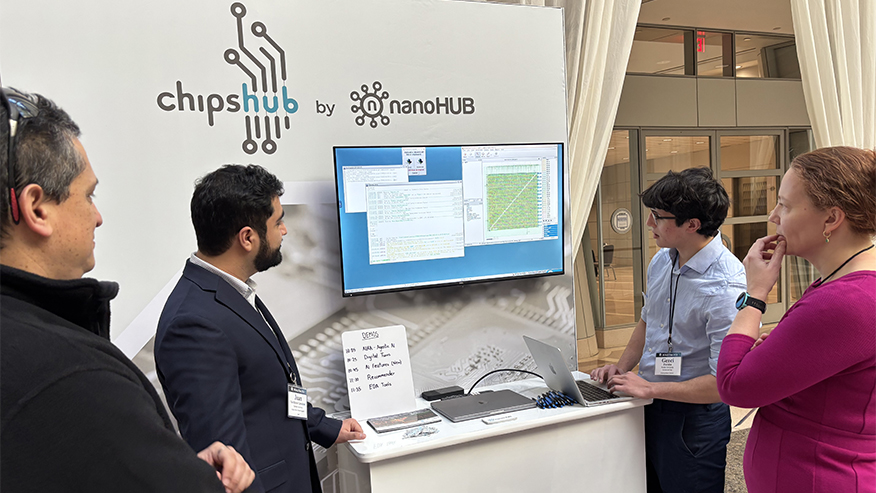
Genci Duraku of Purdue University demonstrates electronic design automation tools — which are used to design chips — running on Purdue’s Chipshub, an academic platform that provides open, accessible and scalable infrastructure for research and education. (Purdue University photo)
WEST LAFAYETTE, Ind. — Purdue University’s Chipshub is leading the charge to bolster available workforce talent for the semiconductor industry by providing free online access to cutting-edge simulation tools used to design chips for educational purposes on the university’s nanoHUB platform. The program is the result of a public-private-academic partnership developed in collaboration with leading industry partners — including Cadence, Synopsys and Siemens — as well as federal agencies like the Department of Defense and National Science Foundation.
“This initiative reduces the cost and time for adoption of electronic design automation (EDA) tools in the classroom and empowers universities across the United States — particularly nonresearch-intensive institutions — to train the next generation of semiconductor engineers and technicians,” said Alejandro Strachan, Purdue’s Reilly Professor of Materials Engineering and co-director of nanoHUB/Chipshub.
Universities can now integrate these EDA tools into their curricula without the burdens of procurement, installation or maintenance and enable rapid upskilling in chip design, simulation and verification.
“Semiconductor innovation is the backbone of modern technology — from AI and electric vehicles to national security — but we’re facing a serious shortage of skilled workers by 2030,” Strachan said. “By making these tools accessible online via Chipshub, we’re removing barriers that have long sidelined smaller institutions. This isn’t just about education; it’s about building a resilient domestic workforce to fuel America’s semiconductor resurgence under the CHIPS and Science Act.”
Purdue’s nanoHUB, a pioneering cyber platform launched in 2002, has facilitated over a million simulations and served 500,000 users worldwide. This new Chipshub EDA initiative builds on that legacy, aligning with national priorities to onshore semiconductor capabilities and grow the STEM (science, technology, engineering and math) workforce.
The U.S. semiconductor sector designs 52% of the world’s chips and is experiencing explosive demand driven by AI, 5G and advanced manufacturing. The workforce must expand by 115,000 jobs by 2030, and current projections indicate over 50% of these jobs are at risk of going unfilled, according to a 2023 report issued by the Semiconductor Industry Association. Traditional barriers to accessing EDA tools — such as specialized hardware requirements and the need for dedicated IT support — have affected nonresearch-intensive universities, which educate a significant portion of the nation’s student body but lack the resources of elite research institutions.
The new initiative improves efficiency for universities, potentially reducing a large portion of cost. Kerrie Douglas, co-director of Purdue University’s Scalable Asymmetric Lifecycle Engagement (SCALE) program, said the nanoHUB partnership goes beyond a learning concept by offering SCALE students hands-on experience with industry tools.
“Our students are being trained with industry standard tools in real-world problems, and this is only possible because of the support we receive through the partnership,” said Heather Orser, assistant professor of electrical and computer engineering at the University of St. Thomas, Minnesota. St. Thomas is one of 35 institutions in the SCALE consortium’s workforce development.
By extending access to over 100 U.S. universities in the first phase, the initiative will reach tens of thousands of students and foster a broader and more inclusive talent pipeline as well as bolster U.S. competitiveness in global supply chains.
“Giving students hands-on experience will positively impact the future workforce,” said David Junkin, academic network program director at Cadence. “We’re excited to partner with nanoHUB because they’re removing a significant barrier for academia by centralizing the IT infrastructure thereby enabling easy access to industry-grade technology.”
“Synopsys is proud to empower the next generation of semiconductor talent by providing universities with state-of-the-art chip design tools and resources through the common Chipshub platform, thereby quickly bridging the gap between academia and industry,” said Katy Crist, director of workforce development at Synopsys.
“Siemens Digital Industries Software is proud to partner with Purdue’s Chipshub to provide state-of-the-art software that equips students with industry-ready skills,” said Joanna Pritchard, head of Siemens’ EDA academic engagement. “By giving learners hands-on access to the same advanced tools used by leading semiconductor companies, this collaboration helps close the skills gap and ensures our customers have access to the highly skilled talent they need to innovate and compete.”
About Purdue University
Purdue University is a public research university leading with excellence at scale. Ranked among top 10 public universities in the United States, Purdue discovers, disseminates and deploys knowledge with a quality and at a scale second to none. More than 106,000 students study at Purdue across multiple campuses, locations and modalities, including more than 57,000 at our main campus locations in West Lafayette and Indianapolis. Committed to affordability and accessibility, Purdue’s main campus has frozen tuition 14 years in a row. See how Purdue never stops in the persistent pursuit of the next giant leap — including its integrated, comprehensive Indianapolis urban expansion; the Mitch Daniels School of Business; Purdue Computes; and the One Health initiative — at https://www.purdue.edu/president/strategic-initiatives.
Media contact: Brian Huchel, bhuchel@purdue.edu
Purdue Computes News

Purdue secures $19M from NSF to develop AI-driven programmable labs for semiconductors, advanced materials
August 5, 2026

Purdue expands semiconductor professional education portfolio to advance global workforce development
July 8, 2026

Purdue-affiliated startup launching educational D-Day simulation
June 1, 2026

Purdue, GCCS partner to scale the future of silicon carbide
May 28, 2026