Homework H2.A – Sp 26

Problem statement
Solution video

Note: Due to the weather-related changes in the course this week, this problem will NOT be collected.

DISCUSSION THREAD

Discussion and hints:

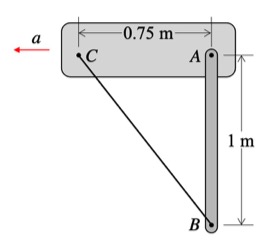
The solution for this problem requires only a straight-forward application of the rigid body acceleration equation, relating the known accelerations of points A and C:

aC = aA + α x rC/A – ω2rC/A

Since this vector equation has two components (x and y), you have two scalar equations from which you can solve for ω and α.


Any questions??

Homework H2.B – Sp 26

Problem statement
Solution video

Note: Due to the weather-related changes in the course this week, the submission of this problem can be delayed until 11:59PM on Friday, January 30.


DISCUSSION THREAD

We encourage you to interact with your colleagues here in conversations about this homework problem.


Discussion and hints:

Enlarged view

This problem is  a straight-forward application of the planar rigid body kinematics equations. The velocity and acceleration of the center of the disk are known, as well as the angular velocity and angular acceleration of this disk. To find the velocity and acceleration of point A on the disk, you can use the following:

v_A = v_O + omega x r_A/O
a_A = a_O + alpha x r_A/O – omega^2*r_A/O

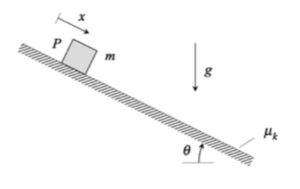
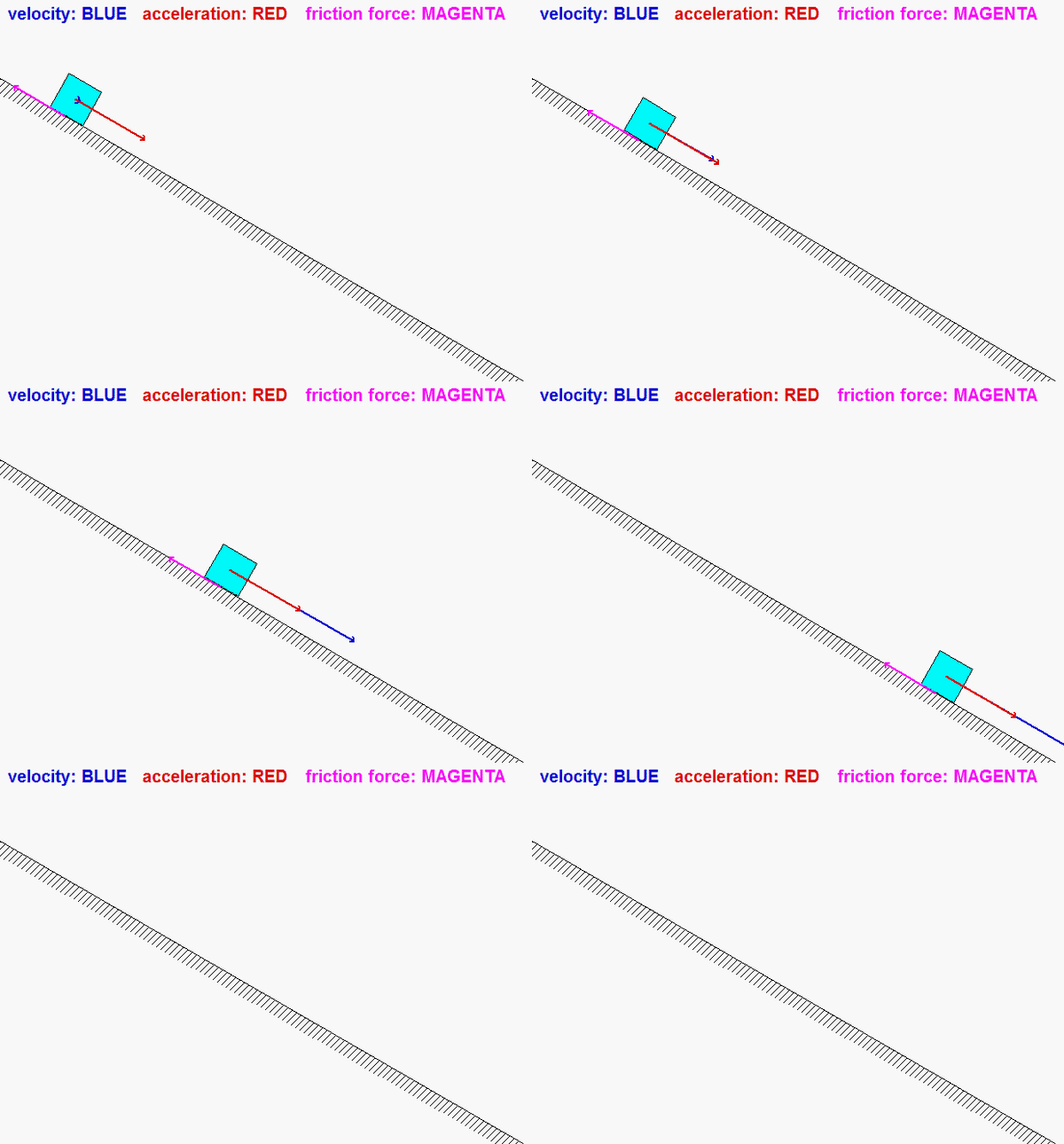
Using the enlarged view above, we can see the interplay between velocity (blue) and acceleration (red) of point A. Using what we learned back in Chapter 1, can you identify times when the speed of A is increasing and when it is decreasing? (Hint: Look at the angle between the velocity and acceleration vectors.) Using the top view, we can see the path of point A – is that the path that you expected for A?


Homework H1.I – Sp 26

Problem statement
Solution video

DISCUSSION THREAD

Discussion and hints:

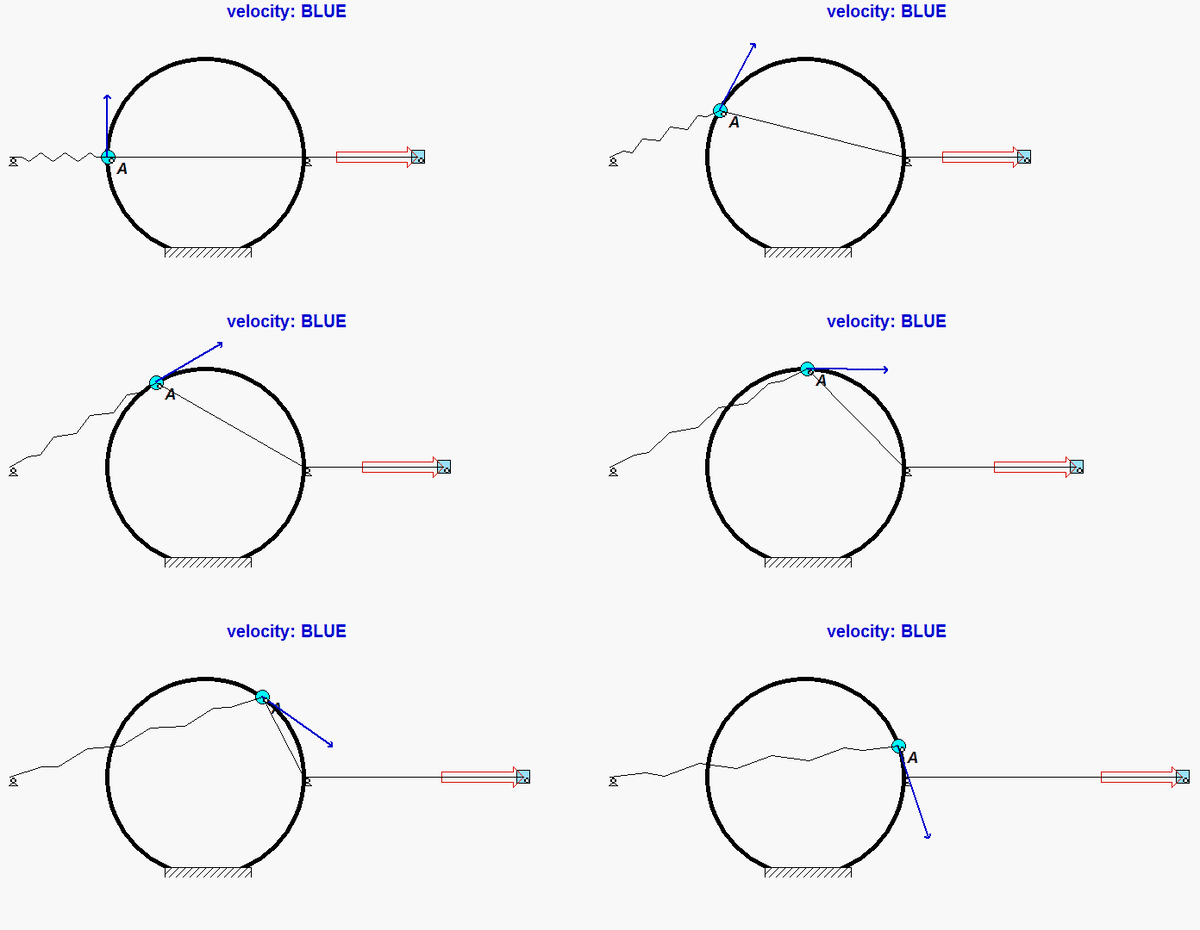
This is a typical cable-pulley problem for us in this course. Here, we need to first write the length of the cable, L, in terms of the position variables of sA and sB, along with some constants. Since it is assumed that the cable does not break, go slack or stretch, the length L is constant. Take a time derivative of the expression above for L. This relates the speeds of blocks A and B.

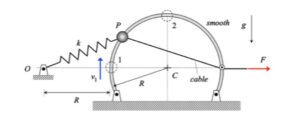
Carefully study the animation of the motion of this cable-pulley system provided below. One of the questions asked of you is the speed of B when sA = 0. What do you see in the animation below as sA passes through zero? Does your equation above tell you the same thing?


Any questions??

Homework H1.J – Sp 26

Problem statement
Solution video

DISCUSSION THREAD

Discussion and hints:

An observer riding along on block A will describe the motion of P relative to themself in terms of the radial distance r and the cable angle θ. Because of this, it is convenient to use the relative motion kinematics equations to write down the velocity and acceleration of particle P:  vP = vA + vP/A and aP = aA + aP/A , where the relative velocity and relative acceleration terms are written in polar form:

vP/A = r_dot e+ r*theta_dot eθ

aP/A = (r_ddot -r*theta_dot2e+ (r*theta_ddot + 2r_dot*theta_dot) eθ

You will need to write the polar unit vectors eand eθ in terms of the Cartesian unit vectors, i and j, at some point before you can add together terms.

QUESTION: What is the relationship between xA and r? (Recall that the cable remains taut at all times.)

An animation showing the path of point P corresponding to θ_dot = constant is provided below. How does this true path differ from the view of the path as seen by the observer on A? Can you visualize that? HINT: The path seen by the observer on A is an inward spiral centered on the observer (point A).


Any questions??

Homework H1.G – Sp 26

Problem statement
Solution video

DISCUSSION THREAD

Discussion and hints:

For this problem, the “Given” information is in terms of the Cartesian kinematical description. The “Find” asks for parameters that are part of the path kinematical description.

For the Given part of the kinematics, you will need to find the first and second derivatives of y with respect to time using implicit differentiation of the the path equation: xy = b, and using that the first time derivative of x is a constant value of c.

Next, you need to relate the Cartesian and path descriptions of the acceleration. There are many approaches in doing this. The most straight-forward approach is to use the projection of acceleration onto the unit tangent vector to find the rate of change of speed: v_dot = aPet, where the unit tangent is found from et = vP/vP. The radius of curvature can then be found directly from the magnitude of acceleration equation: aP2 = v_dot2 + (vP2/ρ )2.

Recall that the sign of v_dot tells us whether P is increasing or decreasing in speed. From the animation below, we see that the acceleration vector has a negative ethroughout the full range of motion. Alternately, you can say that the angle between velocity and acceleration is greater than 90° over that motion. So: increasing or decreasing in speed?


Any questions??

Homework H1.H – Sp 26

Problem statement
Solution video (PDF providing four different versions of the solution)

DISCUSSION THREAD

Discussion and hints:

For this problem, the “Given” information is in terms of the path kinematical description. The “Find” asks for parameters that are part of the polar kinematical description.

The key to the solution of this problem is being able to correctly draw the sets of path and polar unit vectors.

  • The path unit vectors eand eare tangent and perpendicular to the circular slot (the path).
  • The polar unit vectors are defined as: er points outward from O to P (along the slot in the arm), and eθ  in the direction perpendicular to er (perpendicular to the slot) and in direction of increasing angle θ (counterclockwise rotation from er).

For the position of interest (θ = 45°), these vectors are as shown below.

It is recommended that you write the polar unit vectors in terms of the path unit vectors, use projections of v and a onto the polar unit vectors to produce four equations for the four unknowns. (There are a number of equivalent ways to solve this problem involving either vector projections or balancing of coefficients in the kinematics equations, as detailed in lecture and in the lecture book.)

Warning: Do not confuse the roles played by “r” and “R” in this problem.

The animation below shows the results of this analysis over a range of angles θ. There is an interesting result here. These results show that the acceleration vector is always perpendicular to the path (the circular slot). This is rarely the case. What is special about this problem that makes it true here? HINT: Think about the relationship between the angle of rotation of the arm and the angular rotation of P around the circle.


Any questions??

Homework H1.E – Sp 26

Problem statement
Solution video

DISCUSSION THREAD

Discussion and hints:

For the polar description to be used here, the radial unit vector epoints from O toward B. The transverse unit vector eθ is perpendicular to eand points in the direction of increasing angle θ (counterclockwise from eR).

The first time derivative of θ  is given to the the constant ω. Therefore, the second time derivative of θ  is zero. The time derivatives of R are found from direct differentiation of the path equation R = bθ . These results then are used to find the vP and aP in terms of their polar coordinates.

Carefully watch the animation below of the motion of P. As we have seen before, the velocity vector is always tangent to the path, whereas the acceleration vector has both tangent and normal components. The normal component always points inward to the path. Also, as we have seen before, when the angle between vP and aP is less than 90°, the speed of P is increasing. As you can see from the animation below, the speed of P is increasing throughout the entire motion.

Please note the orientations and directions of the polar unit vectors eR and eθ shown in the figure below for θ = 30°.


Any questions??

Homework H1.F – Sp 26

Problem statement
Solution video

DISCUSSION THREAD

Discussion and hints:

For the polar description to be used here, the radial unit vector epoints from O toward P. The transverse unit vector eθ is perpendicular to eand points in the direction of increasing angle θ (clockwise from eR).

The solution of this problem comes down to trig – can you do the projections of vP and aP onto the polar unit vectors eand eθ ? For example, the velocity of P can be written as vP = vP sinθ eR + vcosθ eθ. And, the acceleration of P can be written as aP = –aP cosβ eR – asinβ eθ . No formulas to remember, just look at the figure and do the trig! From these results, you can identify the time derivatives of R and θ.


Any questions??

Homework H1.C – Sp 26

Problem statement
Solution video

DISCUSSION THREAD

Discussion and hints:

In this problem, we know both the magnitude and direction for each of the velocity and acceleration vectors for the center of mass G. We know that the unit tangent vector et is in the same direction as the velocity vector vG. The unit normal vector en is perpendicular to et, and points “up and to the right” (do you know why?). Projecting the acceleration vector aG onto the unit tangent and unit normal vectors gives us the information that we need to find the rate of change of speed and the radius of curvature of the path.

Carefully watch the animation below of the motion of the aircraft. When the acceleration vector shown in RED points “backward” from the direction of travel, the aircraft is slowing down; that is, the rate of change of speed is negative. Conversely, when the acceleration vector is “forward” of the direction of travel, the aircraft is increasing in speed with a positive rate of change of speed. If you follow this logic, you are on your way to understanding the usefulness of the results of the path description of kinematics!


Any questions??

Homework H1.D – Sp 26

Problem statement
Solution video

DISCUSSION THREAD

Discussion and hints:

Here, the distance traveled along the circular path, s, is known as an explicit function of time. The speed of P at any instant is simply v = ds/dt, and the rate of change of speed is: v_dot = d2s/dt2. Since the path is circular, the radius of curvature is given by: ρ = R. With these three quantities, you have everything that you need to write down the velocity v = v e and a = v_dot et + (v2/ρ) en.

Carefully watch the animation below of the motion of P. When the acceleration vector shown in RED points “backward” from the direction of travel, particle P is slowing down; that is, the rate of change of speed is negative. Conversely, when the acceleration vector “forward” of the direction of travel, P is increasing in speed with a positive rate of change of speed. You will see that the period of time during which the speed of P is increasing is rather short, occurring during a time immediately after the direction of P changes.


Any questions??