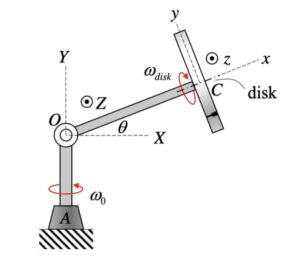
| Problem statement Solution video |

DISCUSSION THREAD
This is a fairly standard problem using the rigid body kinematics equations:
vB = vA + ω x rB/A
aB = aA + α x rB/A – ω2rB/A
| Problem statement Solution video |

DISCUSSION THREAD
This is a fairly standard problem using the rigid body kinematics equations:
vB = vA + ω x rB/A
aB = aA + α x rB/A – ω2rB/A

DISCUSSION THREAD
This is a fairly standard problem using the rigid body kinematics equations:
vB = vA + ω x rB/A
aB = aA + α x rB/A – ω2rB/A
| Problem statement Solution vide |
DISCUSSION THREAD

Part a)
Here it is recommended that you use the relative velocity equation of:
vP = vB + vP/B
For this equation, you know the magnitude and direction of vB (vB = vB i where vB is known) and you know the direction of vP (vP = vPcosθ i – vPsinθ j where the scalar vP is unknown). For the term of vP/B you need to ask the question: What is the direction of the velocity of P as seen by an observer riding along on B? The answer to this is P appears to be moving only along the vertical slot; that is, vP/B = vrel j, where vrel is the (unknown) speed of P as seen by an observer on B. Substitute these three terms into the relative velocity equation and balance out the coefficients of the unit vectors. This will give you two scalar equations for two unknowns.
Part b)
Same hints as for Part a) except substitute in acceleration for velocity.
| Problem statement Solution video |
DISCUSSION THREAD
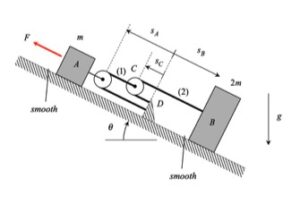
For this problem, add up the lengths of the different sections of the cable in terms of the motion variables sA and sB to produce the total length of the cable L. Since L is assumed to be constant (cable does not stretch, break or go slack), set dL/dt = 0. From the result, determine the speed of B. Take care in the differentiation as one of the terms in the expression for L will involve a square root.
| Problem statement Solution video |
DISCUSSION THREAD

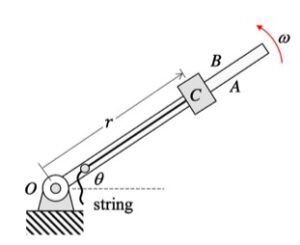
Here you are to use the rigid body aceleration equations for bar OA:
aA =aO + α x rA/O – ω2rA/O
For this equation you know that aO = 0 and you know completely the vector expression for the acceleration of A. From this vector equation, you can write down two scalar equations from balancing the coefficients in front of the unit vectors. Solve these two equations for α and ω.
| Problem statement Solution video |
DISCUSSION THREAD

This is a fairly standard problem using the rigid body kinematics equations:
vB = vA + ω x rB/A
aB = aA + α x rB/A – ω2rB/A
| Problem statement Solution video |
DISCUSSION THREAD

DISCUSSION
Please ask and answer questions here. Either way, you learn.
| Problem statement Solution video |
DISCUSSION THREAD

NOTE: Use phi = 20 degrees.
Discussion and hints:
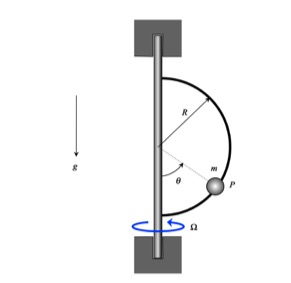
For the polar description to be used here, the radial unit vector eR points from O toward P. The transverse unit vector eθ is perpendicular to eR and points in the direction of increasing angle θ (clockwise from eR).
The solution of this problem comes down to trig – can you do the projections of vP and aP onto the polar unit vectors eR and eθ ? For example, the velocity of P can be written as vP = vP sinθ eR + vP cosθ eθ. And, the acceleration of P can be written as aP = –aP cosβ eR – aP sinβ eθ . No formulas to remember, just look at the figure and do the trig! From these results, you can identify the time derivatives of R and θ.

Any questions??
| Problem statement Solution videohttps://youtu.be/uTfjHrtO_pQ |
DISCUSSION THREAD

DISCUSSION
Please ask and answer questions here. Either way, you learn.
| Problem statement Solution video |
DISCUSSION THREAD

Discussion and hints:
For this problem, the “Given” information is in terms of the path kinematical description. The “Find” asks for parameters that are part of the polar kinematical description.
The key to the solution of this problem is being able to correctly draw the sets of path and polar unit vectors.
For the position of interest (θ = 45°), these vectors are as shown below.

It is recommended that you write the path unit vectors in terms of the polar unit vectors, balance coefficients and then solve for the unknowns.
Warning: Do not confuse the roles played by “r” and “R” in this problem.
The animation below shows the results of this analysis over a range of angles θ. There is an interesting result here. These results show that the acceleration vector is always perpendicular to the path (the circular slot). This is rarely the case. What is special about this problem that makes it true here? HINT: Think about the relationship between the angle of rotation of the arm and the angular rotation of P around the circle.

Any questions??