| Problem statement Solution video |
DISCUSSION THREAD
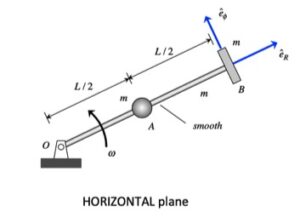
NOTE: Initially, P is not sliding relative to the rotating bar.
Any questions?? Please ask/answer questions regarding this homework problem through the “Leave a Comment” link above.
DISCUSSION
Four-step plan
Step 1: FBD
Draw a free-body diagram particles A and B, along with the bar, altogether. Is angular momentum for this system conserved? Why, or why not?
Step 2: Kinetics – Angular impulse/momentum
Write down the angular momentum for A, B and the bar individually, and then add together. For a particle A, for example, recall that angular momentum is given by HO = m rA/O x vA. For a rigid body, HO = IOω. You will also need the coefficient of restitution equation relating the radial (normal components here) components of velocity of A and B during impact.
Step 3: Kinematics
For writing down the velocity of points A and B, a polar description is recommended. For example, vA = R_dot eR + Rωeθ.
Step 4: Solve
Solve your equations from Steps 2 and 3 for the velocity of P. Do not forget that A will have both radial and transverse components of velocity.
Does the coefficient of restitution e apply to the total velocity of Particle A, or only to the velocity component acting along the eR direction
Based on this problem, this only applies to the velocity component acting along the line of impact. The e^R axis is the line of impact.
Keep in mind from Chapter 4 that the COR is to be used to relate the before and after components of velocity along the “n” direction. That is, it does NOT relate the total velocities of the two impacting bodies.
Are we able to assume that the initial velocity of A in the e^R direction is 0 for this problem?
Yes, that is correct. I have added a note to that effect to the Discussion of this problem.
Is the collision between A and B, or A and the whole bar?
The impact is between bodies A and B.
If we take angular momentum about point O for (A + bar + B) during the impact do the impulse forces between A and B cancel out as internal forces, or do we still need to account for them because they act at different points?
Yes, looking at the system of A + bar + B makes the impact and contact forces internal.
Should the application of the coefficient of restitution be included in the kinematics step of the 4 step procedure? I just want to make sure I’m applying the course logic correctly.
It fits in much better in STEP 2 on Kinetics.
How is the coefficient of restitution used in this problem? By my understanding, all but the final velocity of A in the er direction is zero.
Prior to the first impact, the bar is rotating and particle A is moving outward on the bar. During impact of A with B, the radial component of velocity of A is changed with this change dictated by the COR for the impact. The rotation rate of the arm is not changed during the impact.
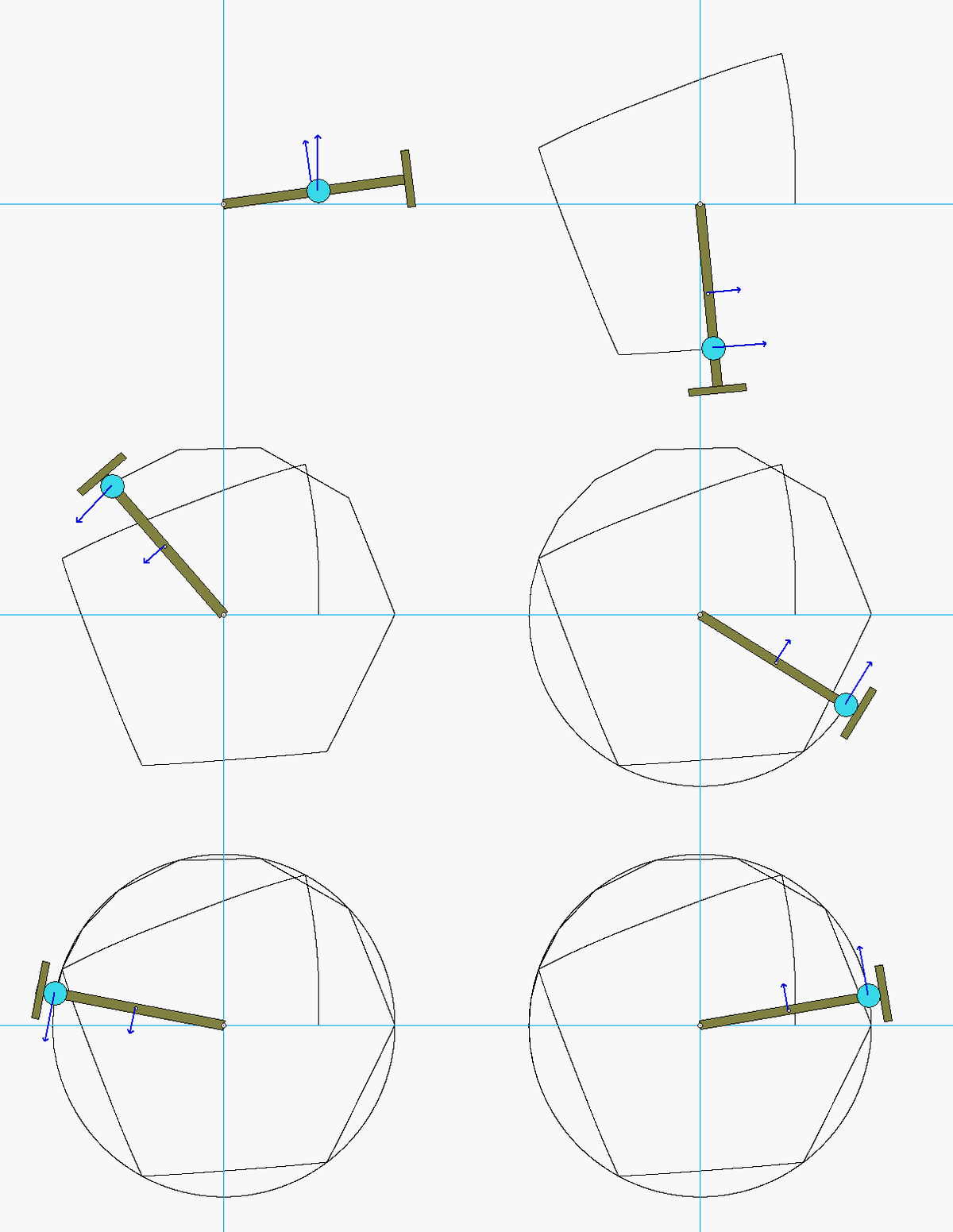
You can see this in the animation provided.
It is also helpful that the vn in this problem is always in line with the bar which is the only component used with the coefficient of restitution. There is no vt of the ball relative to the bar if i’m not mistaken
Can we say that the velocity of A right before the impact in the r direction is the same as the velocity in the r direction initially? Or does the normal force apply work on the particle?
As provided in the Note above, A is initially not sliding on the bar. This means that the velocity of A in the r direction is initially zero.
As the bar rotates, A picks up speed in the r direction. You can find the value of r_dot immediately before impact through the use of conservation of angular moment and the conservation of mechanical energy.
You can’t say that because the initial r velocity is zero, and then it becomes nonzero as A starts to slide outward toward B. Normal force also does not apply work to the particle, but the particle still accelerates outward because of r 2dot = r omega^2.
the coeff of restitution only effects the e_r direction. does this mean that we should use the final angular velocity at length L to find the component tangent?
The impact of A with B does not affect the rotation rate of the arm; that is, omega does not change during the impact.
The answer to this question is not directly necessary, but I am curious: What is happening to the mechanical energy of the entire system? It seems that angular momentum should be conserved, but due to the fact that the collision is not perfectly elastic, energy should be “lost” through the collision. But I’m not sure how that would exactly work.
The contribution to the mechanical energy from radial motion of A dies away with time. The angular momentum, as you describe above, is conserved and does not die away. As a result of the changes in radial position of A, the angular velocity of the bar fluctuates in time but tends to a constant value as the radial motion is dissipated.
Since er × er is 0, angular momentum doesn’t give us an er er relationship. How do we then find the radial velocity of A right before the collision?
I used work-energy to find the radial velocity of A right before the equation. You can then use this result to find the radial velocity of A after the collision with the coefficient of restitution equation.
linear momentum
Is gravity supposed to be included in this problem? The problem statement makes no mention of it yet has a pin joint that appears as though it is on the ground- although the gif for this problem in the blog doesn’t appear to include it.
Please note that the problem statement specifies that all motion occurs in a horizontal plane.
I understand that the system should be set up in a way that allows the collision to be considered internal, but why does the impact of A and B not effect the velocity of the system of particle B and the bar?
Would We need to use the work energy equation to find the speed along the bar from right before impact and after?
Up to the point of A impacting B, this is a standard angular momentum problem that we have solved several times before. In those previous problems, we needed to use the AIM and the W/E equations to determine the velocity of the sliding particle A.
During impact, W/E is not useful. You are not asked to deal with the problem after impact.
How can you reconcile the different components of motion for A?
Not sure of what you are asking here. The velocity of A is used for both AIM and W/E. For AIM, just write down the velocity of A in polar form as you use that for finding its angular momentum. For W/E, the components are not explicitly used, just the magnitude.
Why is angular momentum about point O conserved during impact even though large internal force occurs between particles A and B?
You used the correct words: the large impact force between A and B is INTERNAL when you use the system of A+B+bar. Since the AIM equation takes into account only external forces, the internal impact force has no contribution.
The only external forces acting on A+B+bar are the reaction forces acting on the bar at O. Since they act at O, they make no contribution to the moment about O.
I found it helpful to think of this problem in 3 states- first where A is at the midpoint, second where A is just about to impact B, and third right after A impacts B
When using the W/E equation does the I_G of the bar change from instant 1 to instant 2 because particle A changes position? And because A is a particle would we just use the parallel axis theorem to account for the changes in I_G?
For this problem does it make sense to break this up into 3 moments- initial, right before impact, and right after impact? That makes more sense to solve this systematically in my mind.
moments as in instants, not forces!
thats what worked for me
Particle B doesn’t have a velocity in the radial direction, right?
Yes, because it stays at the same radial distance of L. This helps a lot in the coefficient of restitution equation.
is assuming constant omega actually consistent with the full system dynamics, or is it a hidden approximation in this homework problem? Should we also be using coefficient of restitution or is that incorrect?
That assumption would be very inconsistent with our dynamics. Angular momentum is conserved, which means that as A move outward, the angular speed decreases.
Do we assume that w2 right before impact is equal to w3 right after impact, and if we do, why can we assume this because the collision isn’t elastic?
The only way for omega to change is if the radial distance out to A changes. During impact, there is an instantaneous change in velocity but no change in position. This is an understanding that we have had throughout our investigations of impacts.
A thing that helped me for this question was to separate the motion into radial and tangential directions and understanding what changes during the impact, and I also found it useful to use the conservation of angualr momentum about O along with the restitution equation for the impact at B.