| Problem statement Solution video |
DISCUSSION THREAD
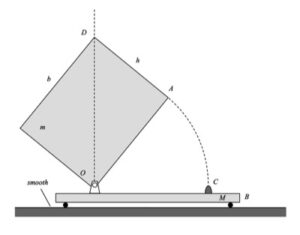
Any questions?? Please ask/answer questions regarding this homework problem through the “Leave a Comment” link above.
Discussion and hints
The four-step plan:
- FBD: It is recommended that you draw a free body diagram of the plate and cart combined.
- Kinetics: Your FBD should show that the summation of forces in the direction of motion for the cart (call that the x-direction) is zero; therefore, linear momentum in the x-direction is conserved for ALL time. Also note that energy is conserved up to the point of impact. During impact, energy is not conserved; however, you are given the coefficient of restitution (COR) for the impact.
- Kinematics: Write down the rigid body velocity equation relating the motion of points O and the plate’s center of mass G. Here you will use the fact that the cart moves only in the x-direction.
- Solve
Is the moment of inertia for the plate I = (1/12)(b^2+h^2)?
Yeah if your doing it around the center of mass of the plate.
Where do I take the moments if point O is moving
I think we can take moments about O even though it is moving if we include a pseudo force acting at the COM to account the carts acceleration.
What method(s) will you use here? Note that the discussion above suggests using the work/energy and the LIM equations since you are looking for the change in velocities. With these two methods you do not need to take moments; therefore, it is not relevant to consider taking moments.
The cart is moving so Vo =/ 0 and is constrained to the x direction, correct?
Correct.
With O being attached to the cart, do I just use the relative motion about O plus the cart’s velocity to get the velocity of the plate CoM before impact?
I would simply use the rigid body equation for this:
v_G = v_O + omega x r_G/O
How is the center of mass for the entire system changing through this motion? To me it seems that its vertical position will change, but the horizontal position will likely not?
The position of the center of mass for the combined system of the plate and the cart does not change horizontally as the system moves because there is no net horizontal force on that system. The center of mass for the plate does move to the right whereas the center of mass for the cart moves to the left.
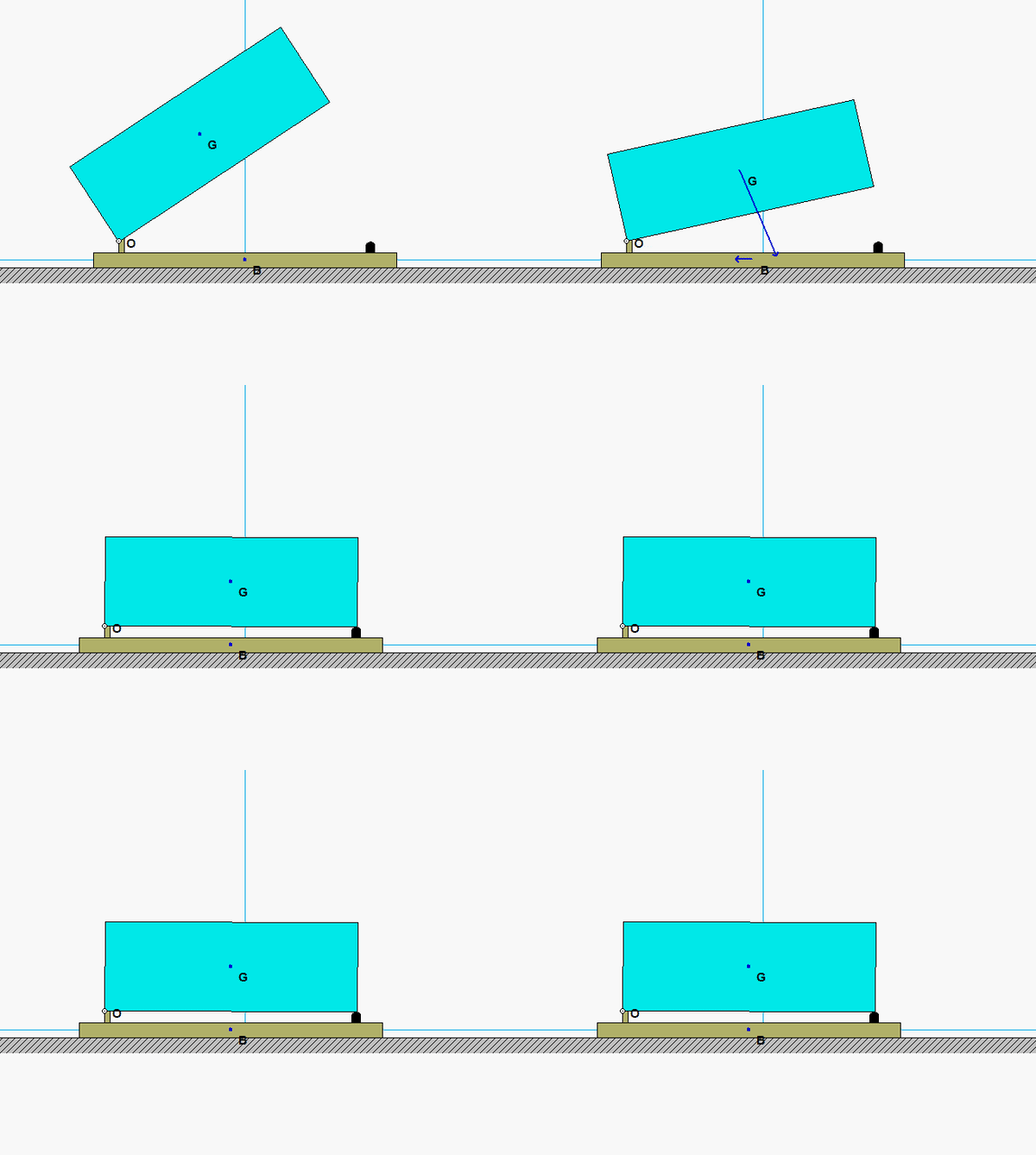
For part b, with e=0, the math says the plate basically ‘thuds’ and stops moving relative to the bumper. If this were a real-life problem, would the whole cart actually come to a dead stop the moment of impact, or is that just a ‘perfect physics’ simplification? It feels counter-intuitive that all that movement just disappears.
“The system is released from rest with corner D displaced slightly to the right of a vertical line passing through the pin at O.” Is this included in the problem statement just to confirm the plate falls with clockwise motion, and can we still assume that the initial location of the plate’s center of mass is directly above corner D?
If we start with D being directly above O the system does not move. Displacing it slightly from above O allows the plate to fall.
Do we assume that right after the collision, the block-cart system has no tangential velocity since the coefficient of restitution is 0 and there are no external forces applied on the system?
When using energy conservation before impact, how do we correctly account for the kinetic energy of the plate if point O itself is moving with the cart?
My recommendation is to use the plate’s center of mass as the KE reference point: 0.5*m*v_G^2 + 0.5*I_G*omega^2.
Add to that the KE for the cart: 0.5+M*v_B^2.
I did this but found that the the COM of the plate had a velocity component in the x direction. Since the cart and the plate stick to each other I assumed that they would have the same velocity after collision, which the simulation appears to show being 0.
Would my solution not conflict with the simulation, which appears to show the the cart having 0 velocity after collision?
I don’t believe the plate and the cart can have motion in the same direction due to the conservation of linear momentum in the x direction.
For coefficient of restitution, do I consider both axes or just one?
I think you consider the vertical axis as this is where the collision occurs.
Would it be easier to understand if we use two FBDs, one for each part?
the thing that helped me for this problem is to use work energy to find the motion of the plate before impact and then use the impact relations for the collision with the bumper. also it was useful to keep track of the cart and plate together instead of separating them