| Problem statement Solution video |
DISCUSSION THREAD
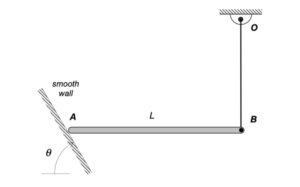
Discussion and hints:

Recall the following four-step plan outline in the lecture book and discussed in lecture:
Step 1: FBDs
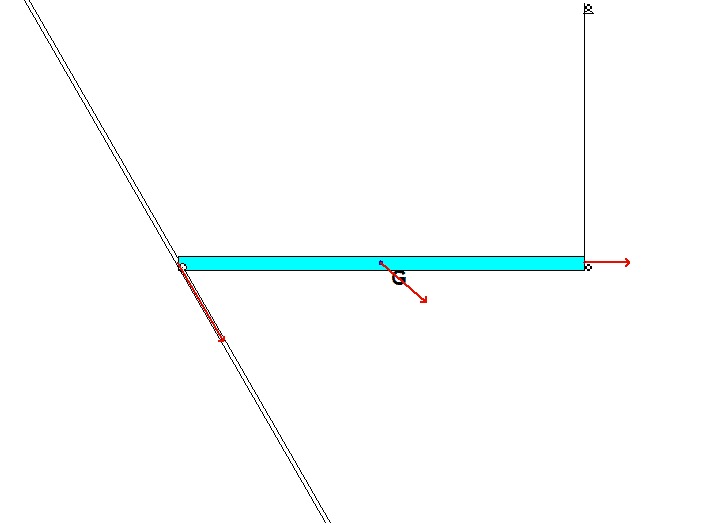
Draw a free body diagram of the bar.
Step 2: Kinetics (Newton/Euler)
Write down the Newton/Euler equations for the bar using your FBD above. Take care in choosing the reference point for your moment equation. In order to use the “short form” of Euler’s equation, this point should be either a fixed point or the body’s center of mass. For this problem, there are no fixed points.
Step 3: Kinematics
The paths of A and B are known: A travels on a straight path aligned with the inclined wall, and B travels on a circular path centered at O. Since the bar is released from rest, you know that the speeds of A and B are zero – therefore, the centripetal component of acceleration for each point is zero. This leaves the acceleration of points A and B tangent to their paths. (You can see this from the animation above for the instant when AB is horizontal.) It is recommended that you use two kinematics equations: one relating points A and B, and the other relating the center of mass G of the bar to either A or B.
Step 4: Solve
Solve your equations above for the tension in cable BO.
Any questions?
The bar is released from rest, so does Point B have to move purely vertically in that first instant because of the cable, or does the tilt of the wall at Point A force the whole bar to shift sideways?
All you need to recognize in writing the kinematics of motion for A and B is:
* A moves along the straight incline.
* B moves along a circular path centered at O and having a radius equal to the length of cable OB.
Use those two pieces of information in the rigid body acceleration equation for link A in order the get your kinematics for the problem.
Does that mean we have to know the length of the cable to solve the problem? The length is not given, so if so can we assume the hypotenuse of the triangle formed by legs OB and AB is perpendicular to the wall and use trig to solve for the length of the wire?
With the system being released from rest, the length of the cable OB is not relevant. It is only relevant that OB and AB are perpendicular, as given in the problem statement. To see this, give the length of the cable a variable name. Carry that through the analysis, and you will see that it does not appear in your answer.
FYI, the hypotenuse of the triangle OAB is NOT perpendicular to the wall.