November 6, 2019
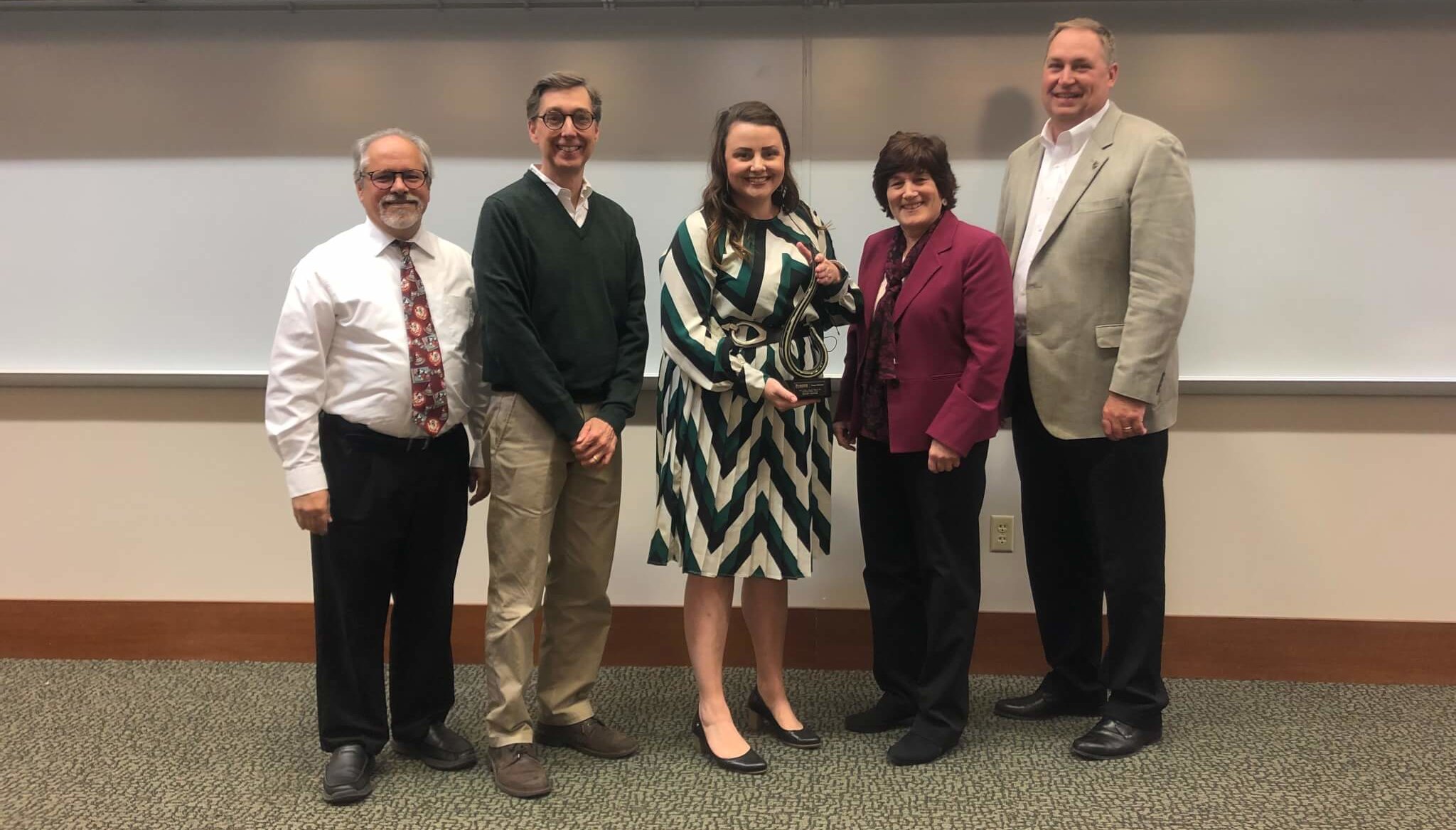
Haley Oliver, associate professor in food science, was recently honored with Purdue Agriculture’s 2019 Corinne Alexander Spirit of the Land-Grant Mission Award. An expert in retail food safety with an international reputation for her lab’s work on the pathogen Listeria monocytogenes, Oliver is the principle investigator and director of the Feed the Future Innovation Lab for Food Safety (FSIL), established through a $10 million grant from United States Agency for International Development (USAID). FSIL will increase food safety awareness, support local research efforts to improve food safety and disseminate information from the research in Bangladesh, Kenya, Ethiopia, Senegal and Cambodia.
Spirit of the Land-Grant Mission Award presented to Haley Oliver
November 1, 2019
The Vet Gazette this week begins a series celebrating the talented faculty members who received promotions effective with the 2019-2020 academic year. This issue focuses on Dr. Kenitra Hendrix, who was promoted to clinical associate professor of veterinary diagnostic microbiology in the Department of Comparative Pathobiology. She also was appointed as the new director of Indiana Animal Disease Diagnostic Laboratory (ADDL) effective June 1.
Faculty Feature Series on Promoted Faculty Shines Spotlight on Dr. Kenitra Hendrix
November 1, 2019
Ximena Bernal, Associate Professor of Biological Sciences and Guang Lin, Associate Professor of Mathematics and Mechanical Engineering, have been named 2019-20 Dean’s Fellows in the College of Science. The Frederick L. Hovde Dean’s Fellow Program in Purdue’s College of Science is designed to provide leadership opportunities for tenured faculty. As part of the College’s leadership team, Fellows will design and complete one or more projects to advance critical goals across the college. Fellows will also benefit from career development opportunities such as leadership coaching, shadowing, and active participation in the College’s management.
October 31, 2019
Parkinson’s disease is a grim diagnosis; it’s typically not detected until a person exhibits the characteristic tremors, when it’s progressed too far to slow the condition. West Lafayette-based Tymora Analytical Operations envisions a routine urine test that would spot Parkinson’s early, when medication and other strategies can slow its progression. The startup has several diseases in its cross-hairs; boosted by recent funding for both Parkinson’s and Alzheimer’s, the company is developing simple urine, saliva and blood tests to detect diseases that are notoriously difficult to diagnose.
October 25, 2019
Theoretically, our immune system could detect and kill cancer cells. Unfortunately, tumors are well armed to fight these attacks. Despite modern cancer treatments, metastases and relapses remain a major problem. Increasing anti-tumor immunity might now be made possible, thanks to copper telluride nanoparticles that mimic enzymes, especially under NIR-II light irradiation. This induces oxidative stress in tumor cells, quashing their immunosuppressive status and triggering inflammatory processes, as scientists have recently reported.
Catalytic immunotherapy for cancer: Nanoparticles act as artificial enzymes
October 24, 2019
While most ethanol in the U.S. is made from corn, the U.S. Environmental Protection Agency requires a percentage of ethanol be produced from non-food based cellulosic feedstock, like crop or wood residue. Researchers at Purdue University have received a $2.3 million federal grant to help find ways to minimize the impact of dried plant material refinery systems.
October 24, 2019
Good news for coffee lovers, you can go ahead and grab a few cups of coffee; it will certainly improve your health and help you live longer, as suggested by new research. In an observational study involving around 25,000 individuals, people who have at least four to five cups of coffee daily were found to have a 63% lower risk of early death compared to those who rarely or never consumed coffee.
Coffee found to reduce the risk of cancer and many other syndromes
October 23, 2019
Twelve undergraduates from the College of Agriculture recently attended the 2019 Borlaug Dialogue International Symposium in Des Moines, Iowa. Founded in 2001, the Borlaug Dialogue is named after Norman E. Borlaug, the founder of The World Food Prize, Nobel Prize Laureate and father of the “Green Revolution.” This event honors his legacy by bringing 1,200 youths from 65 different countries together to discuss topics of food security, sustainable agriculture and nutrition. The theme of this year’s dialogue was Pax Agricultura: Peace through Agriculture.
Borlaug Dialogue fuels students’ passion to make a difference
October 22, 2019
Roughly 15% of premature births in the U.S. happen due to a pregnancy complication caused by high blood pressure, called preeclampsia. While sometimes symptoms dissipate after the mother gives birth, preeclampsia can lead to permanent damage to the kidneys or death. Purdue University researchers and colleagues, including Drs. David Reuter from Seattle Children’s Hospital and David Haas from Indiana University School of Medicine, have been developing technology that would help a patient assess her risk for developing preeclampsia risk using a smartphone and an ambulatory blood pressure cuff. The device will automatically detect changes in her blood pressure indicative of preeclampsia as she switches between lying on her back and left side.
Pregnant women may soon be able to detect their own risk of preeclampsia with a smartphone
October 21, 2019
Haley Oliver has spent years working toward developing the first food technology program in Afghanistan. The project is one of the many reasons Oliver, an associate professor of food science at Purdue University, will receive the 2019 Corinne Alexander Spirit of the Land-Grant Mission Award on Oct. 24. Along with developing the program at HeratUniversity in Afghanistan, Oliver has partnered with multiple sectors to improve that region’s food production industry and raise a greater awareness of food safety.
