
Past News
Drosophila Ahcy is a redox sensor that modulates gene expression to protect against light stress-induced retinal degeneration
September 19, 2025
One-carbon metabolism influences gene expression by providing methyl units for DNA, RNA, and histone methylation.
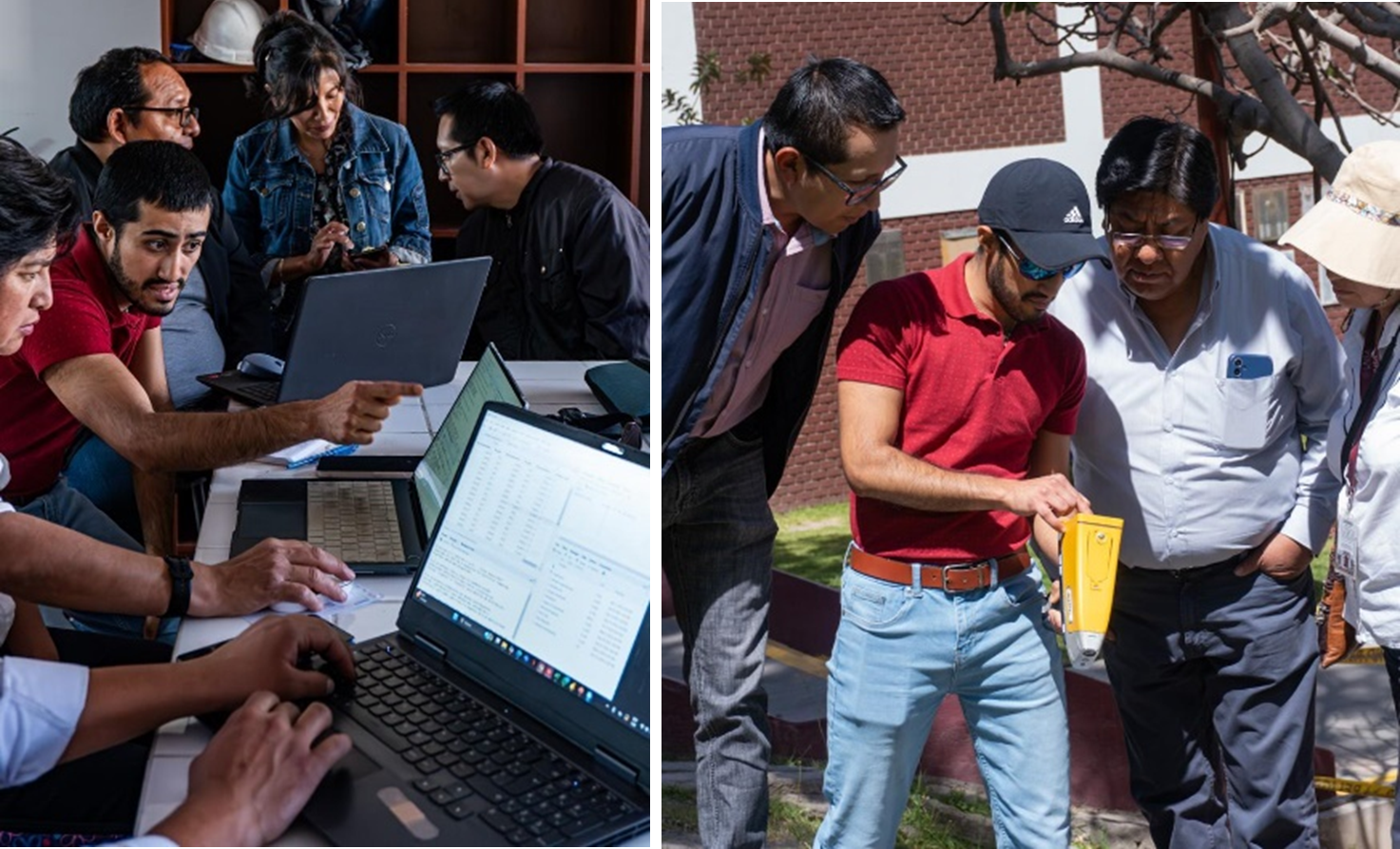
Empowering UNSA Professionals through cutting edge Agricultural Technology training
September 19, 2025
Cristian Salinas, from the Nexus Organic Farming Systems Project, served as the instructor for the course on the use and applications of portable X-ray fluorescence and microbiome held at the National University of San Agustin in Arequipa, Peru. Photo credits: UNSA students
PVM and Indiana ADDL representatives connect with poultry industry
September 18, 2025
Representatives from Purdue University’s College of Veterinary Medicine (PVM) and the Indiana Animal Disease Diagnostic Laboratory (ADDL) demonstrated their ongoing commitment to Indiana’s poultry industry by participating in the annual Indiana State Poultry Association (ISPA) Johndrew Memorial Golf Outing, held Wednesday, September 10, at The Fort Golf Course at Fort Harrison State Park in Indianapolis.
PVM and Indiana ADDL representatives connect with poultry industry
Subtle Cues Between Cells and Immune System Contribute to Metastasis
September 18, 2025
In the march of metastasis, a molecular trail of crumbs guides some cancer cells from the primary tumor.
Subtle Cues Between Cells and Immune System Contribute to Metastasis
New Research Overturns Decades of Thinking on Fat’s Role in Alzheimer’s
September 17, 2025
For many years, scientists believed that fat in the brain had little connection to neurodegenerative diseases. Purdue University researchers are now challenging that view.
New Research Overturns Decades of Thinking on Fat’s Role in Alzheimer’s
Low-Cost Paper Test for Detecting GM Corn and Soybean in the Field
September 17, 2025
A growing toolkit from a team at Purdue University now includes a portable, paper-based biosensor designed to identify genetically modified (GM) corn and soybean. Built on a technique known as loop-mediated isothermal amplification (LAMP), this biosensor offers a faster, more affordable alternative to current field-ready molecular diagnostic tools.
Low-Cost Paper Test for Detecting GM Corn and Soybean in the Field
Subtle cues between cells and immune system contribute to spread of cancer
September 17, 2025
In the march of metastasis, a molecular trail of crumbs guides some cancer cells from the primary tumor to establish new colonies within the body. Blocking the cells’ ability to follow the trail might halt metastasis but could also meddle with an intricate cellular signaling system critical to immune response. Purdue University scientists are deciphering this signaling system to better understand how it could be used to address multiple diseases, including cancer.
Subtle cues between cells and immune system contribute to spread of cancer
When therapy isn’t enough: Purdue undergraduate researcher explores how service animals can help promote psychosocial well-being of sexual assault survivors
September 17, 2025
Emma Senter, a Purdue University Department of Psychological Sciences junior, has always considered herself an animal person. So, when she had the opportunity to join the Human-Animal Partnerships and Interactions (HAPI) Lab in the College of Veterinary Medicine, she jumped at the chance.
Novel biosensor detects genetically modified corn and soybean
September 16, 2025
The continually expanding toolkit from Mohit Verma’s laboratory at Purdue University now includes a portable, paper-based biosensor for identifying genetically modified (GM) corn and soybean. The GM crop biosensor, based on a method called loop-mediated isothermal amplification (LAMP), offers a fast and less expensive alternative to the point-of-need molecular tools already on the market.
Novel biosensor detects genetically modified corn and soybean
In Print: ‘Protein Function Prediction: Methods and Protocols’
September 15, 2025
This fully updated volume explores a wide array of new and state-of-the-art tools and resources for protein function prediction.
In Print: ‘Protein Function Prediction: Methods and Protocols’