
Research Overview
Quantum technologies can harness the properties of single atoms or particles of light, and have relevance to computing, sensing, imaging, metrology, communications, and cryptography. Because of their applicability, quantum technologies have the potential to be truly transformative, with uses in areas including intelligence, financial security, computing, medicine, and navigation.
We have entered the second quantum revolution, but it is still in its infancy, and the nascent quantum industry requires significant fundamental research to mature novel technologies.
In partnership with our industry members, the CQT researchers will use their expertise in quantum science and engineering to develop and transfer foundational knowledge into industry-relevant quantum devices, systems, and algorithms.
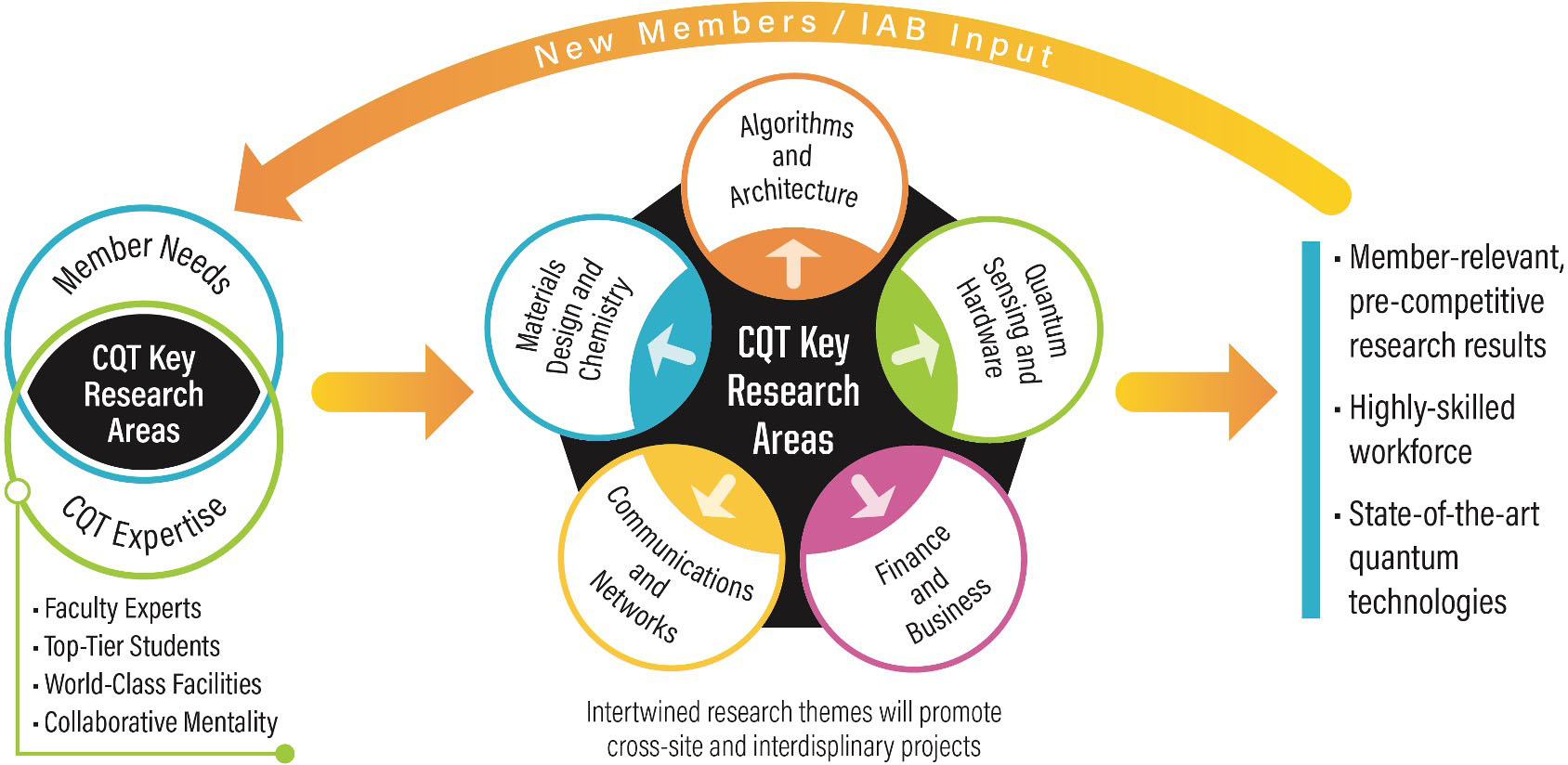
This diagram presents a comprehensive overview of the CQT (Center for Quantum Technologies) Key Research Areas and their dynamic, integrated ecosystem. It outlines how member needs, institutional expertise, and interdisciplinary research converge to drive impactful quantum research and innovation.

⸻

Core Structure: CQT Key Research Areas

At the heart of the diagram is a central black hexagon labeled “CQT Key Research Areas”. From this central point radiate five distinct but interconnected research themes, each represented by a colored circle:
	1.	Algorithms and Architecture (orange)
	2.	Quantum Sensing and Hardware (light green)
	3.	Finance and Business (light purple)
	4.	Communications and Networks (yellow)
	5.	Materials Design and Chemistry (blue)

These five themes are intertwined, signifying strong cross-thematic collaboration and interdisciplinary synergy, which is explicitly noted at the bottom of the diagram:

“Intertwined research themes will promote cross-site and interdisciplinary projects.”

⸻

Inputs: Member Needs and CQT Expertise

To the left, two overlapping circles labeled “Member Needs” and “CQT Expertise” converge on the central theme of “CQT Key Research Areas.” This intersection illustrates how the research agenda is shaped by:
	•	Member Needs, which likely refer to industrial partners or stakeholders providing direction on applied research challenges.
	•	CQT Expertise, which encompasses:
	•	Faculty experts
	•	Top-tier students
	•	World-class facilities
	•	Collaborative mentality

⸻

Feedback Loop: New Members and IAB Input

An orange arc across the top labeled “New Members / IAB Input” (IAB = Industrial Advisory Board) feeds into the central research area. This symbolizes an ongoing feedback loop where new ideas, needs, and directions are continuously incorporated into the research roadmap, helping it stay relevant and future-ready.

⸻

Outputs and Impact

On the right, another arrow points outward, highlighting the outcomes of the research activities and collaborations:
	•	Member-relevant, pre-competitive research results – Applied findings shared before commercialization.
	•	Highly-skilled workforce – Talent development through education and hands-on research.
	•	State-of-the-art quantum technologies – Cutting-edge tools and methods in quantum computing, sensing, and communication.

These results demonstrate the tangible benefits for both academic and industrial partners, reinforcing the center’s dual mission of scientific excellence and practical impact.

⸻

Summary

This diagram communicates a sophisticated, systems-level view of how CQT structures its research ecosystem to deliver innovation in quantum technology. It captures the synergy between academic expertise and industry needs, the integration of diverse thematic areas, and the flow of feedback and results that sustain a productive, future-focused research enterprise.
While research proposals will be accepted in any area relevant to quantum technology development, feedback and input from the industry and government members suggest that proposals be focused on these areas:
-
Quantum Materials and Hardware
-
Quantum Sensing, Imaging, and Microscopy
-
Quantum Coherence
-
Quantum Emitters
-
Quantum Machine Learning & AI
-
Quantum Error Correction and Mitigation
-
Quantum Networking, Quantum Key Distribution (QKD) and Post Quantum Cryptography (PQC)
-
Quantum Algorithms, Optimization and Annealing